
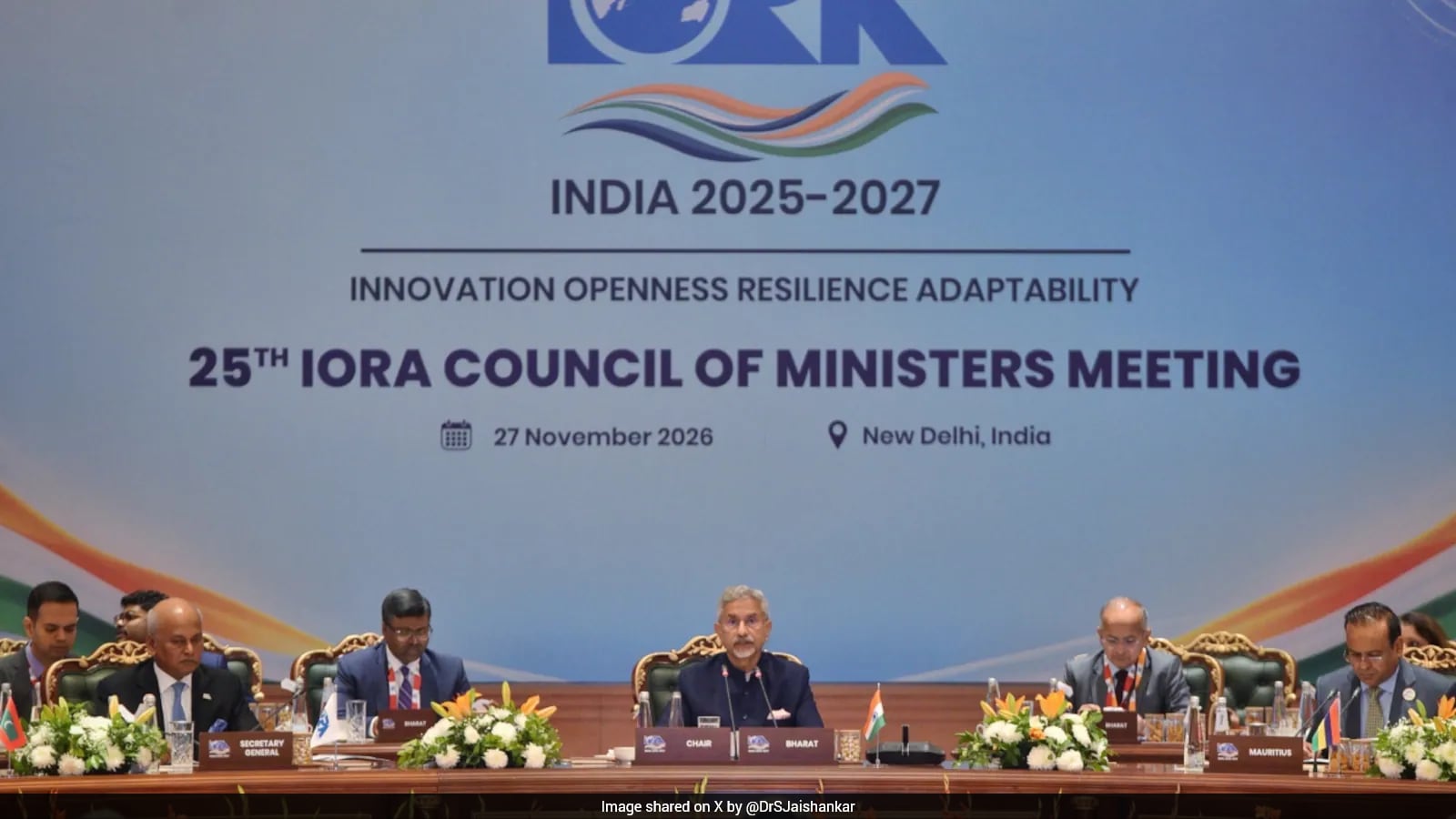
New Delhi: India hosted the 25th meeting of the Indian Ocean Rim Association (IORA) Council of Ministers (COM) in New Delhi, where 23 member states and 12 dialogue partners discussed several issues concerning the Indian Ocean Region. The Foreign Ministry said that the meeting is also an opportunity for India to underline the fact that there is an indigenous, consensual platform in the Indian Ocean and it is steered from Delhi.What is IORA?Established in 1997, IORA has its secretariat in Ebene, Mauritius. It is the only Indian Ocean-wide organisation encompassing the African, Gulf, South and Southeast Asian coasts and Australia. Members range from India, Australia, Indonesia and Iran to Kenya, South Africa, the UAE, France (via Reunion) and Sri Lanka. Dialogue partners are China, the United States, Japan, Russia, Saudi Arabia, the EU and the UK. Pakistan, meanwhile, is not a member.The Council of Ministers is the supreme decision-making organ of the body. It formulates policy, analyses and determines future areas of collaboration.India As A ChairIndia has been IORA's chair since 2025 (until 2027). The theme is 'Innovation, Openness, Resilience and Adaptability in the Indian Ocean Region'.In December 2025, Delhi organised a one-week training programme for IORA officials. It also held the Track 1.5 Indian Ocean Dialogue in May and, in June, the 28th high officials' meeting.The May dialogue focused on "Indian Ocean Region in a Transforming World", encapsulating the current spirit. Organisation's Secretary-General Sanjiv Ranjan told The Hindu in an interview that navigating maritime security in the wake of the war in the Middle East is at the top of the agenda during India's chairmanship. The MAHASAGAR FrameEarlier, the Foreign Ministry said the New Delhi meeting will reaffirm India's commitment to the vision of MAHASAGAR (Mutual And Holistic Advancement for Security and Growth for All in the Region), driving collective action for an open, inclusive and rules-based maritime order.MAHASAGAR vision is the follow-on from Prime Minister Narendra Modi's 2015 SAGAR doctrine. It conveys India's aspiration to be recognised as the Indian Ocean's lead first responder and security partner in addition to being a maritime power.IORA is well suited to this aspiration. Not being a defence alliance, IORA addresses diverse topics from ocean security and fisheries through to blue economy, disaster management, trade and academia.Thus, India can spearhead regional collaboration on common issues without the complications associated with a union. This year's meeting between Foreign Minister S Jaishankar and the IORA Secretary-General illustrated India's approach to multilateralism, connectivity and adherence to international law.Why The Stakes Are HighThe Indian Ocean is subject to various concurrent influences. It is a key conduit for global oil and container shipping. Strategic straits of Hormuz, Bab-el-Mandeb and Malacca border the ocean. However, the conflict in the Middle East has increased the vulnerability of these passages. As an energy-import-reliant nation and one which conducts much of its trade by sea, India attaches considerable importance to ocean security.Moreover, there is concern in Delhi about strategic encirclement given China's increasing assertiveness. China's navy, scientific ships and Gwadar to Hambantota port investments all contribute to this concern. Although India is unable to exclude China from IORA, as it is a dialogue partner, it can control the agenda and therefore ensure that the region's rules are developed from a consensual regional perspective. As a result, New Delhi emphasised both 'openness' and a 'rules-based' system and does not mention adversarial nations.Partnerships As LeverageApart from IORA, India is active in other forms of regional multilateralism. This includes security collaboration with Sri Lanka, the Maldives and Mauritius; data and ocean monitoring partnerships; and the Quad with the US, Japan and Australia.Australia, France and Indonesia are also key strategic partners within IORA. Being able to discuss with Washington, Tokyo, Brussels and Moscow in the same room is another benefit of the dialogue-partner status.Alongside security, connectivity is a further area of multilateralism. India provides options to China's Belt and Road Initiative in terms of ports, shipping, sub-sea cables, energy and digital infrastructure. While littoral states typically seek foreign investment, they are also often anxious about indebtedness. Consequently, India promotes its offering as a choice.What To WatchWhilst IORA is consensual in nature, it is not particularly well resourced. Historically, it has also shied away from tackling security. Furthermore, some members (Iran, UAE and Yemen, for example) have complex, and occasionally opposing, interests in West Asia. Here, the war has further complicated the prospect of common rhetoric. Moreover, littoral states often adopt a middle course in their relations with both Delhi and Beijing. Consequently, they may agree to multilateral collaboration but stop short of adopting a defined strategic stance.Analysts suggest that tangible outcomes will be the test of IORA's effectiveness. These include enhanced ocean situational awareness, improved disaster management and successful blue economy projects. Greater significance will be attached to a statement that members actively carry out rather than just set out aspirational goals. Given that the 30th anniversary summit is anticipated next year, Delhi has around twelve months in which to demonstrate how its IORA chairmanship has altered the ocean's governance.
How Indian Ocean Rim Association Fits Into Delhi's 'Mahasagar Vision'
Full Article
Original Source
Read the full article at Ndtv →KhanList aggregates and links to publicly available news content. We do not host full articles from third-party sources. Always verify important information with original sources.