
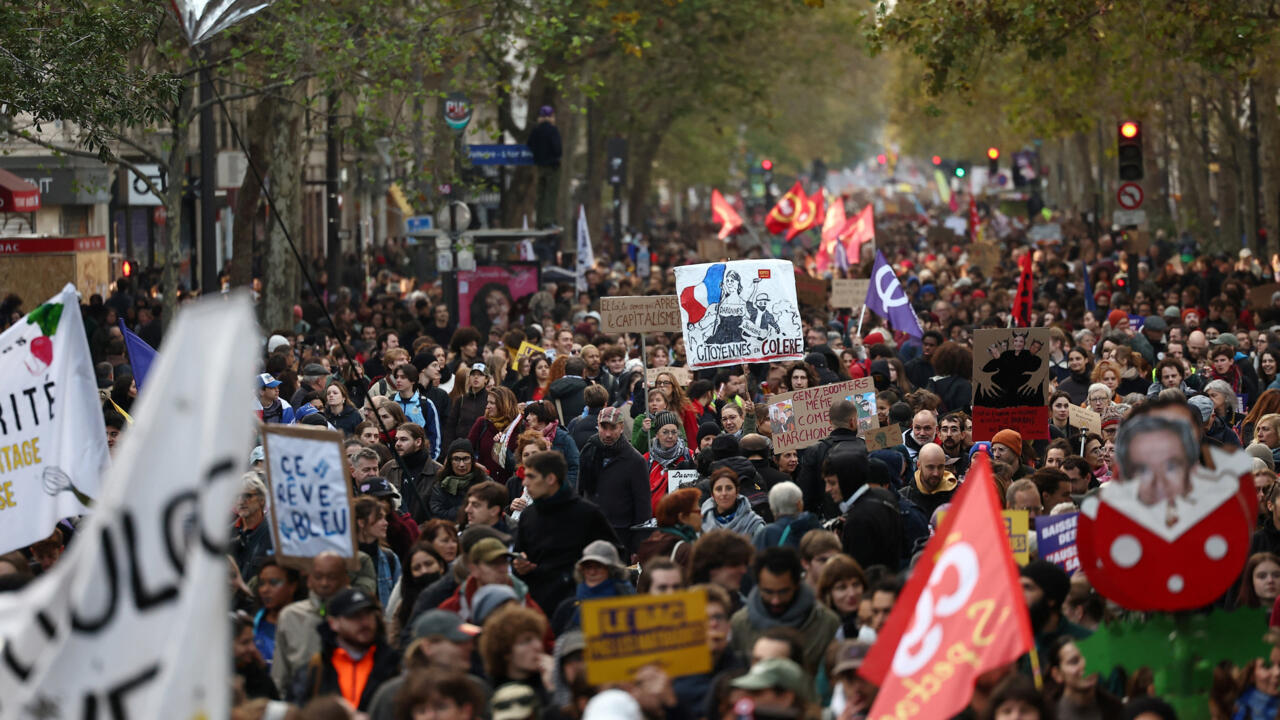
What began in September as a student protest over deteriorating school conditions has over recent weeks grown into a broader social movement across France. The violent police response, notably against young protesters, has helped galvanise support, drawing in university students, trade unions and the wider public. Since late September, hundreds of thousands of people have taken to the streets across France to protest against the high cost of living, deteriorating public services and what many see as government inertia. The protests began with a movement by high school pupils, which has grown to encompass a broader mobilisation against the rising cost of living that has drawn in university students, public sector workers and trade unions. The demonstrations have unfolded against a backdrop of violence – by some protesters and by police against demonstrators, notably young students. "The repression has given students reasons to protest. Some people initially said, 'Oh, come on, another student demonstration. They're spoiled kids. What do they want?' But when they saw the violence, it became one of the reasons university students joined the movement, one of the reasons trade unions joined the movement," said historian Manon Pignot, who studies the history of childhood and the role of children in French society. Listen to an interview with Manon Pignot and more on the student protests in the Spotlight on France podcast: Spotlight on France, episode 152 © RFI During the first weeks of the student mobilisation, police used tear gas, stun grenades and rubber bullets to break up blockades. Several students were seriously injured. One teenager lost a hand after a grenade exploded and another lost their sight in one eye, while a 14-year-old had his jaw broken. These incidents have prompted investigations into alleged police misconduct and drawn attention to police tactics, including the use of mass arrests. Youth energising social movement But the violence did not deter the high schoolers, who were joined by university students, with both eventually becoming part of the broader protests. Pignot says young people have breathed new life into a social movement that never entirely disappeared after the Gilets Jaunes – Yellow Vest – protests. "The youth movement is giving energy and hope to the social movement,” she said. “All the signs and slogans, they are so funny, but also so political." The Yellow Vests mobilised in 2018 in opposition to a planned increase in diesel fuel taxes which quickly developed into a wider anti-government protest, which was met with a forceful police response. Yellow Vest activists supported calls for a nationwide demonstration on 17 October, and were joined by student organisations and trade unions. French students demonstrate solidarity in the fight for better schools 'Convergence' of struggles The idea of a convergence of movements has long been the desire of the French left. But political scientist Bruno Cautrès cautions that the current situation looks more like different groups taking to the streets at the same time. "We are certainly seeing an accumulation of anger on the streets," he told RFI. "But to call that a convergence of struggles is something else. It would mean that the different demands are finding common ground." For now, various groups have their own demands, even if they share common grievances against an unpopular president, a budget impasse in parliament and the high cost of living. "What unites all the different demands is, essentially, the feeling that the government is failing to explain where we are today, and why we are in this situation," Cautrès says. Violence overshadowing protests While the 17 October demonstrations were largely peaceful, outbreaks of extreme violence took centre stage. Shops and businesses in Paris were looted, while cars and street furniture were set on fire. Protesters forced their way into Marseille’s city hall, while masked groups set fire to the Limoges town hall, and violence was reported in several other cities. What we know about the people behind France’s riots and looting The government attributed much of the violence to looters, so-called ‘ultra-left’ groups and the black blocs – groups of masked protesters who actively engage in confrontation with police and property destruction. The authorities acknowledged they had been caught off guard by the scale of the violence, and in subsequent demonstrations police imposed tighter restrictions, banning some protests, limiting where marches could go, imposing curfews and making large numbers of arrests. 'Authoritarian' tactics Groups representing magistrates and lawyers, along with the League of Human Rights, have accused the government of an authoritarian shift. In a joint statement, the groups accused authorities of denying the fundamental right to demonstrate and shutting down dissenting voices. Serge Slama, a professor of public law and secretary-general of the Association for the Defence of Constitutional Freedoms, says the use of state power against demonstrators has been intensifying for years. "It’s a slippery slope. For about 20 years, since the state has imposed various states of emergency, there has been an increase in restriction of freedoms, with more powers given to the administrative state and people being placed in police custody," he told RFI. Many of the measures used today against demonstrators were originally developed in response to other forms of unrest. "They come essentially from the states of emergency, but also from measures that were already being applied in the suburbs. Curfews, for example, have been used extensively in the suburbs since 2005," he said. France confronts deep divides 20 years after teen deaths set off Paris riots That year, there were riots in working-class suburbs across France after two teenagers died in Clichy-sous-Bois, east of Paris, while fleeing police. The government responded by declaring a state of emergency, giving authorities greater powers. "Today’s movement is not like a suburban riot, but it is being treated as though it were, with the same tools, the same weapons, the same methods," says Pignot. The current student protest movement began in working-class neighbourhoods around Paris, Bordeaux and Lyon, but students at more prestigious and better-resourced schools quickly joined in solidarity. Pignot believes the government might have responded differently had the demonstrations started in more affluent neighbourhoods in central Paris. Legitimate concerns Cautrès also believes the authorities were too quick to characterise the early student demonstrations as urban riots, potentially overlooking the legitimate concerns driving the movement. "Of course, there were troublemakers. Of course, some police officers were injured, and we have seen the consequences of that," he said. "But, ultimately, by communicating exclusively that way the government may have missed the essential point: the overwhelming majority of students are genuinely concerned about the state of their schools and their future." The government initially suggested that the protests were being fuelled by the hard-left France Unbowed party, seeking to influence young people in a politically charged atmosphere. But as the demonstrations continued, it became increasingly difficult to dismiss the students' demands, and authorities changed tack, acknowledging that many of the grievances were legitimate and arranging meetings with student representatives. Protests continue This has so far failed to satisfy the protesters, who continue their mobilisation and are calling for further demonstrations. "There needs to be strong moves to defuse such anger," says Cautrès. "Not only strong gestures, but politicians also need to explain where the major public policy priorities lie today. Is it education? Healthcare? Something else? We have sort of lost our direction and our compass." But the government’s ability to respond decisively or to commit public funding is limited, given budgetary concerns and the approaching presidential election in April and May 2027. "The current government knows it has only a few months left in power," says Cautrès. "In six months, there will be another prime minister, whatever the result of the presidential election." Listen to an interview with Manon Pignot and more on the student protests on the Spotlight on France podcast episode 152 here.
How France's student protests grew into a broader movement amid police violence
Full Article
Original Source
Read the full article at Rfi →KhanList aggregates and links to publicly available news content. We do not host full articles from third-party sources. Always verify important information with original sources.