
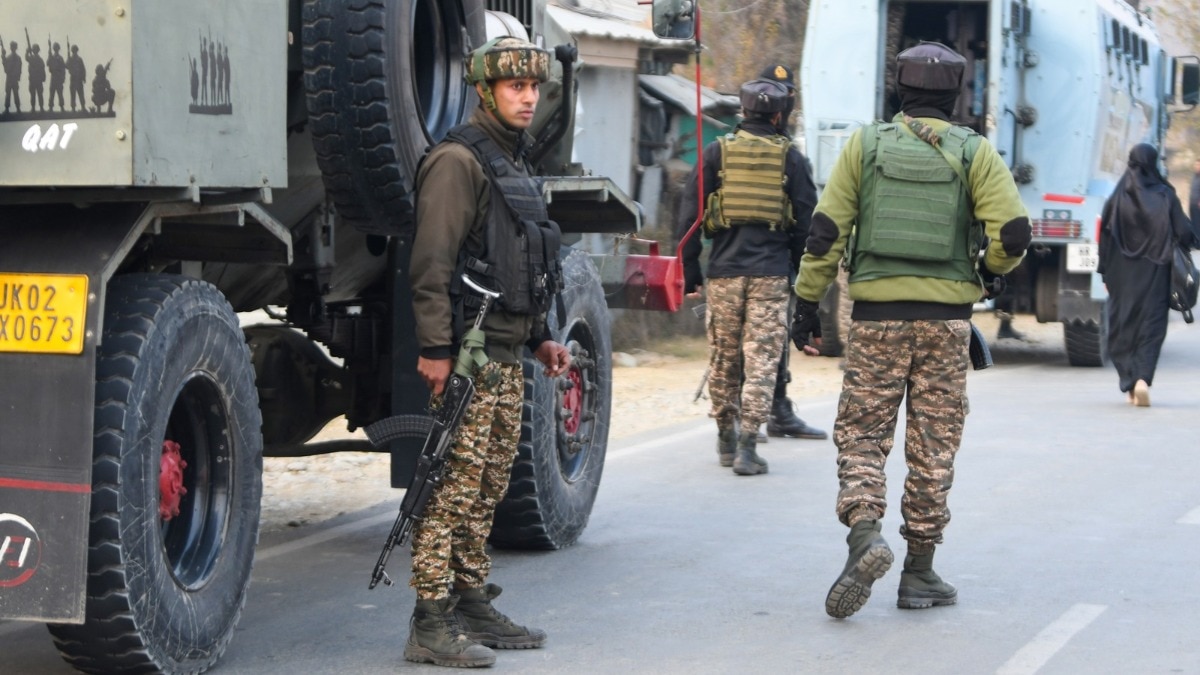
The near-simultaneous attacks unfolded after a relative lull and the Kashmir police chief declaring that only one active local militant remained in the Kashmir ValleyOn November 11, a sunny afternoon in south Kashmir, the routine of a roadside security checkpoint in Kulgam was shattered by a sudden burst of gunfire. Three personnel from the 46th Battalion of the Central Reserve Police Force (CRPF) were left injured even as their attackers melted into the surrounding landscape. One of the troopers suffered critical wounds.The attack took place in Akhran area of Kulgam while lieutenant governor Manoj Sinha was in the district to inaugurate the Veshow Literature Festival. In July, two migrant labourers were killed in a terrorist attack in Kulgam’s Kelam, not far from Akhran.The same day, reports emerged of the disappearance of two special police officers (SPOs) in Kishtwar, on the other side of the Pir Panjal mountain range that separates Kashmir from Jammu. On November 12, their bullet-riddled bodies were found in the remote forested folds of the Dachhan-Marwah belt. The service weapons were missing.These near-simultaneous attacks unfolded after a relative lull and just days after Kashmir zone inspector general of police (IGP) Sujit Kumar declared on November 5 that only one active local militant remained in the Kashmir Valley. The incidents have forced a sober re-evaluation of the security scenario in Jammu and Kashmir. Were these isolated spasms of residual militancy, coordinated signals from terror handlers in Pakistan or evidence that small modules still retained the capacity to strike at will?Even as investigations continued and security forces resumed search operations to track down the Kulgam attackers, the assault followed a classic hit-and-run template: a brief, intense burst of fire directed at a security checkpoint close to the national highway, followed by a quick escape.In Kishtwar, the pattern appears different. The two SPOs, attached to the Special Operations Group of the J&K police and moving between a police camp and a temporary operating base of the Indian Army’s 17 Rashtriya Rifles, are suspected to have been ambushed in difficult terrain. As observed in the past, militants in the Chenab Valley favour strikes against isolated or softer targets in the forested higher reaches, where real-time surveillance is thinner and cellular networks sparse.The higher reaches and dense forest areas of Dachhan-Marwah and Chatroo regions of Kishtwar district have been infested with highly-trained militants from across the border. The areas have seen multiple encounters between security forces and terrorists in the past.In January this year, security agencies launched a special operation in Chatroo. An armyman was killed and several soldiers were injured in a gun-battle with militants. The group was pursued—one terrorist was killed on February 4 and three others on February 22.The contrast between the two incidents suggests distinct local terror modules rather than a tightly knit, cross-region command structure. Evidence of active logistical coordination between south Kashmir and the Chenab Valley has also remained limited. The Kishtwar attack also points to overground worker (OGW) networks, sources said, though degraded by sustained pressure from security agencies. In past attacks, scores of OGWs were apprehended by security forces for alleged involvement in providing intelligence and facilitation.A massive manhunt is underway in Kulgam to nab those behind the assault. They are thought to be heavily armed and emerged from a dense cluster of trees near the site. The attack appears to fit an evolving pattern in which small groups of foreign terrorists, aided by local support networks, retain the capacity to carry out targeted strikes despite sustained counterinsurgency operations.Coming after IGP Kumar’s assessment that a single local terrorist, supported by transient foreign militants who constantly shift locations, remains active, these latest incidents raise the inevitable fear of attempts to revive insurgency.Security agencies suspect Lashkar-e-Toiba operative Mohammed Lateef Bhat, the surviving local militant in Kashmir, was involved in the Kulgam attack, along with one or two foreign terrorists. His alleged involvement in earlier attacks points to the continuing operational significance of local facilitators in sustaining the activities of foreign militants.The post-2019 security gains—sharp drops in local militant recruitment, reduced encounter intensity and improved force protection—remain largely intact. The CRPF is actively deployed in Kashmir. Its recent achievement of zero operational fatalities for 12 consecutive months—the first such stretch in nearly five decades—reflects better equipment, medical evacuation and planning across multiple theatres, including J&K.Sharing his views on the latest attacks, Lieutenant General (retd) D.S. Hooda, former general officer commanding-in-chief of the Northern Command, told INDIA TODAY that terrorist attacks mostly follow extensive reconnaissance, with militants seeking specific chances to strike vulnerable targets. He, however, remains uncertain whether the recent incidents were coordinated.Lt Gen. (retd) K.J.S. Dhillon, who served in Kashmir in 2019 when J&K was stripped of its special status and downgraded to Union territory, described the Kulgam attack as a “desperate act” by Pakistan, driven by its own internal crises. In his comments to the media, Dhillon argued that Islamabad resorts to the Kashmir card to divert domestic attention and disrupt the consolidation of peace and the approaching winter tourism season in the Valley.Hooda noted that the earlier suicide attacks by militants had given way to hit-and-run ambushes because fewer terrorists remained. This approach, he said, minimises own (terrorist) casualties while focusing on vulnerable and soft targets, including the tourists killed in the April 2025 Pahalgam attack.Hooda, though, does not rule out high-profile attacks in the future. “I don't rule out high-profile attacks at all. Multiple [terror] groups still seek to prove their presence and show that terrorism remains active in Kashmir,” he said.According to former J&K director general of police (DGP) S.P. Vaid, while the latest attack came after a considerable gap, the same Kulgam locality had witnessed violence just months earlier. The latest incident, he said, indicates the “presence and movement” of terrorists in south Kashmir. However, the “security grid in the region is robust” and the attackers would soon be “neutralised”. Vaid observed that the ground situation in Kashmir had improved significantly, with local recruitment having dropped.On the other hand, National Conference president and former chief minister Farooq Abdullah, while saying that “terrorism should not intimidate people”, made a strong pitch for dialogue between India and Pakistan. He asserted that bullets and military confrontation cannot resolve political disputes.The attack on the CRPF checkpoint has nevertheless exposed the vulnerabilities in Kashmir’s security landscape, underscoring how a decline in local recruitment has not necessarily translated into elimination of threat. “I don’t think we should expect that suddenly everything will just come down to zero, because there are groups and people who want to cause damage. Maybe the numbers are much lesser but those people still exist and are out to prove they are here,” explained Hooda. He, however, emphasised that post-2019, the violence graph had come down significantly. “It is better to take a comprehensive and long-term view of the situation,” he said.The timing of the Kulgam attack is significant. As winter sets in, it is worth recalling that this season has traditionally been the time when militants descend towards lower elevations before heavy snowfall restricts movement in the upper reaches of Kashmir forests. This seasonal movement, coupled with the presence of small, mobile groups, presents a challenge for security forces tasked with maintaining surveillance across a difficult terrain.Subscribe to India Today Magazine- Ends
How terror strikes in Kashmir, Chenab Valley test security gains
Full Article
Original Source
Read the full article at Indiatoday →KhanList aggregates and links to publicly available news content. We do not host full articles from third-party sources. Always verify important information with original sources.