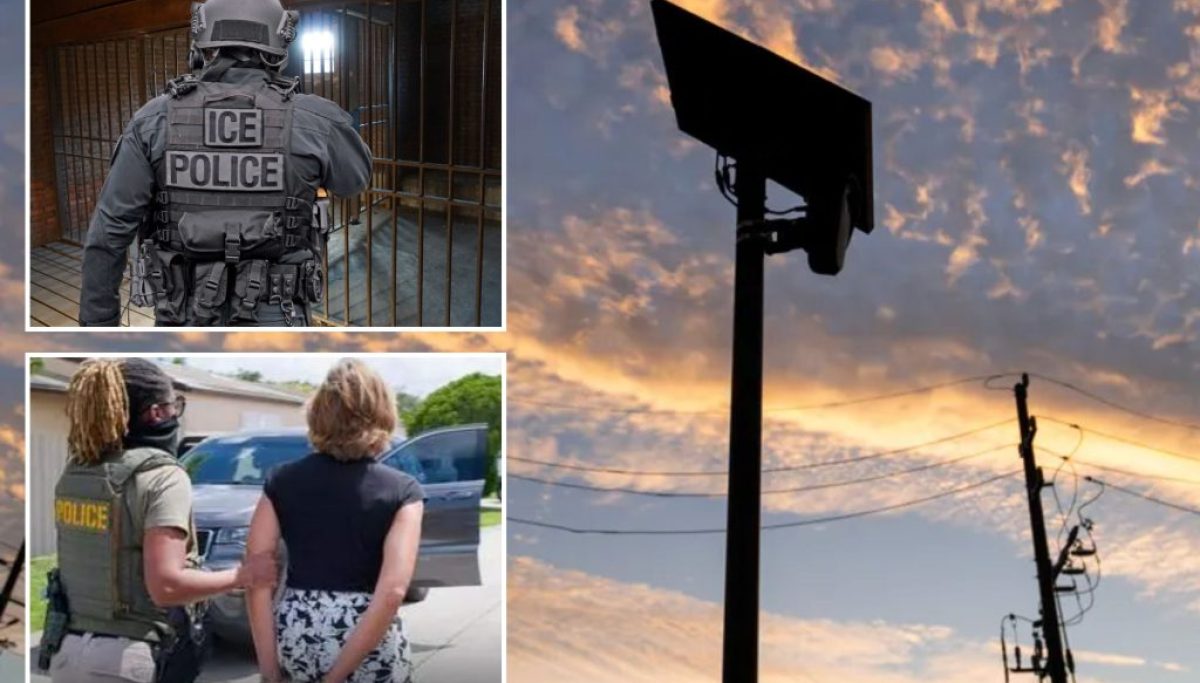
In Focus delivers deeper coverage of the political, cultural, and ideological issues shaping America. Published daily by senior writers and experts, these in-depth pieces go beyond the headlines to give readers the full picture. You can find our full list of In Focus pieces here.Immigration and Customs Enforcement has found a roundabout way to legally surveil and track select illegal immigrant drivers through the use of Flock’s license plate camera readers.Although ICE is barred by the billion-dollar tech company from obtaining contracts to use Flock’s videos and databases, the agency has signed cooperative agreements with state and local law enforcement in more than 2,300 jurisdictions nationwide, according to ICE. Part of that cooperation can include local or state police pulling footage and data from Flock and then sharing it with ICE. A former senior ICE official familiar with the agency’s use of cameras said the cooperation with local and state police who willingly share Flock data began before President Donald Trump took office last year, but has grown since then, as more police departments enter into contracts with Flock and formal agreements to assist ICE.The Flock company has become a household name in recent months, catching the focus of tens of millions of people, some of whom are concerned that the artificial intelligence-powered police cameras are creating a surveillance state.What is Flock? Flock is an Atlanta-based company that manufactures license plate-reading cameras and databases. The systems are sold to local and state police, as well as some federal agencies, but not ICE and Customs and Border Protection.More than 5,000 law enforcement agencies across 6,000 communities use Flock, according to the company’s website.The company’s automated license plate readers are installed along roads and intersections throughout communities nationwide. The solar-powered cameras scan every vehicle that passes by, taking information such as the license plate number.The information is immediately cross-referenced against police databases using artificial intelligence. Given that most communities have Flock cameras set up across the city or region, officers can input a license plate for a vehicle they are looking for, and Flock will list when and where that vehicle has passed by and alert that officer of future sightings.Officers can also ask Flock to search for specific colors, makes, and models of vehicles within their jurisdiction. The cameras do not scan the faces or bodies of drivers or passengers.The cameras have proven useful in tracking down stolen vehicles, kidnapping victims, solving crimes, and in some states, helping ICE figure out a suspected illegal immigrant’s travel patterns.The International Association of Chiefs of Police has hailed Flock as a “crime-fighting star” for how it essentially multiplies the number of eyes police have on the roads.Flock’s website is full of news articles that credit Flock’s cameras with leading police to hit-and-run suspects, homicide suspects, and more.How ICE can see Flock data ICE and CBP initially participated in pilot programs with Flock, but ultimately did not have contracts with the company as of August. That means federal police must have connections with state and local law enforcement who are willing to access the Flock system on their behalf.In sanctuary zones where local police are barred from working with ICE, such as New York or Seattle, those officers will not run license plates for ICE.However, in places such as Texas and Florida, state troopers are not only happy to assist ICE, but they also seek out federal immigration authorities when they detain people on traffic stops or in criminal arrests who they suspect are illegal immigrants.A Florida state police official spoke with the Washington Examiner about how the state and federal police coordinate in the use of Flock. The official, who spoke on the condition of anonymity, explained that every search in the Flock database has to have a valid reason.“We have to have a reason to look for you,” the Florida state trooper said. “We’d have to have a knowledge that you’re involved in some kind of criminal activity to even put you in the system and look for you. We pull a case number. We have to list a reason why we’re looking it up, what we’re searching for, and usually, for us, we’re using it for, like, if a trooper does a traffic stop and as he’s walking up to the car, the car flees, the guy takes off. We can use that footage right then and there. We’ll go in and start doing a search for it, and it searches the cameras all in the area that you pick.”How ICE uses Flock data The system is used by state and local police to assist ICE and CBP when they are looking to arrest an illegal immigrant driver, but need help determining his driving patterns in order to make a plan for where to interdict him. Police assisting federal immigration officers must note their reason for the search, such as using terms such as “ICE,” “immigration,” or “ICE warrant.”“I’ve had some of the ICE guys call me,” the trooper said. “If the guy actually has a warrant for his arrest or a warrant for him to be deported because he’s here illegally or something of that nature, and they can show it to me, I’ll look in the Flock system to see, ‘Hey, yeah, this guy was in this area on this day. He frequents this area.’”“Let’s say ICE calls me, ‘Hey, we’re going to do an [operation]. We have this [illegal immigrant] we know that is driving this vehicle. We want to arrest this guy,'” the state trooper said. “I’ll look in that area to see if he’s in that area or frequenting that area, so that way I can say, ‘Okay, he comes in about this time. That’s the kind of car he drives,’ to make sure that their intel is correct.”Concerns with Flock Flock states on its website that it has no present relationship with ICE, although it has engaged in very limited pilot programs in the past that were ended due to public pushback about the use of the technology.“Does Flock Share Data With ICE? No,” the website states. “Communities control federal data access. By default, sharing with federal agencies is disabled. ICE does not have direct access to Flock cameras, systems, or data.”Even so, Flock has increasingly become the subject of debate nationwide as its solar-powered camera poles pop up in more towns and cities. Aside from how local and state police use Flock to assist immigration authorities, some are concerned about how they are used to track the public.NYC RESIDENTS SAY ICE HAS ARRIVED AND IS INFLICTING ‘UNACCEPTABLE TERROR’Although Flock cameras do not scan faces, USA Today columnist Sara Pequeno warned in an op-ed last week that the government and private sector’s growing use of surveillance technology is a serious concern because it is being integrated into people’s everyday lives so quickly.“The U.S. government benefits from these surveillance tools,” Pequeno wrote. “If the powers that be are not seeing the downsides to this issue, then it’s unlikely they’re going to ban surveillance technology.”
How Flock cameras help lead ICE to illegal immigrants
Full Article
Original Source
Read the full article at Washingtonexaminer →KhanList aggregates and links to publicly available news content. We do not host full articles from third-party sources. Always verify important information with original sources.