
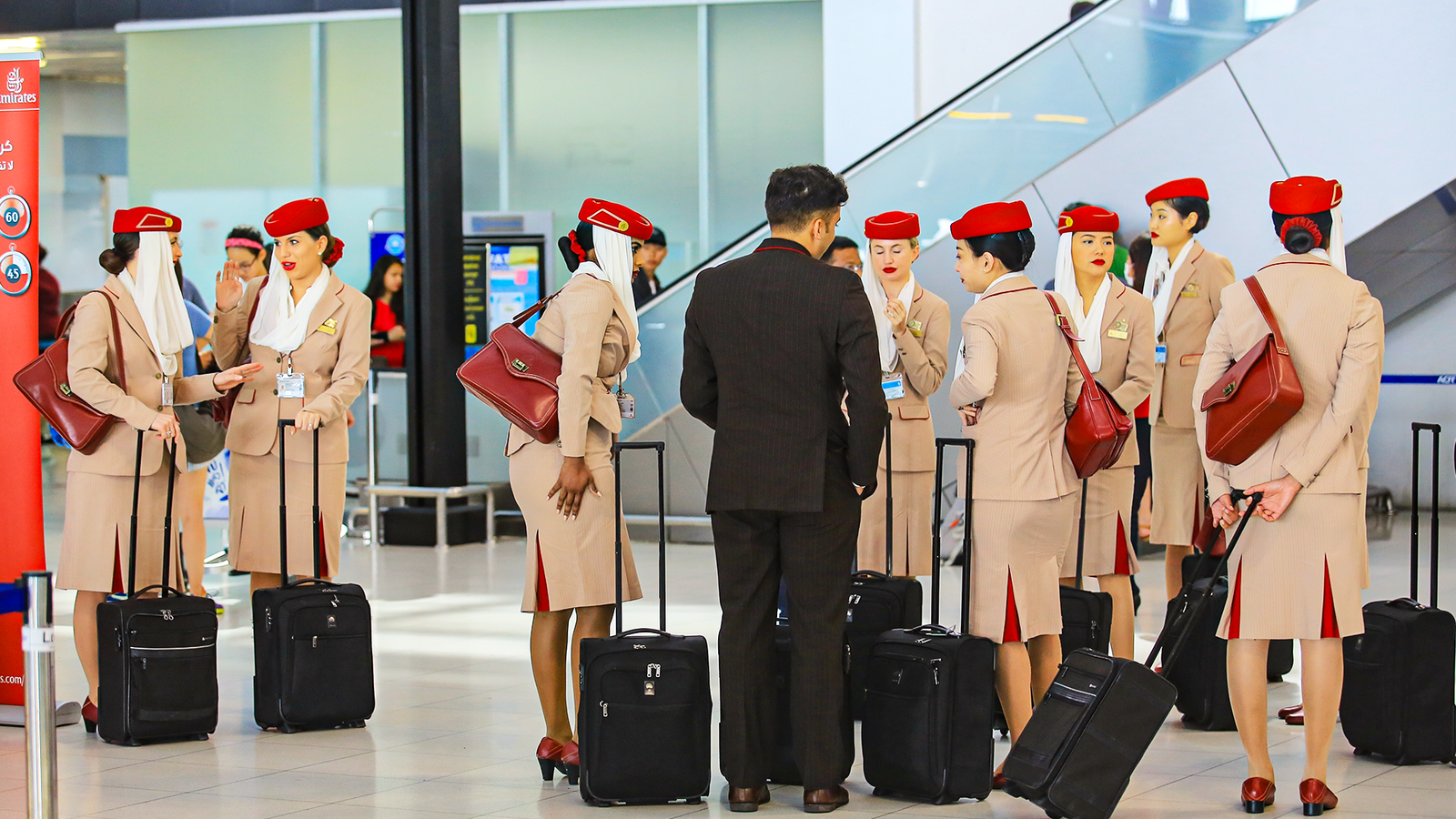
The first time passengers see flight attendants or cabin crew is when they board the aircraft, although they have already been on duty before reaching the aircraft, completing essential safety tasks in preparation for the flight. But how early do flight attendants need to be at the airport before working on a flight? Flight attendants typically have to report about an hour before a flight from their home base in the US, though the exact time depends on the airline, the type of flight, and where the trip starts. Report times in the US are set in each airline's union contract. In the UK and Middle East, cabin crew usually report 90 minutes before a flight departs from their home base, as standard procedure. Pre-Flight Duties Credit: Jacktamrong | Shutterstock Typically, most flight attendants and cabin crew arrive early for their shift. The report time is noted on the roster, and you are not allowed to be late under any circumstances, or you risk your job. We usually clock in with our ID card on arrival at the crew base, usually some 15 minutes to 30 minutes early or more. This allows us to have a coffee, check any changes to our schedule, and read up on any changed safety procedures. We may have to pick up duty-free floats and paperwork too. In the UK and the Middle East, we usually report a minimum of 90 minutes before the flight is due to depart. There is a pre-flight briefing prior to the flight, which takes around 15 minutes. The senior crew member gives the cabin crew all the details of the flight and assigns positions based on seniority. Every crew member is tested individually with safety and emergency procedures and first aid questions to make sure they are proficient and up to date. If the crew member fails at this stage, they are removed from the flight. We meet the flight crew for more flight details and then are bussed to the aircraft after going through security. Before passengers board, we perform a security check on the aircraft, checking the cabin, lavatories, and galleys. This ensures that nothing unusual or out of place is left behind. Once complete, we perform safety and emergency equipment checks to ensure everything is serviceable and ready to use in case of emergency. The galley equipment and meals are also checked to make sure that we have everything we need for the flight. Once these are complete, the senior reports to the flight crew and only then can we start boarding passengers. Report Times For US Flight Attendants Credit: American Airlines American Airlines' flight attendant contract, in a version published by its union, the Association of Professional Flight Attendants (APFA), defines on-duty time as starting one hour before scheduled departure on domestic flights and an hour and 30 minutes before international flights. This applies to the first flight of a trip sequence at the airport. This may vary depending on the airline, the aircraft type, and the type of flight. A sample clause from another airline's contract, collected by Law Insider, follows a similar pattern in that flight attendants report 60 minutes before their first departure of the day at their home base, also called their domicile, and 45 minutes before when starting a day away from base. Some airlines require more lead time for international flights and may need to check in one and a half hours before the flight. One cargo and charter airline's contract, for Air Transport International, allows report times of up to an hour and a half for domestic flights away from base and up to two hours for international flights. Their contract is agreed through the Association of Flight Attendants-CWA (AFA-CWA). All duties during this time before boarding the passengers are very similar, regardless of the airline. Reporting At The Gate Credit: American Airlines Reporting to the gate is different from signing in at the airline base. Some airlines set a separate time for flight attendants to be at the aircraft itself. This may be because of last-minute reports for reserve or standby duty, when a flight attendant is called out to cover a late or sick crew member. Standby can take place from the airport, home, or the base, depending on the airline. This can be a set period of between six and eight hours in which you can be called out. On August 1, Southwest Airlines moved that from 30 to 35 minutes before departure on most Boeing 737-800 and 737 MAX 8 flights, while 737-700 flights stayed at 30 minutes. A Southwest spokesperson said flight attendants report 35 minutes before departure to complete safety checks, not to start boarding. This still begins 30 minutes before departure on domestic flights. Assigned seating and problems finding space for carry-on bags caused boarding time to be extended. In general terms, flight attendants in the US need to be at the gate around 45 minutes before the flight departs. Legacy carriers like American, Delta, and United require crew members to electronically sign in at the airport 60 to 75 minutes prior, then arrive at the gate with 40 to 50 minutes to go. Reporting Downroute & Turnarounds Credit: Fire-fly | Shutterstock Downroute, we will have a similar report time, but that may change depending on how far we are staying away from the airport. The time will be agreed by the senior and flight crew, and we meet in the hotel reception at that time to take transport to the airport. We aim to be at the aircraft at least 45 minutes before departure. We discuss the return flight details, take the same assigned positions, and go about our security and safety equipment checks as normal. Then boarding begins. If working on short flights, which can be up to four flights a day with turnarounds, we do the same security checks, check the cabin after every flight, and prepare the galley and cabin for the next sector. Security and safety are always key. Turnarounds can be anything from 20 minutes to 45 minutes depending on the airline. Legacy carriers usually have 45-minute turnarounds whilst low-cost airlines and regional airlines may only have 25 to 30 minutes. On long-haul routes, turnarounds are longer, between 1.5 hours and 3 hours when a new crew comes onboard to take the flight back to base. Our rosters usually feature the date, report time, and flight number. You can also see the scheduled flight times, aircraft type, destination, and the time we are expected to finish our duty after the trip. Forty-five minutes is the standard duty time after each flight with a layover: this is just the 45 minutes once the aircraft door is opened. No extra duty time is given or paid for time getting through the airport or transportation to the hotel. The Introduction Of Boarding Pay Credit: BalkansCat | Shutterstock It has been a long-standing issue with flight attendants in the US over the years that boarding time was unpaid. Most flight attendants at most US airlines are only paid their hourly rate from when the aircraft door closes, so the report time, safety checks, and boarding have historically been unpaid or paid at a reduced rate. Delta Air Lines was the first airline in the US to introduce boarding pay in June 2022. Flight attendants receive 50% of their standard hourly wage during the passenger boarding process. Boarding pay begins when boarding starts and continues until the aircraft cabin doors close, a change from the traditional industry standard where pay only began once doors were closed Boarding times for certain aircraft were adjusted (moving from 35 to 40 minutes) to support the transition. However, boarding pay is only paid for the scheduled period, and if there is a delay or issue, the pay will not be extended. In practice, many flight attendants also arrive earlier than required, especially those who commute to their base from another city and need a buffer for delays. This may mean traveling the day before a planned flight. In general, most airlines do not accept flight attendants being late for work or support commuting as a rule, and being late means a warning, and then three warnings mean loss of job in most cases. If you are late, you are then put on standby duty. Key Takeaways Credit: Buzz_v2 | Shutterstock In general, flight attendants need to report at their base or at the airport, depending on the airline, between one and two hours before the flight departs. This can change depending on the flight; for example, a regional flight on a small aircraft type will take less time to board and prepare than an international long-haul flight on a Boeing 777. The longer the flight, the longer the report time, although in the UK and the Middle East the report time is a standard 90 minutes, regardless of the flight. Duties pre-flight but after sign-in include the pre-flight briefing, checking schedules, going through security, and being taken to the aircraft by bus. There is usually 45-50 minutes scheduled to check the aircraft, check that all the equipment is serviceable, and prepare the galley and cabin. Boarding passengers normally takes between 20 and 45 minutes, depending on the size of the aircraft and number of passengers. Most flight attendants and cabin crew arrive earlier than their report time to relax before the flight, have a coffee and a snack, chat with their colleagues, and read up on any changes to procedures and prepare for the pre-flight briefing by reading up on their manuals. Commuting crew usually have to leave the day before their flight in order to leave enough time for standby travel.
How Early Do Flight Attendants Need To Be At The Airport Before Working A Flight?
Full Article
Original Source
Read the full article at Simpleflying →KhanList aggregates and links to publicly available news content. We do not host full articles from third-party sources. Always verify important information with original sources.