
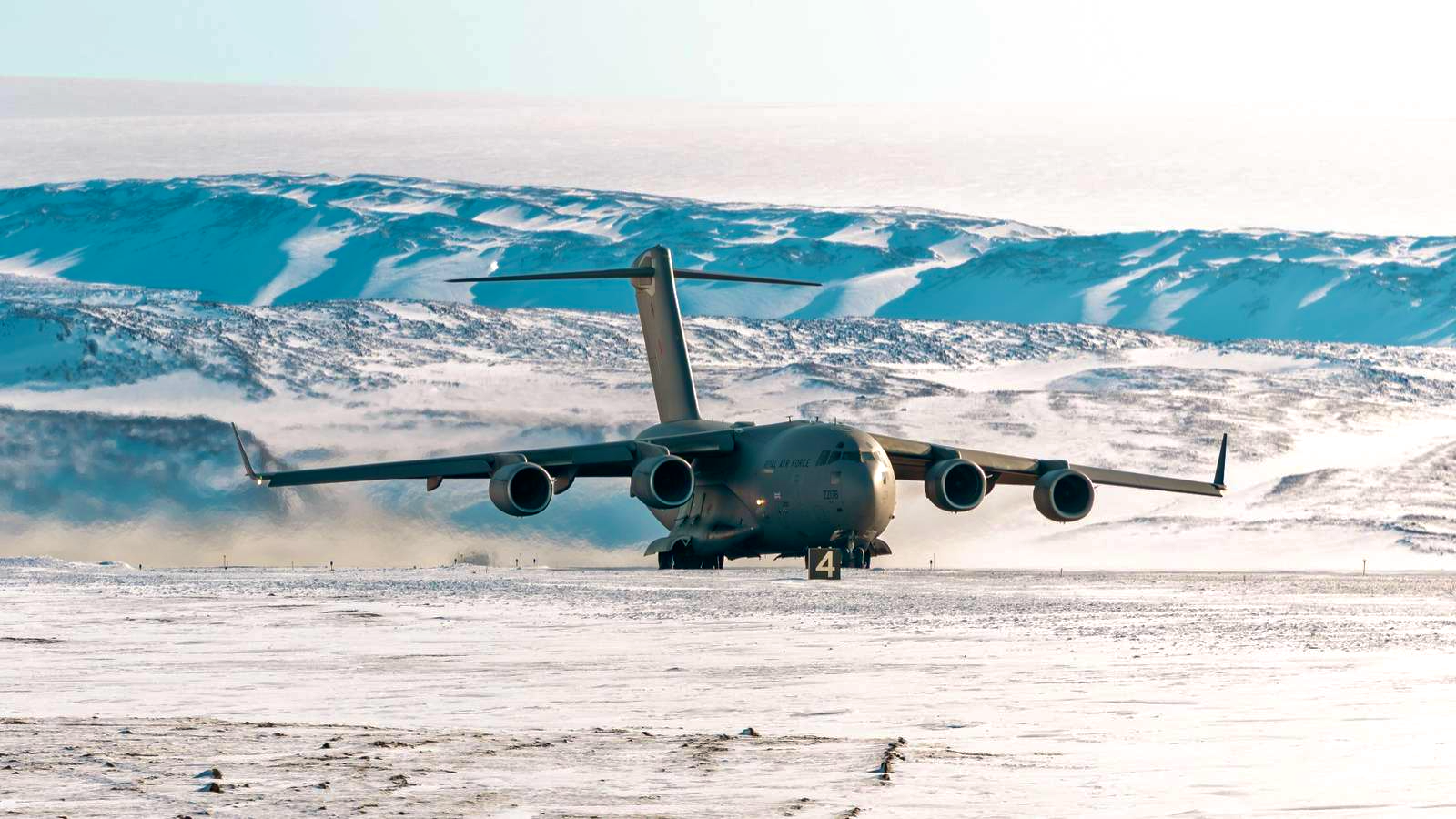
Published Nov 12, 2026, 7:01 PM EST Aaron is an aviation enthusiast and world traveler with a deep interest in aerospace history and technology. He has traveled around the world numerous times, often incorporating visits to aviation museums and historic aircraft collections into his journeys. A native of New Zealand, he is an expert in aviation and maintains a broad interest in a variety of other subjects. The Boeing C-17 Globemaster III has been explicitly designed to be able to reverse at austere airports and to conduct three-point turns while carrying a full load. This is an important set of features that allow it to be versatile and to operate from forward airstrips where infrastructure is rudimentary, and where the airstrip is as narrow as 75 feet (23 meters). Reversing under their own power is typically one of the advantages that turboprop transports (including the Airbus A400M) boast over jet-powered airlifters. But the C-17 is not unique as a reversing turbofan transport, as the smaller C-390 and the roughly comparable Il-76 jets also appear to have some measure of reversal capabilities. But what is remarkable is how well the C-17 can do it, including in tight spaces and with a heavy load. Military Transports That Can Reverse Credit: DVIDS Military cargo aircraft are designed to operate in a fundamentally different environment than commercial freighters. Commercial freighters can count on tow trucks to push them back at airports around the world. Operating in austere and dangerous forward airstrips is another matter entirely. It is more practical for turboprop tactical transports to be able to taxi backwards than large jet transports. The Lockheed C-130 Hercules family is able to go backwards, as is the European Airbus A400M Atlas tactical/strategic airlifter. But this is not universal for military turboprops. The smaller tactical C-295 is powered by two Pratt & Whitney Canada PW127 turboprops with reversible-pitch propellers. This means that the aircraft has the basic propulsion characteristics needed for reverse taxiing, but it is unclear if reverse taxiing is an approved or regularly used feature of the aircraft. The massive C-5 is equipped with thrust-reversing capability, but it is unclear if it actually can reverse under its own power. The same is true for the Antonov An-124. According to Aviation Week, the tactical KC-390 Millennium comes with reverse taxiing as one of its ground-maneuvering capabilities. Among larger jet-powered strategic airlifters, the Boeing C-17 Globemaster III is unusual for being able to easily reverse under its own power. All the established reversing airlifters are noticeably smaller. The C-17 Globemaster III's Ability To Reverse Credit: DVIDS The C-17 Globemaster III is able to combine the reversing capability typically associated with turboprop transports (C-130, A400M) with large jet transport. This is an explicitly recognized C-17 operating procedure and is not just a hack pilots can do with their thrust reversers. Globalmasters are powered by four Pratt & Whitney F117-PW-100 turbofan engines (based on the commercial PW2040). Those engines are part of the family of PW2000 engines that power the Boeing 757, Boeing C-32A, and even the upgraded Russian Ilyushin Il-96M variant. The USAF's Air Mobility Command explains, "Each engine is rated at 40,440 pounds of thrust and includes thrust reversers that direct air flow upward and forward to avoid ingesting dust and debris. Additionally, thrust reversers provide enough thrust to reverse the aircraft while taxiing backwards and create in-flight drag for maximum rate descents." Select military transports Powerback capability Note (per USAF, etc.) C-130 Hercules Confirmed Explicit capability C-17 Globemaster III Confirmed Explicit capability A400M Atlas Confirmed Explicit capability C-5 Galaxy Permitted, restricted Uncommon, in USAF manual KC-390 Millennium Reported Stated by Aviation Week Il-76 Reported/Unverified Anecdotal reporting, reverse thrusters confirmed by Canada One of the top advantages of the design is that the Globemaster III has the capability to "operate into and out of short runways and austere airfields carrying large payloads." Separately, it is worth noting that the C-17's closest Soviet/Russian analogue, the Ilyushin Il-76, would seem like it can reverse to some extent. One line of evidence of the Il-76's ability to reverse is from the Transportation Safety Board of Canada investigation into a Volga-Dnepr Il-76TD-90VD runway overrun at St. John's. How The Globlemaster III Backs Up Credit: DVIDS While the Globlemaster III's turbofans are based on those of the Boeing 757, they are not the same. These military variant engines' thrust-reversing system directs airflow upwards and forwards. Conventional turbofans' reverse thrust mostly directs air forwards. The difference is important, as it allows the C-17 to reduce the amount of foreign material like dust and debris that its engines ingest when operating in austere conditions. The feature also allows the transport aircraft to generate significant backwards thrust without requiring a pushback. All four engines come with thrust reversers. One of the most eye-catching capabilities of the C-17 is that it is able to do this even when operating at very high weights. This includes backing at the maximum ramp weight of 586,000 lb (265,800 kg), on gradients of up to 2%. Yet another hat trick is that the Globlemaster is able to perform a three-point turn on narrow runways. Pilots have very limited visibility directly behind the aircraft, and so the loadmaster acts as the pilot's eyes when backing up. The loadmaster remains in continuous interphone contact with the pilots, feeding continuous instructions. The loadmaster calls the stopping point. This is similar to having someone outside the car assist in telling the driver how much space the car has, when to turn, and when to stop. The C-17 Can Use Tiny Airstrips Credit: Aaron Spray | Simple Flying The US Air Force states, "The design of the aircraft (high-lift wing, slats, and externally blown flaps) allows it to operate through small, austere airfields. The C-17 can take off and land on runways as short as 3,500 feet (1,064 meters) and only 90 feet wide (27.4 meters). Even on such narrow runways, the C-17 can turn around using a three-point star turn and its backing capability." The detail of airstrips only 90 feet (27.4 meters) wide is notable. For reference, the C-17 is only 174 feet (53 meters) long, and the minimum airstrip width is much less than its own wingspan of 169 feet 10 inches (51.75 meters). Its much larger C-5M Super Galaxy counterpart is 247 feet (75.3 meters) long. In November 2026, I flew with Pacific Missionary Aviation to the remote Pacific island of Ulithi, where the tiny landing strip covers the width of the island. I asked the pilot what the largest aircraft that could operate on it was. He said, for commercial aircraft, it was the nine-seater Beechcraft Super King Air 200 we were flying. Taking off, we used almost the whole runway. Incredibly, even this tiny airstrip gets tantalizingly close to what the massive C-17 can use. Generally, the C-17 requires 3,500 feet (1,066 meters) of runway, while Ultithi is 3,000 feet (914 meters). However, the C-17 can get clearance to operate below 3,000 feet, making it possible. The strip is also narrow at 75 feet (23 meters). That said, there is a wider bump at the ends of the airstrip that could make it large enough. Becoming More Important Credit: DVIDS The ability of the Globlemaster III to operate on tiny airstrips like Ultithi (a tight fit) is becoming increasingly important as the USAF implements its Agile Combat Employment (ACE) doctrine. In the past, the importance was more heavily focused on being able to fly into austere forward bases. This is becoming increasingly problematic as aircraft become vulnerable on the ground. What is becoming increasingly important is dispersion and mobility. Aircraft need to disperse out of Guam's Andersen Air Force Base and land in various airstrips around the region. Realistically, heavy transports could be pushed back from frontline areas, but these Second Island Chain bases may remain feasible, even if the First Island Chain becomes contested. The other factor is that to be survivable when deployed forward, aircraft need to move. A C-17 is a prime target and a sitting duck on the ground. When flying into forward airbases, it will need to operate in a fast turnaround time. The more the aircraft is able to operate from dispersed bases, including without infrastructure (like tow trucks), and return to safer bases, the more survivable it will become and the more useful it will be. Reversing Carries Inherent Risks Credit: DVIDS Reversing, even with the loadmaster's help, risks bumping into things. Generally speaking, operators elect a pushback if feasible. One notable insight into these large military transports is an investigation of an incident with a French A400M during Exercise Pitch Black in Australia. The French A400M operating at RAAF Darwin, where there was only one access route and no space to turn around. The French requested a towing tractor, but it would take hours to arrive. Instead, they opted for a power back. The aircraft used reverse mode on all four TP400 engines; its rear cargo ramp was opened, and the loadmaster positioned himself on the ramp to guide the pilots. The aircraft hit a mobile light unit located at the edge of the taxiway. Instinctively, the pilot braked, causing the aircraft to tip backward with the auxiliary landing gear lifting and the ramp hitting the ground. The aircraft was damaged in several areas, with the report stating, "Engine 1 propeller was severely damaged." It notes, "Performing the power-back maneuver repeatedly in similar conditions for three weeks, the crew has developed a representation of the area that had never changed." Put another way, the crew didn't expect the German detachment to position a mobile light unit where they had reversed before and didn't check the surroundings properly.
Why The C-17 Globemaster Can Taxi Backwards Without A Tow Truck
Full Article
Original Source
Read the full article at Simpleflying →KhanList aggregates and links to publicly available news content. We do not host full articles from third-party sources. Always verify important information with original sources.