
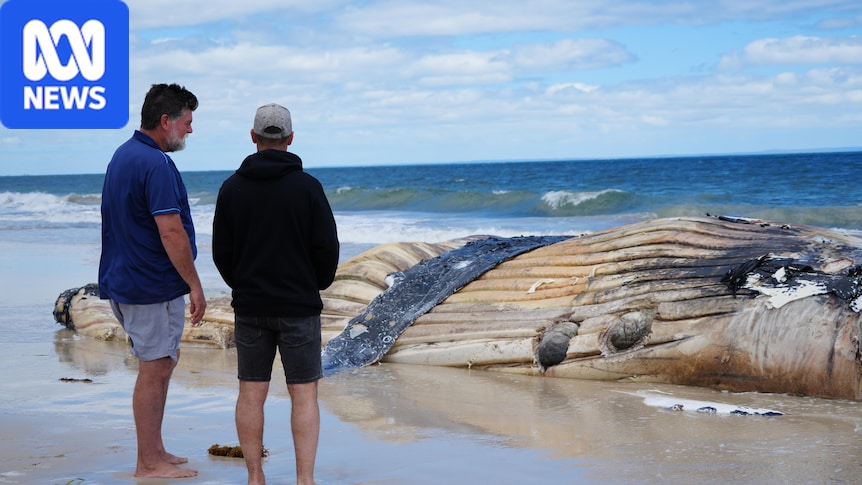
A run of whale carcasses washing up on West Australian beaches has sparked debate on the best method to remove remains and who should foot the bill.Whale researchers say centralised responsibility and offshore disposal are the preferable approaches, but concede both carry complications.Peppermint Grove Beach, around 200km south of Perth in the Shire of Capel, was the latest to deal with the problem, with the rotting 12.5-metre humpback washing ashore on Tuesday.The 14-tonne carcass was removed with a crane on Wednesday and trucked to a disposal site. It is at least the fourth whale carcass to have washed up on a WA beach in recent weeks.The whale was removed by crane and buried on shore. (ABC South West WA: Gabrielle Becerra Mellet )The state government insists the responsibility for removals rests with the land manager, which in most cases is the local government.The policy left one Perth council saddled with a bill of almost $180,000 to remove a carcass from its beach.Calls for centralised removalsWhile the Shire of Capel has not revealed the cost of the removal, it noted the process was "entirely necessary" in the interests of public safety.Shire president John Fergusson said a formal agreement between councils and state government was needed to manage whale disposal.The Shire of Capel says the beach will be closed for at least a week for testing and patrols. (ABC South West WA: Gabrielle Becerra Mellet )"I think there probably should be some cooperative or mutual model available for this type of procedure," he said."You don't want local councils blinking about the process when in fact they're dealing with community safety because they're concerned about the budgetary considerations."Griffith University marine scientist Olaf Meynecke said dealing with dead whales was complex and costly, and most local councils lacked the appropriate resources."They do not have the knowledge, the management plans in place," Dr Meynecke said."It's a big burden; the issue of carcass removal should be centralised, and it should come from at least the state." Olaf Meynecke says removing whale carcasses is complex and costly. (ABC: Glenn Mullane)A Department of Biodiversity, Conservation and Attractions spokesperson said it had been in contact with the Shire of Capel regarding the removal."DBCA will provide technical advice on carcass handling and removal, access to specialist equipment and experienced staff to assist with the operation if required," they said.Offshore removals Transporting to landfill remains the most common method of carcass disposal.Some researchers say towing a whale back out to sea, where possible, is preferred. (ABC South West WA: Gabrielle Becerra Mellet)But Macquarie University marine scientist Vanessa Pirotta said towing the remains back out to sea was preferable."[It] means the animal can go back into the environment and have the animal contribute back to the natural ecosystem that it was a part of," Dr Pirotta said.But she acknowledged complications with this method, including the risk of the carcass washing back on shore.Vanessa Pirotta says taking whale remains back out to sea is preferable, but carries risks. (ABC News)"Authorities and decision makers will need to ensure that the whale is disposed of correctly to ensure that there's not a risk of an animal stranding again due to currents or weather," she said.Dr Meynecke said towing a whale offshore was ethical and environmentally friendly, with satellite tracking and search-and-rescue software a potential resource."The idea is that the modelling allows us to predict where the whale might end up when we place it in a certain area out at sea," he said.Crowds gather at a whale carcass that washed up at City Beach in Perth. (ABC News: Andrew O'Connor)"If we're tracking it live with a satellite tracker, we know exactly where it's going, and if it does happen to move back to shore, it can be intercepted again with the same contractor."Mr Fergusson said he understood calls for the remains to be towed out to sea, but the risks were high."If you're towing it offshore and it's shedding, then it's providing attraction for sharks," he said."If you do tow it offshore, unless you tow it a long, long way, there's a very real risk it will just wash back up on shore."
How do you remove a rotting whale from a public beach?
Full Article
Original Source
Read the full article at Abc →KhanList aggregates and links to publicly available news content. We do not host full articles from third-party sources. Always verify important information with original sources.