
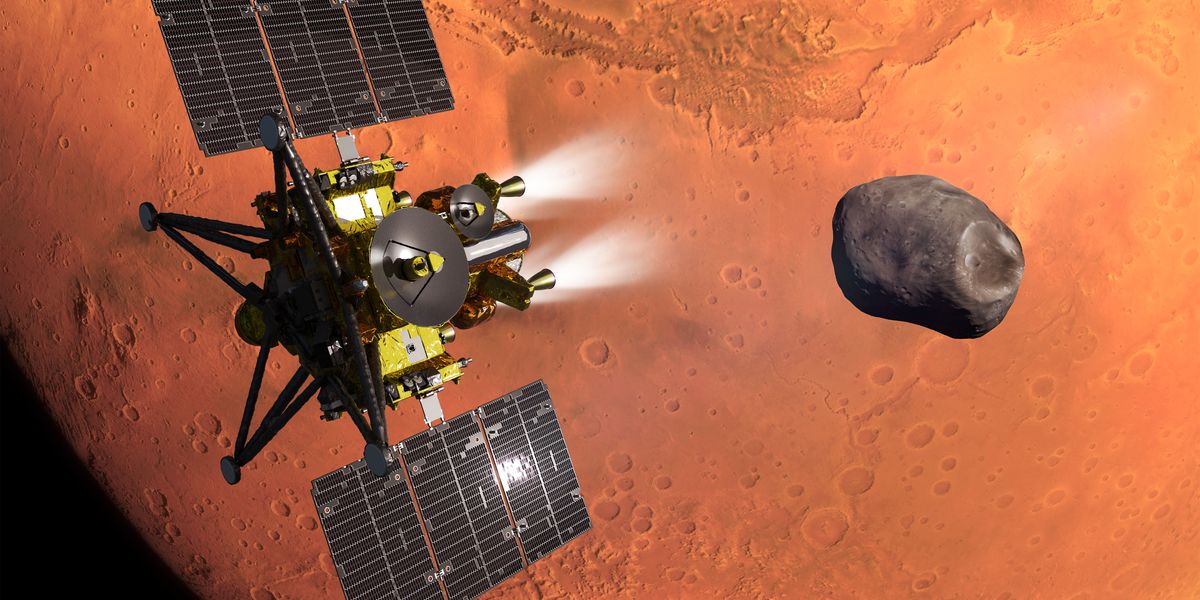
Japan's MMX spacecraft will fire its engines to slow down and enter orbit around Mars.Last August, looking up from the edge of an ancient river delta on Mars, the Perseverance rover’s electronic eye spied an oblong shadow crossing the distant, glowing Sun. Phobos, the Martian moon named for the Greek god of fear and panic, was transiting the solar disk. Too small to darken the pale, dust-tinged sky, but orbiting close enough to eclipse a significant fraction of the Sun, Phobos passed in less than a minute. NASA’s Perseverance rover captured Phobos passing in front of the Sun from the surface of Mars.ASU/MSSS/SSI/JPL-Caltech/NASAThe tiny moon, with its murky origins, is an enigma, and one whose makeup and history could tell us much about Mars and the wider solar system. And now the international Martian Moons eXploration (MMX) mission, which successfully launched on 20 October, seeks to explore that mystery with an unprecedented series of landings on the unknown surface of Phobos.This mission brings unusual challenges—for example, designing an orbit to study a microgravity moon orbiting a much larger planet. Engineers also had to figure out how to assess and land on this low-gravity pile of loosely assembled dirt and rock, how a rover might rove across it, and how the spacecraft might take samples and return them to Earth.“I often say that landing on Phobos is like trying to land a balloon,” says Yasuhiro Kawakatsu, project manager of MMX at the Japan Aerospace Exploration Agency (JAXA). “It’s very difficult to drop a balloon to the ground and prevent it from tilting or bouncing.”Why Phobos Is Such a Strange MoonPhobos is one of two small Martian moons; the other is Deimos, named after the Greek god of dread and terror. Their cosmic origins are unknown, though there are two prevailing theories. One holds that the moons were once asteroids from the belt between Mars and Jupiter, captured by the smaller planet’s gravity. In the other theory, Phobos and Deimos formed when a large celestial body slammed into Mars, sending debris into orbit. Some models suggest the pair are the last survivors from a cluster of satellites. The enormous Stickney crater, roughly 9 kilometers across, dominates this view of Phobos taken by NASA’s Mars Reconnaissance Orbiter.University of Arizona/JPL-Caltech/NASAScientifically speaking, Phobos is considered a rubble pile, a loosely consolidated aggregate of rock and dust. Far too small to become spherical under its own mass, it’s shaped like a lumpy potato, roughly 27 kilometers in length, with only 1/1,800th of Earth’s gravity. On Phobos, a typical adult would weigh about as much as a tennis ball does on Earth.More than 10 years in the making, MMX launched on Japan’s flagship H3 rocket from Tanegashima spaceport on 20 October local time. It will arrive at Mars in 2027 carrying scientific payloads from several space agencies, including NASA, and a new rover called Idefix developed by the French and German space agencies (CNES and DLR) in collaboration with JAXA. Engineers assembled MMX’s modules at Japan’s Tanegashima Space Center before the spacecraft’s October 2026 launch.JAXAMMX consists of three modules: a propulsion module to power its journey to Mars and apply the brakes to enter orbit around the red planet; an exploration module carrying the rover, sampling gear, and other scientific instruments; and a return module, attached to the exploration module, that harbors the capsule destined for a high-speed reentry into Earth’s atmosphere. After collecting samples on Phobos, the exploration and return modules will lift off together. The exploration module will then be jettisoned while the return module sets a course back home.If all goes according to plan, MMX will deliver a 10-gram sample to Earth in the second half of 2031. But the mission will face a series of daunting challenges to reach that end point, including navigating complex orbits around Phobos and landing on its surface while Mars periodically blocks communications with Earth. The MMX’s modular design includes the propulsion module [left] and the exploration and return modules [right].Kyodo News/Getty Images“It’s the most complex mission I have ever seen,” says Patrick Michel, director of research at CNRS (the French National Center for Scientific Research) and co-principal investigator on Idefix.How MMX Will Orbit Phobos An H3 rocket carried MMX into space on 20 October 2026, beginning the mission’s five-year journey to Phobos and back.The Asahi Shimbun/Getty ImagesOnce MMX reached low Earth orbit, its propulsion module’s engine fired, kicking off a nearly year-long deep-space cruise to Mars. On arrival, the spacecraft will need to fire its engines in an extended, carefully timed burn to slow down enough to be captured by Mars gravity. The propulsion module will then be jettisoned, leaving the exploration and return modules to orbit Mars.“If something doesn’t go according to plan, MMX will fly by Mars and get catapulted into the solar system,” says Nicola Baresi, an astrodynamicist who coauthored a paper on specially designed orbits for MMX.From that initial orbit, MMX will transition into a specially designed quasi-satellite orbit that allows it to keep pace with the small moon but also move around it. Since Phobos is too small to orbit in the conventional sense, the spacecraft will orbit Mars alongside the moon, following a clever egg-shaped path that slings MMX alternately ahead of and behind the moon. “When you’re closer to Mars, you’re accelerating with respect to Phobos, and when you’re farther from Mars, you’re decelerating. So you essentially go back and forth,” explains Baresi. Martian Maneuvers To reach Phobos, MMX will execute three major maneuvers: MOI-1 will put the spacecraft into orbit around Mars, MOI-2 will transfer it toward Phobos, and MOI-3 will place it into its final orbit alongside the moon.Chris PhilpotThe best existing images of Phobos, from spacecraft such as NASA’s Mars Reconnaissance Orbiter and ESA’s Mars Express, have resolutions of only a few meters per pixel. That’s larger than Idefix, the mission’s rover, itself about the size of a microwave oven. To map the surface in greater detail, MMX will loop in front of and behind Phobos at distances ranging from 200 kilometers to less than 20 km from the surface.During its two-year remote sensing campaign, the exploration module will use several cameras and a laser altimeter to map the surface in high resolution and look for candidate landing sites. When Mars passes behind the Sun as seen from the Earth, causing a roughly two-week communications blackout, MMX will retreat into a larger, stable orbit. After communications resume, MMX will prepare to send its first visitor down to the surface.Idefix Rover: The First PenguinBefore the exploration and connected return modules attempt to land, Kawakatsu says, MMX will send a scout that in Japanese is called “the first penguin,” leaping into unknown waters. For this mission, the first to leap will be the Idefix rover, named for the canine companion to Obelix in the French comics series Asterix. The exploration module will release the rover during a low-altitude pass of between 40 and 100 meters above Phobos’s surface in 2028 or early 2029. MMX will use its TENGOO camera [left] and LIDAR laser altimeter [right] to map Phobos’s terrain.JAXAIt will be a tense moment that calls back to 2005, during Japan’s Hayabusa mission to explore the asteroid Itokawa. In a similarly designed drop, the MINERVA rover was released from an orbiter, but erroneously at 200 meters instead of the intended 70 meters. The rover missed the asteroid and, without propulsion, drifted off into deep space.Idefix will get a slight nudge out of the exploration module toward its negligible-gravity target, freefalling and likely tumbling as it goes. It’s expected to touch down with a velocity of less than 1 meter per second. Unlike rovers that have landed on other surfaces with airbags or dedicated landing legs, Idefix will land without protection, apart from some extra padding on the solar panels due to their critical nature. The barely-there gravity of Phobos should allow the 23-kilogram rover to land softly, though exactly how this landing will play out is hard to predict. The Idefix rover will travel to Phobos with its wheels tucked in and solar panels folded.DLR“It will bounce probably several times,” says Stephan Ulamec, Idefix’s co-principal investigator and project manager at DLR. “It will come to rest somehow in some position.” Once it’s still, four retracted legs will deploy to right the rover autonomously, regardless of its orientation. It will then unfold its solar panels to charge its batteries for exploration tasks ahead. A simulation shows how Idefix is expected to tumble onto Phobos, right itself using its articulated legs, and begin exploring the moon’s surface. DLR Once operational, Idefix will roll at a snail’s pace, topping out at one millimeter per second. Its metal wheels have protruding blades like a paddle wheel, designed to gain traction in Phobos’s microgravity. “If we were to drive our rover faster, then it would actually be more like we were swimming through instead of driving across the surface,” says Cecily Sunday, a doctoral student involved in testing Idefix’s WheelCams at the Institut Superieur de l’Aeronautique et de l’Espace (ISAE-Supaéro) in Toulouse, France.The WheelCams, a pair of cameras placed on the underside of the rover, will observe the wheels and their tracks during Idefix’s planned 100-Earth-day primary mission. The images will help researchers study the size and distribution of grains in Phobos’s regolith and how cohesive they are. How much or how little the grains stick together will greatly impact how Idefix moves. Sunday likens this to the difference between driving on dry and wet sand. “Think of trying to build a sandcastle with dry sand,” she says. “You can’t. Add water, and suddenly you can.” The Idefix rover was mounted between the MMX spacecraft’s landing legs for the journey to Phobos.DLRThe team tested the rover’s nine-bladed wheels on a variety of materials, including Phobos regolith simulants provided by JAXA and DLR, lunar simulants, glass beads, quartz sand, and clay pebbles. “We characterize the mechanical properties of each simulant precisely, then test across the full range, with varying grain size, angularity, and even color, so we can map what we see in the WheelCam images back to actual surface properties,” Sunday says.Despite the microgravity and Phobos’s rubble-pile nature, Sunday says Earth-based tests can approximate the rover’s motion on the surface of the small moon fairly well. While Phobos’s reduced gravity lowers the rover’s effective weight, there is also reduced pressure between the grains beneath its wheels. “As long as you’re moving very, very slowly and using the same materials and the same weight of the system, they should be representative,” Sunday says. With four paddle-like wheels and deployable solar panels, Idefix is designed to crawl across Phobos.Ardan Fuessmann/Imago/AlamyIdefix’s interactions with its new home will offer “sub-millimeter resolution and information on porosity, on grain size, on surface strength, on how hard is the material,” Ulamec says. “It fills a gap between remote observations from orbit and detailed observations of the return samples back on Earth.”What Idefix finds on this rocky, rugged world will help determine how and where JAXA attempts to land the main spacecraft. Michel says the touchdown will provide ground truth for understanding of Phobos. When NASA’s OSIRIS-REx spacecraft touched down on the asteroid Bennu to collect a sample, its sampling arm surprisingly sank nearly half a meter into the loose material. But Ulamec doesn’t think Idefix will sink deep into Phobos, noting that Bennu is very different and much smaller, with a diameter of 500 meters.How MMX Will Land and Collect SamplesOnce Idefix has investigated the surface, MMX will face an even greater challenge: landing its much larger exploration module on Phobos. The spacecraft will make a controlled descent to roughly 10 meters above the surface, then drop the remaining distance in free fall. With so little gravity to pull it downward, even a small sideways motion could cause the lander to tip or bounce away. A successful, upright landing would mark the start of up to two hours on Phobos for the crucial sampling phase.The MMX mission draws on the experience and technologies of Japan’s two Hayabusa sample-return missions, which landed on the asteroids Itokawa and Ryugu. But this mission has many more moving parts. MMX’s exploration module will use two sampling devices—a coring sampler developed by JAXA and a pneumatic sampler provided by NASA and fabricated by Honeybee Robotics, a subsidiary of Blue Origin. Data from these tools, and those carried by the Idefix rover, could answer questions about the origin of Phobos and how the Mars system has evolved.The coring sampler uses a robot arm and a cylindrical corer designed to reach at least 2 centimeters below the surface. The arm can maneuver to find the best site for digging. “That by itself is a challenge because we’ve never done it,” Michel says. “You never know what can happen at the very sampling site itself, where you might have a boulder and the arm cannot move.”Probing beneath the top layer will be valuable because solar radiation, galactic cosmic rays, and micrometeorites have battered and weathered the surface. The material below should offer a better record of the moon’s origins, and JAXA aims to collect at least 10 grams of it. MMX will carry both the Idefix rover [bottom] and a robotic coring sampler [top] designed to dig beneath Phobos’s weathered surface.JAXAThe pneumatic sampler takes a different approach. Mounted on one of the lander’s legs, it will inject pure, non-reactive nitrogen gas into the surface and capture the grains stirred up. This sample could illuminate the changes Mars and its moons have undergone over time. The dual system also adds redundancy in the face of Phobos’s unknowns. “If the surface of Phobos proves to be very hard, [the coring sampler] may struggle to penetrate the ground. [The pneumatic sampler] would not experience this issue and still be able to gather material,” Kawakatsu says.One of the most intriguing aspects of MMX is the additional possibility of collecting material from the planet below. It’s likely that Phobos has been peppered by Martian ejecta thrown into space by meteor impacts, so MMX also provides an opportunity to return the first Martian samples to Earth. Michel estimates that the samples could contain “a few hundred grains coming from Mars.” Scientists can distinguish those grains from native Phobos material by analyzing their oxygen isotopes.That possibility raises a planetary-protection question. A direct Mars sample-return mission would have to follow strict rules to ensure that potentially living biological material from Mars doesn’t contaminate Earth. But those protocols don’t apply to MMX, even if its sample does collect grains of Martian soil. A panel of experts concluded that any microbes blasted off Mars wouldn’t survive the violent impact and ejection or the intense radiation exposure on the way to Phobos. This saved MMX from implementing expensive and time-consuming quarantine and containment protocols for the returning sample. After landing on Phobos, MMX will have roughly two hours to collect samples from the moon’s surface before lifting off again.JAXADuring the brief surface operation, the robotic arm will deposit the samples in a storage unit, from which they’ll be transferred into a capsule aboard the return module and sealed in a vacuum. After that, lift off.Once back in Mars orbit, the exploration module will resume its observations of Phobos and make several flybys of Mars’s other diminutive moon, Deimos, to gather data on its surface, structure, and composition. In November 2030, during a favorable alignment of Mars and Earth, MMX will begin the homeward leg of its trip. The return module will separate from the exploration module and power the voyage home, its sole objective to bring the dust of Phobos to Earth. MMX’s sample return capsule will carry material from Phobos through Earth’s atmosphere in 2031.JAXAFinally, in 2031, the 60-centimeter-wide sample capsule will plunge into Earth’s atmosphere at roughly 12 kilometers per second. Assuming it survives the extreme heat of reentry and lands safely in Australia, scientists will begin to tease out clues about Phobos and the early solar system. JAXA’s Institute of Space and Astronautical Science will receive and curate the samples, which will also be shared with mission partners.“We have macroscale measurements from the spacecraft, microscale measurements with the rover, and then sample analysis,” Michel says. “So we can relate the three kinds of scales together because we have all of them.” The insights gleaned from orbital images, close-up images of the regolith, and the chemical analysis of the samples could have wider implications for our understanding of our solar system.“MMX is a mission to understand the Mars system and shed light onto how terrestrial planets like the Earth, and maybe Mars, develop a habitable environment,” Kawakatsu says. “We strongly suspect that our terrestrial planet region formed dry, and water and organics were scattered inwards from the icy-rich outer solar system.” Mars, he says, sits at the gateway between the inner and outer solar system, making its moons valuable witnesses to the processes that shaped potentially habitable worlds.
How Do You Land on a Moon With Almost No Gravity?
Full Article
Original Source
Read the full article at Spectrum →KhanList aggregates and links to publicly available news content. We do not host full articles from third-party sources. Always verify important information with original sources.