
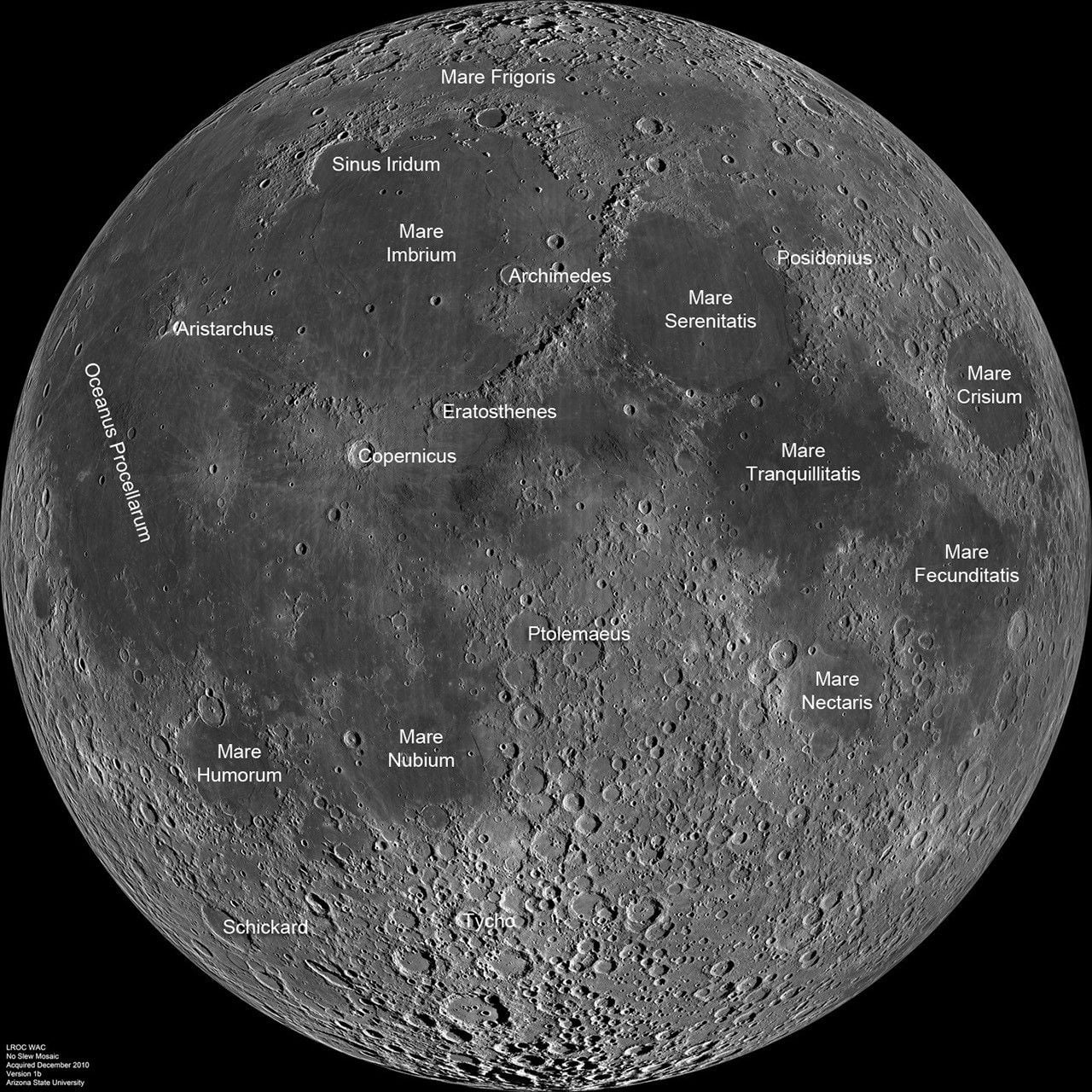
We typically think of the Moon as a static, floating object that has remained the same for basically its entire lifetime, with an occasional asteroid impact serving as an exception. That understanding is grounded in physics - the Moon should have cooled rapidly after forming when a huge protoplanet hit the early Earth around 4.5 billion years ago. But, some lunar material returned from the Chang’e-5 mission was notably formed only around two billion years ago, yet appeared to be volcanic in origin. So how did a world that was supposed to have settled down without volcanism remain hot enough to create these materials more than two billion years after its violent birth? A new paper from Miao Chen of the Chengdu University of Technology and his colleagues, and recently published in the journal Planet, offers an explanation - tidal heating. Let’s first set the stage of the Moon’s creation. Our best guess is that it was created when another early protoplanet, named Theia, slammed into Earth in a massive collision, creating a chunk of debris that coalesced into the Moon. However, that amount of debris was relatively small - only about a quarter the size of the Earth itself, which meant the internal heat generated during its formation would rapidly radiate away, turning the Moon itself geologically dormant. But when Chang’e-5 returned some lunar basalts from Oceanus Procellarum back to Earth, laboratory dating showed them to be only around two billion years old. Basalts are only formed in active volcanoes, or other environments with similarly high pressures and temperatures. Environments that, at least according to traditional geological theory, shouldn’t have existed on the Moon two billion years ago. Fraser explains why the Moon is moving farther away. Despite that, scientists have tried offering other solutions. Radioactive elements, such as potassium and uranium, emit some heat as they decay. But there wasn’t enough un-decayed material left on the Moon to offer the amount of heat needed to form basalt two billion years ago. Asteroid strikes could cause localized high impact thermal spikes, but the heavy bombardment period that gave the Moon most of its craters had ended long before the basalt was formed. So instead the authors turned to gravity - specifically to a phenomenon called tidal heating. This happens when a celestial body is squeezed, stretched, and kneaded as it travels in an elliptical orbit around a larger parent body. Perhaps the most famous example of this in the solar system is Io. This moon of Jupiter is constantly erupting due to the tidal squishing it undergoes during its orbit around the largest planet. Obviously, the Moon doesn’t seem to be undergoing any such squishing currently. However, two billion years ago, the Moon was much closer to the Earth than it is today, orbiting our planet in sixteen days rather than the twenty seven it takes now. Its orbit was also much more eccentric, looking much more like an oval than a circle. All of which means that Earth itself exerted huge rhythmic tidal forces on the Moon' s interior during the course of its orbit. Fraser details Tidal Locking, which also affects the Moons geology. We’ve known that for awhile, but astronomers have always modeled the Moon as a mostly uniform sphere when trying to understand how these gravitational squeezes affected it. However, scientists knew this was a simplification - there is an ultra-low viscosity zone of rock wrapping itself between the Moon’s core and mantle. When the research team plugged a more realistic 3D representation of the mantle setup into a convection simulation, they noticed that a ton of energy was directed specifically at two symmetric regions along the lunar core-mantle boundary. These regions, which they named Tidal Heating Anomaly Zones (THAZs) , absorbed a huge amount of energy. They calculated that, around 3.2 billion years ago, despite taking up only 2.5% of the mantle’s total volume, the tidal strain on these regions delivered 150 gigawatts of power - more than four times the amount of energy generated by radioactive decay. This seemed to be the driving force behind much of the Moon’s geological history. It helped keep the lunar core warm, which helped sustain a magnetic field for much longer the models originally predicted (and was a puzzle when scientists realized that Apollo lunar samples seemed to have formed in a strong magnetic field). It also drove huge mantle plumes that swelled toward the crust. Billions of years later, long after the tidal engine has calmed down, those stranded pockets of mantle melted to produce the basalts seen in the Chang’e-5 samples. If there’s one thing that’s clear from the paper’s theory, it's that we still don’t know a lot about the Moon’s geological history. This new model offers some elegant answers to some of the most persistent questions in that area, but as of now it’s still only a theory. Maybe some of the numerous lunar missions planned over the next decade will be able to provide more definitive data to finally solve the evolutionary questions of our nearest neighbor. Learn More: Higher Education Press / EurekAlert - Could tides have concentrated heat deep inside the moon? A new model reveals a possible heat source M. Chen, D. Wang, & Y. Liu - Tidal Heating Anomaly Zone at the core-mantle boundary of the Moon UT - A Buried Volcano on the Moon Hints At An Ancient Lunar Dynamo UT - The Moon had Volcanoes More Recently Than Previously Believed
Earth's Gravity May Have Kept the Early Moon's Volcanic Heart Beating
Full Article
Original Source
Read the full article at Universetoday →KhanList aggregates and links to publicly available news content. We do not host full articles from third-party sources. Always verify important information with original sources.