
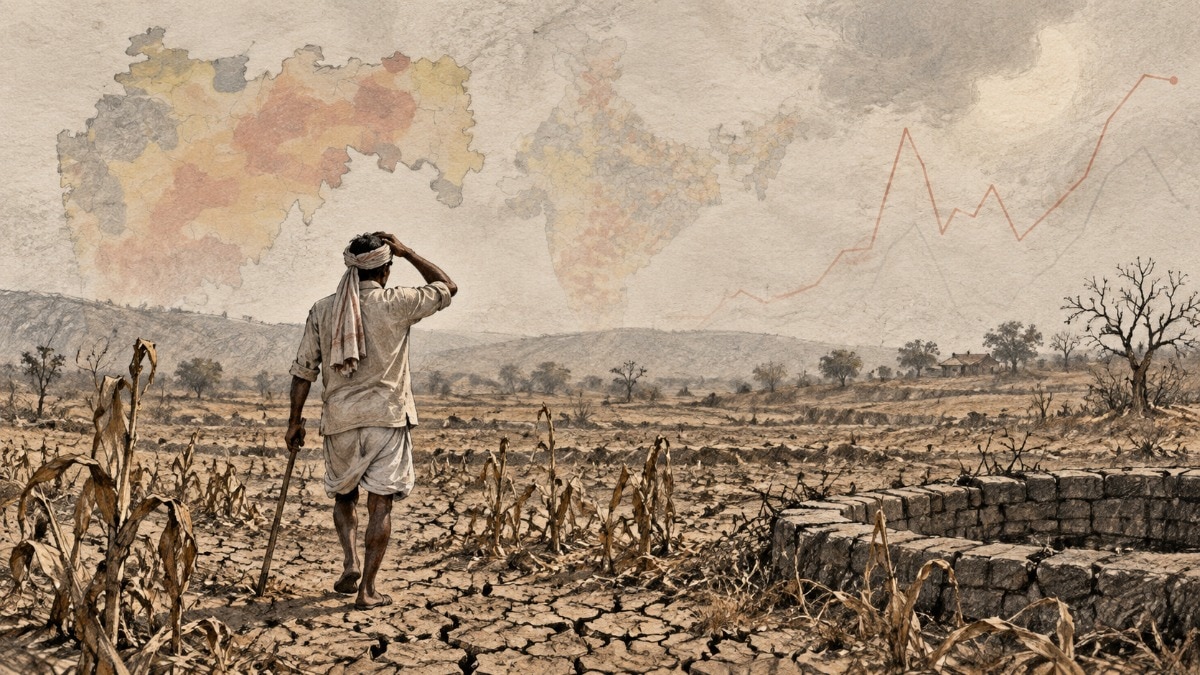
More than half the state is in severe drought, the most since mid-September 2021. The state's first drought notice is due by Saturday.By the end of the monsoon, Maharashtra's land should be at its wettest. This year, most of the state is dry. In Akola, Solapur, Wardha, and Washim, every reading now shows severe drought or worse.It began in the south. In mid-August, most of Sangli slid into severe drought and stayed there. Satara followed a week later. By the last week of August, it had taken hold of Solapur in the south, and Akola, Wardha, and Nagpur in the east all at once. By mid-September, farmers in Washim and Beed took to the streets to ask the state to declare drought.The monitor's numbers show the scale. Nearly 84 per cent of Maharashtra was abnormally dry or in drought in the week of September 16. More than half the state, 56.5 per cent, was in severe drought or worse. No mid-September in its records, which begin in 2021, comes close.The state government has not yet said where the drought is. A preliminary notice is due by Saturday, the chief minister said on September 22. That notice will shape where relief goes. "Just declaring drought is not enough. We need to ensure that measures related to drought mitigation are implemented. The first notification will be issued in three days," Devendra Fadnavis said. The figures come from the India Drought Monitor, run by the Water and Climate Lab at the Indian Institute of Technology Gandhinagar. Each week it scores the land on rain, river flow, and soil moisture. Each is set against what is normal for that place and time of year. A low score means dry land. Below a set line, the monitor calls land abnormally dry. Lower still, it calls it severe drought. By its own count, Maharashtra is past both lines across most of its land.WHERE DOES MAHARASHTRA STAND?Near the top. Only Goa, at 94.6 per cent, and Andhra Pradesh, at 92.8 per cent, had more of their land abnormally dry or in drought in the week of September 16. Maharashtra was at 83.5 per cent. Across India, 52.5 per cent of land is abnormally dry or in drought. A month earlier, it was 38.9 per cent.WHEN DID THE LAND TURN?In three weeks. In the week of August 19, about 14 per cent of the state was in severe drought or worse. By the week of September 9, it was 61.5 per cent. That is more than four times as much land, our calculation shows. It eased only a little by September 16.The season was poor from the start. In the week of June 24, 79.2 per cent of the state was abnormally dry or in drought. In no week of the monsoon did that share fall below 41 per cent. Week for week, our analysis found that 2026 was the driest of the last five monsoons in 14 of its 16 weeks so far.This year's line sits above every other year for most of the season. It climbs hardest in the last weeks of August.WORSE THAN 2023?Yes, by a wide margin. In mid-September 2023, 52.7 per cent of the state was abnormally dry or in drought. But only seven per cent was in severe drought or worse, a DIU analysis shows. This year the severe share is eight times as large.It also reaches further. In the week of Sept 13, 2023, no division had more than 12.9 per cent of its land in severe drought or worse. Nagpur division had none. This year, Nagpur has 63.2 per cent. In no mid-September from 2021 to 2025 did a single grid point in Nagpur division show severe drought.WHERE IS IT WORST?Beed and Dharashiv follow the four districts with no land outside severe drought, at 92.9 and 90.9 per cent. In all, 19 of the 33 districts large enough to rank had at least half their land in severe drought or worse.The spread is plain week by week. Sangli has had half or more of its land in severe drought or worse for six weeks in a row, Satara for five, and Nagpur, Akola, Wardha and Solapur for four, our analysis shows.By division, Amravati is worst, with 84.8 per cent of its land in severe drought or worse. Next is the Chhatrapati Sambhajinagar division, which covers Marathwada, at 65.9 per cent. Nagpur is at 63.2 per cent and Pune at 57 per cent. Konkan and Nashik fared best, at 30.4 and 29.4 per cent.DOES THE RAIN TELL THE SAME STORY?Mostly. Maharashtra got 787.2 mm of rain from June 1 to September 22. That’s 17 per cent less than the normal of 953.2 mm, the India Meteorological Department's district rainfall report shows. The shortfall is deepest where the monitor's drought is. Marathwada was 37 per cent short and Vidarbha 28 per cent. Beed was 48 per cent short, Dharashiv 45 per cent, and Akola 40 per cent.The west is different. Pune district got 18 per cent more rain than normal and Nashik 40 per cent more, the same report shows. The monitor agrees. Only a small part of either district is in severe drought.The coast is where the two part ways. Ratnagiri's rain was 16 per cent below normal, inside the band the weather office counts as normal. Yet the monitor puts 80 per cent of the district in severe drought. Its score also counts soil moisture and river flow, so it need not follow rain alone.WHAT CAN'T THE MONITOR SEE?The monitor shows how dry the land is. It cannot count failed crops or the farmers who grew them. Each grid cell is about 27 km across. That is too coarse to give Mumbai a figure of its own. The record is short too. With five earlier years to compare, "the most since 2021" is as far as it goes.The state is gathering its own evidence. It is collecting data on rain, water storage and crops to identify the affected areas, the chief minister said.WHAT NOW?Fadnavis says the state will not wait for the Centre. It will start paying farmers now and send a separate plea for central help under National Disaster Response Fund rules, he told reporters. "We will complete all the legal requirements and send the proposal, but we will not wait for that assistance. Whatever help we have to provide, we will continue to provide it," he said. Ministers and legislators will visit the worst-hit areas to meet farmers.A Cabinet subcommittee under Revenue Minister Chandrashekhar Bawankule will decide on relief, with Cabinet-level powers.Farm groups want more. A farmers' leader, Ravikant Tupkar, has asked for Rs 1 lakh a hectare in relief. Sharad Pawar, who leads the Nationalist Congress Party (Sharadchandra Pawar), has written to Fadnavis seeking Rs 50,000 a hectare.When the crop checks will start has not been settled yet. Field checks of crop damage, called panchnamas, were to begin on September 23. Another report, however, said they would come after October 5.The first notice is due on Saturday. Will it name Solapur, Akola, Wardha, and Washim, where the monitor finds no land outside severe drought? That is the first test of how far the two measures agree.- EndsPublished By: Pathikrit SanyalPublished On: Sep 23, 2026 16:55 IST
How did Maharashtra slip into drought in just a few weeks?
Full Article
Original Source
Read the full article at Indiatoday →KhanList aggregates and links to publicly available news content. We do not host full articles from third-party sources. Always verify important information with original sources.