
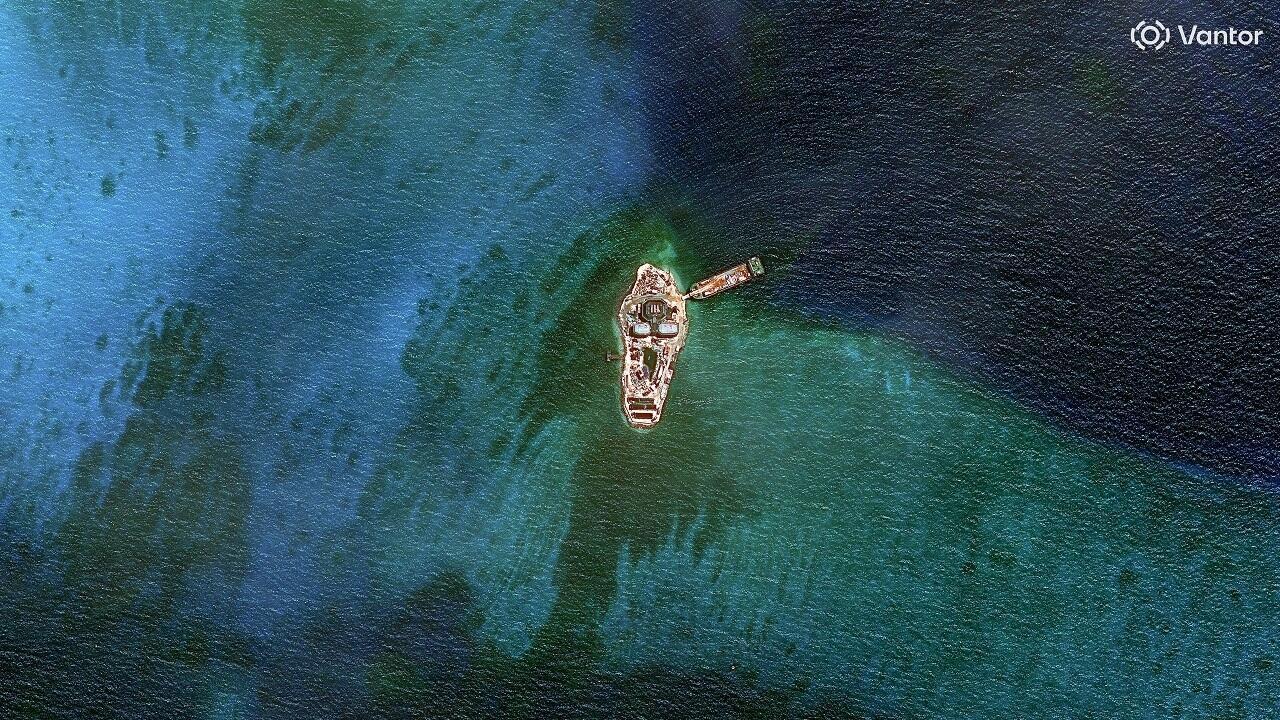
China is rapidly expanding two artificial islands in the disputed Paracel Islands, with analysts saying the new facilities could strengthen Beijing’s military reach towards Vietnam and along key South China Sea shipping routes. In just a few months, China has transformed two previously unused sandbanks into artificial islands bearing the hallmarks of military installations. After building around 20 outposts across the South China Sea since 2013, Beijing has resumed construction in waters disputed by several of its neighbours, notably Vietnam. A mysterious triangular concrete structure, a harbour and a long strip of reclaimed land resembling a runway have emerged since China began major dredging and construction work in the Paracels in December 2025. Satellite imagery analysed by the Asia Maritime Transparency Initiative (AMTI) shows the rapid transformation of two sandbanks that Beijing had previously left undeveloped. “We cannot say for certain yet, but all the evidence suggests that China is building a very large military base on Antelope Reef,” Harrison Prétat, deputy director and researcher at AMTI, a project funded by the Washington-based Centre for Strategic and International Studies, said. Pacific Islands Forum overshadowed by growing concerns about China's influence in the region Possible military base Across roughly six square kilometres in the heart of the South China Sea, sand has been covered with concrete and sections of coral reef appear to have been cleared to accommodate the steady movement of ships. Military analysts are closely watching the work, although the precise purpose of the new facilities remains unclear. “On Yagong Island, 14 kilometres from Antelope Reef, it looks like support facilities for the military base,” Prétat said. “The most likely scenario would be the construction of detection and radar equipment to support the base at Antelope.” Much of the attention has focused on a large triangular concrete structure at the centre of the small island, which analysts believe could eventually house surveillance equipment. That interpretation would fit with Beijing’s broader network of strategic outposts along major commercial and military routes. “It’s like a fortress in the desert,” said Hugo Tierny, a military historian at the École pratique des hautes études and researcher at France’s Institute for Strategic Research, Irsem. “It provides a permanent location for monitoring movements, a harbour for ships, facilities for launching aircraft, and all of it monitored by radar.” Between 2013 and 2017, Beijing sharply expanded its network of outposts as it sought to reinforce its claims over the South China Sea, more than 90 percent of which it considers its own. AMTI said China already operates around 20 militarised outposts in the Paracels, which are also claimed by Vietnam, compared with seven in the Spratly Islands closer to the Philippines. Until now, many Chinese installations have followed a relatively standard pattern. “China has been carrying out a sort of ‘copy-and-paste’ of facilities across its various outposts,” Prétat said. “But what we are seeing on Yagong Island does not exactly resemble any type of structure already seen in the South China Sea.” Submarine missile test puts China's Pacific ambitions on display Vietnam in view If construction continues at its current pace, the function of the new structures may soon become clearer. Their location, however, already offers clues to Beijing’s intentions. Around 400 kilometres off the Vietnamese coast and roughly midway between the Taiwan Strait and the Strait of Malacca – two of Asia’s most strategically sensitive maritime chokepoints – China is creating what would be the second-largest artificial island in the Paracel archipelago. Vietnam, which claims sovereignty over the islands, has demanded that Beijing “immediately halt construction”, describing the work as “illegal”. Hanoi has traditionally been less outspoken than Manila in challenging China’s activities in the South China Sea. But while maintaining close relations with Beijing, Vietnam has also pursued a more assertive strategy of its own. It has built around 20 artificial islands, increased defence spending and diversified its military partnerships, including with Russia, the US and France. “The main purpose of new detection equipment at this location is to have more sensors directed directly towards Vietnam,” Prétat said. “Nothing obstructs the equipment’s ability to scan the maritime area as far as the Vietnamese coast. This provides a clear line of sight that is slightly different from those they already have.” The site could also strengthen China’s ability to support its coastguard presence in the area, resupply vessels and reinforce its claim of sovereignty – particularly towards Vietnamese fishermen and sailors operating nearby. France frets as China strengthens ties with allies in South Pacific Wider regional strategy The new installations also form part of a wider strategic calculation involving Washington. “The Chinese are continuing their policy of developing strategic depth to the south of their coastline,” Tierny said. “In the event of regional escalation, they believe, in particular, that this will hinder the US Navy’s access from the south and strengthen their defensive perimeter.” Each additional base also offers China another potential logistical and military fallback point. Although the Paracels lie more than 1,000 kilometres from Taiwan, a stronger Chinese foothold in the area could prove valuable in the event of a wider regional conflict – particularly if Beijing were to attempt the “reunification” with Taiwan repeatedly advocated by Chinese President Xi Jinping through military force. This article was adapted from the original version in French by RFI's Nicolas Rocca
How China’s Paracel expansion extends its military reach towards Vietnam
Full Article
Original Source
Read the full article at Rfi →KhanList aggregates and links to publicly available news content. We do not host full articles from third-party sources. Always verify important information with original sources.