
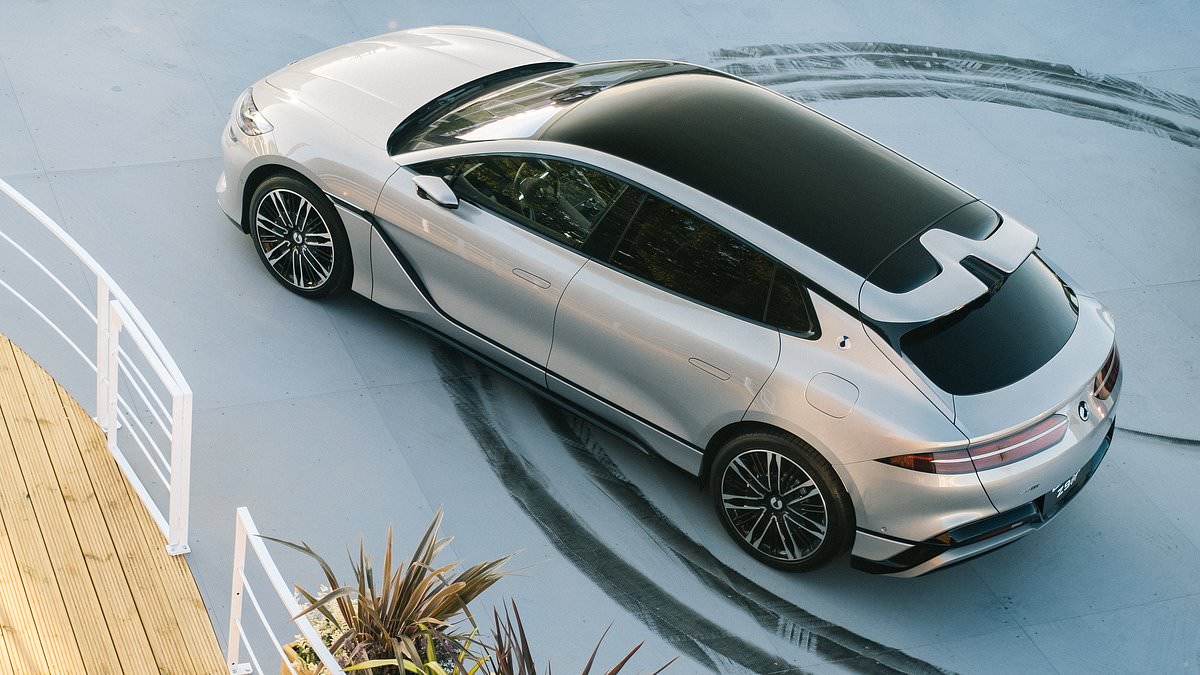
A third of drivers feel anxious or even downright scared about parking.That's according to a study by Korean car giant Kia published earlier this year.The research found that one in three Britons consider bay parking the most difficult manoeuvre, while almost two-thirds believe parking spaces simply aren't wide enough for modern cars.A separate report by Fiat, published months earlier, also suggested that 44 per cent of UK motorists suffer from what it called 'parallel-o-phobia' - a clearly made-up term for the fear of parallel parking.With drivers' stress levels clearly heightened by parking, many will be overjoyed to learn that car makers are developing technology that could make their lives infinitely easier.These systems are far more advanced than the automated parking features fitted to luxury cars over the last decade, where vehicles steer themselves into empty spaces but still rely on drivers to operate the accelerator and brake.Manufacturers, particularly those in China, are now taking things a step further to make parking a far simpler task.Here are five systems aiming to revolutionise parking in the years ahead. The Denza Z9GT is a £100,000+ luxury electric sports saloon from China with plenty of tricks up its wheel arches. And one of these is a parking system like no other...1. Denza Toe Out RotationDenza is one of the latest Chinese brands to emerge, though it is owned by a name many motorists will already know: BYD.Denza is the EV giant's luxury, technology-focused spin-off. And that's reflected in its prices, with its debut model, the Z9GT shooting brake, costing from around £105,000.The stylish premium family car is blisteringly fast, exceptionally quick to charge and packed with cutting-edge driver-assistance systems, including one of the most eye-catching parking technologies currently on sale.Because the 1,140bhp EV has an electric motor driving each wheel, they can all be controlled independently.That means one wheel can rotate extremely quickly while another spins in the opposite direction or remains locked altogether. The Toe Out Rotation lets a motorists drive nose-first into a parallel parking space with the rear end still sticking out in the road. But by spinning the wheels in different directions, it scuttles the back end into the space The system means drivers can squeeze into the tightest parallel parking bays... though it will limit the life of the tyres if used too oftenThe result is a car that can almost rotate around its own axis and manoeuvre itself into the tightest parking spaces.Using the oddly named Toe-Out Rotation function, the car can identify a parallel parking space only marginally longer than its 5.2-metre body.The car first steers its nose into position, with the rear still protruding into the road.By activating the Toe-Out Rotation system, the wheels then perform a moonwalk-style manoeuvre, shifting the rear of the vehicle sideways so it slides neatly into the space. The Yangwang U8 is a luxury SUV that costs the equivalent of £120,000 in China. If it were to be sold in the UK, it would likely cost north of £200k The 3.5-ton SUV's party trick is its 'Tank Turn'. The rear wheels spin in opposite directions and one of the front wheels drives in reverse to rotate the giant SUV up to 360 degrees2. Yangwang Tank TurnWho is Yangwang, you ask?It's yet another premium sub-brand from BYD, this time focused on high-end SUVs.Its flagship U8 is enormous, measuring 5.3 metres long, 2 metres wide and 2 metres tall. It also weighs around 3.5 tonnes before passengers or luggage are added.No wonder it needs some clever technology to help owners park it.Like the Denza Z9GT, each wheel is independently driven, allowing it to perform some remarkable tricks.One of these is called the Tank Turn.This is where the rear wheels spin in opposite directions and one of the front wheels drives in reverse to rotate the giant SUV on the spot, effectively turning it within its own footprint.That means a nervous driver wanting to reverse into a bay at the supermarket can simply position the vehicle perpendicular to the empty space.Activate Tank Turn and the Yangwang can pivot through 90 degrees, allowing the driver to reverse straight into the bay.How quickly it wears through tyres, however, remains open to debate.Denza uses the same system on its models, too, but calls it a Compass Turn. Enjoy your trip! Mercedes and Bosch have co-launched a driverless parking function at a German airport. Once the owner walks away, the car will take itself to a pre-booked space within the multi-storey car park Owners drive to a parking garage, remove their luggage and then send the car to a pre-booked spot using the Automated Valet Parking feature in the Mercedes smartphone app Drive Pilot is available in luxury models like the S-Class (pictured) and EQS electric saloon. Both are high-end luxury saloons kitted out with a multitude of sensors and radars to direct the tech The system has debuted at Stuttgart Airport (pictured) and is the world's first fully-automated parking system in a public place3. Mercedes Intelligent Park Pilot airport valetNot to be outdone by its Chinese rivals, Mercedes offers one of the most advanced self-parking systems in the world. The catch is that, for now, it can only be used in one location.Intelligent Park Pilot has been developed with Bosch and is the first commercially approved self-driving airport parking valet system after receiving the green light from Germany's Federal Motor Transport Authority.Owners can drive to the dedicated valet parking level at Stuttgart Airport, unload their luggage and then send the car to a pre-booked bay using the Automated Valet Parking feature in the Mercedes smartphone app.Once the driver has left the car park, the vehicle drives itself to its assigned space and parks autonomously.When the owner returns, a command issued via the app summons the Mercedes, which drives itself back to a designated pick-up point.The technology relies on sensors embedded throughout the parking structure to detect obstacles and communicate with the vehicle.For now, it is only approved for use in Stuttgart Airport's P6 parking garage, the sole location where the system is installed.That means premium Mercedes models, including the S-Class, E-Class, EQS, EQS SUV, EQE and EQE SUV, can autonomously navigate ramps and move between floors without a driver on board. Chinese tech giant Huawei has developed a self-driving feature that allows cars autonomously move between over one million car parks in the country4. Huawei Parking Lot to Parking LotLike Mercedes, Chinese technology giant Huawei has developed an Airport Valet Parking system currently operating at Shenzhen Bao'an International Airport.It allows drivers to drop off passengers and luggage before the vehicle drives itself to a parking space. Like the Mercedes system, the car can later return autonomously to a collection area when summoned by its owner.But Huawei has taken the concept much further with a feature called Parking Lot to Parking Lot, or Park-to-Park.Think of it as self-driving between car parks.With more than one million Chinese parking facilities covered by Huawei's Qiankun ADS intelligent driving network, drivers can instruct the car to leave one parking space and navigate to another, potentially hundreds of miles away.The driver must remain in the vehicle and be ready to take over whenever requested, but the system is capable of handling long-distance journeys with minimal intervention.It can navigate out of a parking bay, even from underground car parks, before driving on urban roads and motorways using Huawei's NCA Navigation Cruise Assist technology.Upon reaching its destination, the vehicle can enter the car park, search for an available space and park itself.The system also features machine-learning capabilities, allowing it to improve routing and parking behaviour based on frequently visited locations. BYD's so confident in its autonomous parking system that it has pledged to cover any damage caused while the system is in operation5. BYD God's Eye and Intelligent ParkingChinese EV giant BYD recently confirmed that its God's Eye advanced driving system now supports highly autonomous parking functions under specific conditions.The technology builds on the car maker's existing Advanced Driver Assistance Systems (ADAS).It combines cameras, radar, ultrasonic sensors and, on higher-spec versions, LiDAR to create a detailed picture of the vehicle's surroundings, allowing it to undertake self-driving functions where conditions permit.The Intelligent Parking function can carry out complex parking manoeuvres automatically and even supports valet parking similar to the systems offered by Mercedes and Huawei.God's Eye has quickly earned a reputation as one of the most advanced mass-market driver-assistance systems currently available.And to demonstrate its confidence in the technology, BYD has pledged to cover damage caused during autonomous parking if a collision occurs while the system is operating. CARS & MOTORING: ON TEST
How car makers are making parking easier for you: From tank-turning EVs to automated airport valets
Full Article
Original Source
Read the full article at Dailymail →KhanList aggregates and links to publicly available news content. We do not host full articles from third-party sources. Always verify important information with original sources.