
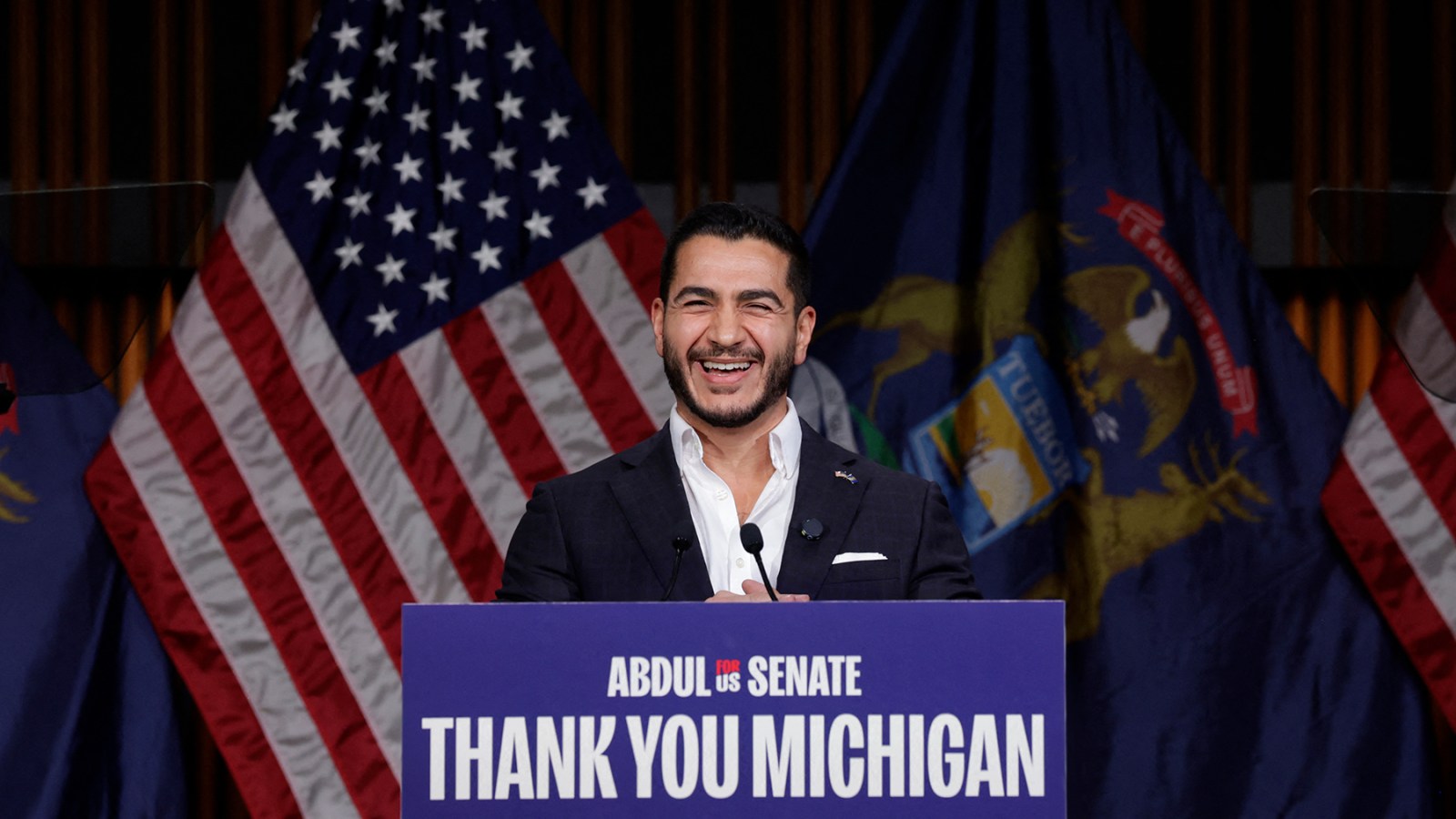
The state's Senate race was one of the ugliest in recent memory. In the end, "the bad guys lost," as the progressive put it on Wednesday Abdul El-Sayed endured an ugly amount of hate during his senate campaign. Let us count the ways. President Trump said he was in Michigan because “I’m here to keep a jihadist Muslim Brotherhood member from becoming a United States senator.” Vice President JD Vance declared him a little weasel who should shut his mouth and show a little gratitude to the country that gave him everything. Republican Senator John Kennedy proclaimed that El-Sayed slept in a Bin Laden jersey as Mike Rogers, El-Sayed’s Republican opponent, laughed along and later falsely stated that El-Sayed said America delivered 9/11. Rogers then said “the data” proved he had terrorist ties. None of it was true. And then Haley Stevens, his defeated primary opponent, pulled the ultimate heel turn, endorsing Rogers days before the election. Not unrelated, AIPAC dumped at least $50 million to defeat him. In short, if ever a candidate was entitled to give a “fuck the haters” victory speech, it was El-Sayed early on Wednesday morning. He did not disappoint. He machine-gunned his enemies beginning with Rogers. “Mike, enjoy your retirement. I know you got a house in Florida and two yachts. See, you chose hate, and Michigan chose hope. May we never have to see the likes of you in the state again.” He told the Ohio native Vance, “There is this delicious irony in the fact that you’re constitutionally obligated to swear me in in January. So you know that means Wolverine one, Buckeye zero.” And then he turned to the president. “Donald, look, I know you struggled with my name. So after JD swears me in in January, you could just go on and call me senator.” The crowd went nuts. Mind you, this was after El-Sayed talked about the struggling mother with two kids working about health insurance and the UAW worker who had seen his wages stagnate. You won’t see much of that soaring rhetoric quoted today. That’s the other side of El-Sayed. He gave his victory speech last night in downtown Detroit at The Department, an event space built on the desiccated bones of the flagship store for Hudson’s, a once-proud department store chain where my mother once worked and an iconic representation on a state that has fallen on hard times. It is located about five miles from where I first met El-Sayed in 2020 on the remains of another once proud Michigan institution, the shuttered Detroit’s Herman Kiefer Hospital, formerly a magnificent medical center for the poor and desperate. We stood near abandoned filing cabinets and rat-infested offices, discussing a pandemic that was exposing everything America preferred not to know about itself, namely the virus was exponentially more fatal for Detroit’s poor and uninsured. El-Sayed had a front seat for it as an epidemiologist and the former medical director for the city of Detroit. Editor’s picks We talked about how the Democratic Party could possibly count on the votes of the poor and dispossessed in the future if their Covid experience was our country’s recent and worst example of what they got back for their support. “Votes have to be earned,” El-Sayed told me. “There has to be a message sent of how we are going to make the future better, how it is going to be different.” Six years later, El-Sayed tried to answer that question. If you turned off your TV and the social media feeds of both his opponents, you could hear it. “Money out of politics, money in your pocket, and Medicare for All” was the slogan, one that was both accurate and so repetitive that I began to dread it as much as the Cars-4-Kids jingle as I followed his campaign. The pitch required no elaborate translation: Your life is too expensive, and your government only listens to the people paying for campaigns. These are not coincidences. Related Content In the Upper Peninsula, El-Sayed and Alexandria Ocasio-Cortez listened as mothers talked of having to drive hundreds of miles to deliver their babies. In Saline, I watched him console crying residents distraught over a giant data center plowing over cornfields without their consent. Unfortunately much of that talk was drowned out by the endless data center-like drone of ugliness as much of conservative America went into full-freakout over the idea of El-Sayed becoming the first Muslim-American in the United States Senate. The American Israel Public Affairs Committee weighed in early and often, backing the campaign of Stevens, a cartoon character who became an even larger cartoon character. El-Sayed’s campaign saw an opening and mobilized much of his campaign into a referendum on America’s Israel policy and Israeli influence on American policy. El-Sayed partnered with the hugely popular Hasan Piker, a modern shock jock who inspired young progressive voters while uttering the occasional toxic statement —it was Piker who implied America deserved 9/11 — which, I guess, is what happens when you livestream six or seven hours a day. The vitriol became farce by the end with Stevens becoming a reality-tv character threatening to pull her endorsement over an ugly anti-Israel ad run not by El-Sayed but by — sigh — Piker’s uncle Cenk Uygur. Stevens switched sides Sunday, appearing with Rogers at a black church. This was kind of like throwing your hand in with Napoleon while he was dying on St. Helena. Within a few hours, Stevens’ staff quit, she was denounced by the Democratic Party and was last seen wearing an enormous sun hat on a bleak Michigan November day as she headed to vote. With all that going on, it was understandable and awesome to hear El-Sayed proudly standing up for his Muslim heritage in his speech. “My name is Abdulrahman Mohamed El-Sayed, and I am so proud and honored to stand here as your senator-elect from the great state of Michigan. Up until right about now, you might have noticed I always say “Inshallah” or “God willing,” whenever the outcome of this race was mentioned. But today, tonight, we can turn that “Inshallah” into Alhamdulillah.” (Arabic for “Praise be to God.”) His victory speech had its Festivus moments, allowing for the airing of grievances. He thanked AIPAC for the opportunity to beat it twice. He described his opponents’ effort as an attempt to make his name and religion stand in for an argument about the country which they could not win. “They might have been pointing to my name and my faith, but we all know that my name and my faith aren’t the reason you can’t afford your gas,” he said. “Not the reason you can’t afford your groceries. Not the reason you can’t see a doctor.” It brought me back to a black Detroit church right before the primary. There were no cameras. A mother wailed for her child lost to gun violence. After the speeches, El-Sayed and his wife, Sarah, went over and hugged her. Then, he listened more than he talked — a big part of the job awaiting him. That all could wait for another day. Last night, El-Sayed summed up his victory by telling parents how to explain the night to children who had watched his opponents’ sneering racism and insinuations that the color of your skin made you less of an American. El-Sayed smiled. Trending Stories “Let them know tomorrow that the bad guys lost.”
How Abdul El-Sayed Overcame the Hate and Won Big in Michigan
Full Article
Original Source
Read the full article at Rollingstone →KhanList aggregates and links to publicly available news content. We do not host full articles from third-party sources. Always verify important information with original sources.