
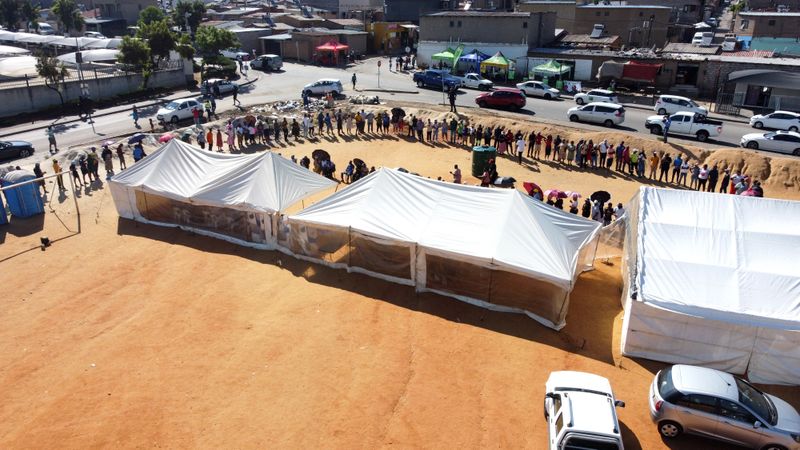
The Independent Electoral Commission (IEC) had declared a “war on queues” for the 2026 local government elections. It meant a quicker voting turnaround for many on Wednesday, 4 November. According to the IEC, more than 29.2 million eligible voters registered to vote across 23,696 voting stations nationwide and, by 10am, 3.5 million had already voted. The IEC introduced stricter voting protocols, mandating that voters could vote only at the station where they were registered. Data from the IEC confirmed that fewer than 1% of voting stations opened late, with stormy weather affecting most of those. IEC Chief Executive Officer Sy Mamabolo said the commission had trained its volunteers and supplied them with new equipment, including handheld barcode scanners and sequence numbers to ensure that voters would be processed quickly. IEC chief electoral officer Sy Mamabolo briefs the media at Hyde Park High School in Johannesburg before the arrival of President Cyril Ramaphosa. (Photo: Naledi Mashishi)“This work you see unfold today is a culmination of efforts of many good men and women over the past few years, at least. We have a war on queues today. We have ensured that we train up and … the equipment we use will facilitate the management of queues,” he said during a site visit to Hyde Park High School in Johannesburg, minutes before President Cyril Ramaphosa arrived to cast his vote.Preliminary data from the IEC indicates this faster turnaround time may have had an impact. By 4pm, 40% of registered voters had cast their ballots, compared with 44% overall in the 2021 local government elections.At a media conference in Midrand, Mamabolo confirmed that by 5pm, preliminary figures showed that 12 million voters had cast their vote. Gauteng recorded the highest number of voters at three million, followed by KwaZulu-Natal at 2.5 million, Western Cape at 1.5 million, Eastern Cape at 1.4 million, Limpopo at 1.1 million, Mpumalanga at 854,901, North West at 702,137, Free State at 588,237, and Northern Cape at 299,381. Mamabolo said the commission was pleased with the voter turnout at the many stations across the country. ‘Largely smooth voting’Voting under way in Alexandra, Johannesburg. (Photo: Felix Dlangamandla) Voters across the country told Daily Maverick about their largely smooth voting experiences, although some faced a long wait. While queues varied between voting stations, several voters praised election officials for keeping the process organised and ensuring that lines continued to move.In Benoni, 24-year-old nurse Kiara Geldenhuys said she had a quick voting experience at her local voting station, arriving in her nursing attire before heading to her shift at Linmed Hospital’s critical care unit.“I got to jump the queue because of my work,” she said, laughing.In Stellenbosch, 23-year-old Hope Watt said she and her family arrived at their voting station around 6am before heading off for the day.‘Organised and pleasant’She said election officials were organised and pleasant. Her group was among the first voters in the queue. Although voting began slightly later than expected, Watt said older voters were prioritised.By about 7:45am, she noticed a significantly longer queue forming outside the station.However, she said the situation appeared to ease as the morning progressed, with voters later able to enter, cast their ballots and leave without lengthy delays.Her mother and sister also reported a quick voting experience at a station in Onrus, Hermanus, where they reportedly spent about 10 minutes casting their ballots.Meanwhile, Nonny Beale said her experience at a local high school voting station was similarly positive, although she had a long wait. After arriving at about 7am, Beale said she waited about 75 minutes before casting her ballot.She praised the atmosphere among voters, describing people as friendly and relaxed, while also noting that party activities remained outside the school grounds.“People were smiling, happy, making friends,” she said.Beale said election officials explained and demonstrated the voting procedure, including the stamping of ballot papers, before she completed her vote. She was back home by roughly 8:30am.Long distances for somePart of a voters’ queue in Observatory, Cape Town, on 4 November 2026, that spanned more than two blocks. (Photo: Righard Kapp) However, the new system produced some hiccups. One was reported by Rise Mzansi leader Songezo Zibi, who took to his personal X account to state that for some voters, their new voting district had shifted to “unmanageable distances”.“After this year’s round of voter registrations, some people were shifted from where they normally vote to another voting station within the same voter district. For some, the distance was manageable; for others, it was not. I was one of those,” Zibi posted. He said some voters were moved more than 5km from the voter district they had previously registered at, while his mother was moved more than 45km from her previous station. This resulted in some stations having longer than normal queues and others being unusually empty. “The franchise is a fundamental right. The IEC was charged with making it accessible. Long distances make it inaccessible,” he said. 21/2-hour waitVoters wait to cast their ballots at MTR Smit Children’s Haven, Springfield, Gqeberha on 4 November 2026. (Photo: Deon Ferreira) Some stations reported lower-than-usual voter turnouts. One of these was Wits University in Johannesburg. An IEC official, who did not wish to give their name, told Daily Maverick that many students began queuing from 5am, with the queue growing by 7am. However, by the late afternoon, the numbers had dwindled. The official said the turnout was “not that high” since students were studying for exams, with some scheduled to write in the morning. Some voters also reported long waits. Mikayla Ross, 26, said she waited roughly two-and-a-half hours to cast her ballot in Benoni, but described the experience as a reminder of the importance of civic participation.“Although it was a long wait time, my biggest takeaway was how proud I am to be South African and how proud I am to be a part of a community that shows up for change,” she said.A similar wait was reported by 23-year-old Nonhle Mchunu, who voted at Dainfern College in the Fourways/Midrand area.Mchunu arrived at about 6:15am, before the official opening of voting, and said there appeared to have been a slight delay before voting got under way.However, she said the process improved once voting began, with seven voting rooms, each containing three voting stations, helping to manage the flow.“Once the voting started, the process was incredibly smooth,” she said, adding that election officials were helpful in keeping queues moving.After voting day, IEC officials are expected to announce the results within seven days, while new mayors are expected to be elected within 14 days. DM
LOCAL GOVERNMENT ELECTIONS 2026: New protocols and tech kept lines moving, but some voters still faced long queues
Full Article
Original Source
Read the full article at Dailymaverick →KhanList aggregates and links to publicly available news content. We do not host full articles from third-party sources. Always verify important information with original sources.