
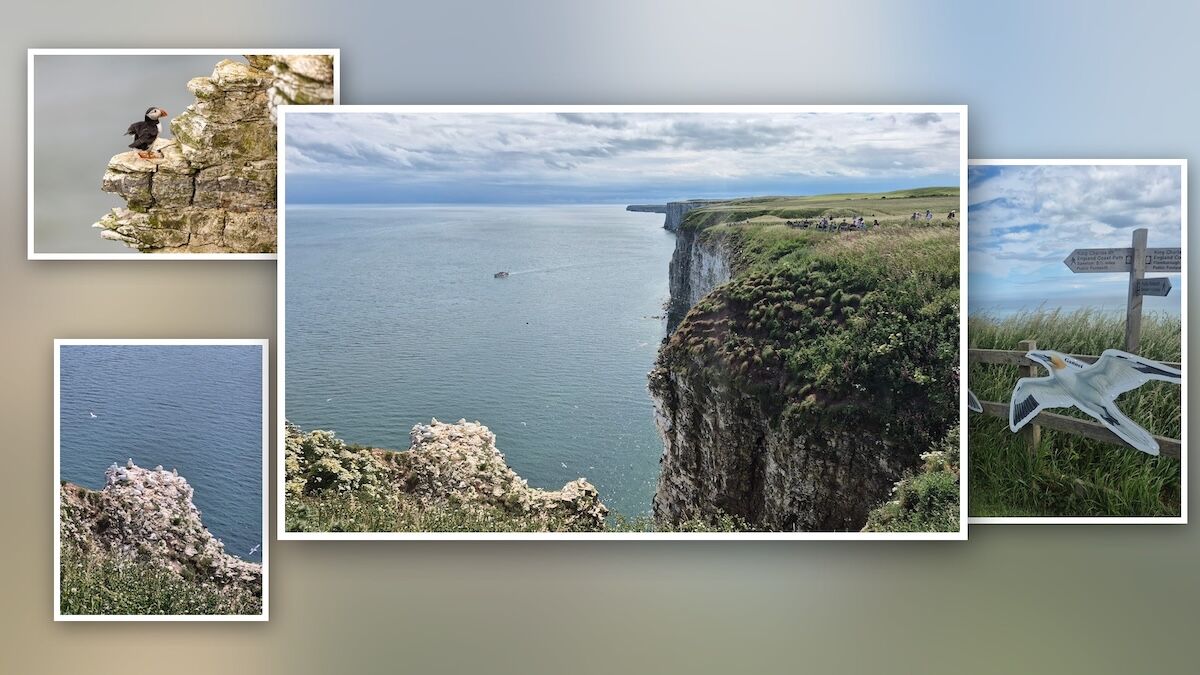
Bempton Cliffs is one of 220 nature reserves in the United Kingdom managed by The Royal Society for the Protection of Birds (RSPB). An independent conservation charity born from a 19th-century campaign against the use of feathers in fashion, these are places to encounter birds while learning about environmental stewardship. As natural attractions and cities face pressure from overtourism, the RSPB’s reserves operate on a different model: the organization relies on membership subscriptions, donations, grants, and visitor income to fund its work. Visiting these reserves can also mean contributing to its protection and keeping a sustainable cycle going. Where puffins fly, humans flock Around half a million seabirds gather at these chalky cliffs on England’s northeast coast between March and August. Peak viewing season for Atlantic puffins (roughly 1,500 breeding pairs) runs from May until June. The so-called clowns of the sea share the bluffs with England’s only mainland gannet colony and kittiwakes, guillemots, and razorbills. One time, we spotted a short-eared owl watching us from the grasslands, which led to a lively debate over its identity. “Experiencing the joy of listening to birdsong or watching wildlife builds a connection, and the reality is people are far more likely to want to protect what they love and value,” says Neil Boyes, the Head of Visitor Operations for the RSPB. This rings true: there is a real sense of camaraderie at Bempton Cliffs, which I think is partly why my family and I keep returning, even during winter when we know full well we won’t see a puffin. Strangers help each other pinpoint birds through rented binoculars; volunteers share news of recent sightings and surrender their camera rolls. Favoring cliffside crevices and grassy burrows, and with a wingspan of around 20 inches, puffins don’t make it easy. Marked trails, overlooks, and hides mean visitors get to observe birds at RSBP reserves without disturbing them, while special events go deeper into species behavior and conservation. “Guided birding walks, pond dipping, small mammal safaris, and binocular open weekends are just a few of the regular events taking place across reserves,” says Boyes. “Being as inclusive as possible means catering for people who’ve never set foot on a nature reserve before just as much as expert birders.” Wildlife as the reason to travel Bempton has the only mainland gannet colony in England. Photo: Hannah D. Cooper Minsmere was established as one of the RSPB’s earliest reserves in 1947, when, for the first time in over a century, avocets were seen breeding on the Suffolk seaside. As it turned out, the defensive flooding of coastal pastures during the Second World War was an unintentional step towards restoring the wetlands these elegant wading birds depend on. Under “Operation Zebra,” a group of former soldiers monitored the avocets and the bird is now represented in the RSPB’s logo and included on the UK’s Birds of Conservation Concern Amber List. A similar story followed in 1954, when a pair of ospreys was spotted nesting in the Abernethy Forest — now part of Scotland’s Cairngorms National Park. In their case, the birds of prey had been hunted to extinction as a breeding bird in Great Britain. Yet again, the RSPB stationed volunteers (civilians, this time) to guard the nest around the clock. Within a few years of “Operation Osprey,” Loch Garten was opened, attracting 14,000 visitors in less than two months and continuing to receive nesting pairs every summer. Volunteers remain central to the RSPB. According to Boyes, around 12,000 people contribute their time to the conservation charity. Besides helping us visitors locate and identify birds, they carry out crucial habitat management and wildlife surveys that support the RSPB’s science-backed conservation. “At Loch Garten, that could take any number of forms, from helping a young child to enjoy a moment in nature which most of us might take for granted, right through to explaining the finer details of what habitat management techniques we use to support Capercaillie and other pinewood wildlife,” says Boyes. The conservation loop Species for scale. Photo: Hannah D. Cooper Emily Williamson, Etta Lemon, and Eliza Phillips laid the groundwork for the RSPB as they lobbied against the extraction of plumes, and the charity continues to campaign for the protection of birds and wildlife habitats. Climate change and overfishing are leading reasons why puffins are one of 70 species on the UK’s Birds of Conservation Concern Red List, the highest category of conservation concern. After 25 years of campaigning, driven largely by the RSPB as well as other organizations, a ban on industrial sandeel fishing in 2024 could see the seabirds, along with kittiwakes, turn Amber. “Wildlife in the UK is in serious trouble, with one in six species at risk of extinction in Great Britain,” says Boyes. “If there was one message I’d want visitors to our reserves to leave with, it’s that taking action to help save nature is something every one of us can do and the need has never been greater. We know that engaging more people in saving nature and inspiring them to take action is essential if we’re to deliver conservation at the scale needed.” Visiting a RSPB reserve: a reason to return Photo: Hannah D. Cooper Visiting the reserves (over 170 are open to the public) can also boost local economies. Invest East Yorkshire reported 135,561 visitors at Bempton in 2025, an 18 percent increase on 2024, which can positively impact footfall at independent restaurants and hotels in this lesser-visited part of England. As part of their partnership with the RSPB, whereby each booking contributes to restoring one square meter of woodland, the Certified B Corporation Holiday Cottages promote rentals close to reserves. With my parents being non-drivers, we appreciate that many reserves are accessible by public transport: the website lays out the options for car, bus, train, and bicycle. The one-mile ramble from the train station turns our annual, or sometimes biannual, outing to Bempton into a full day out, with the option to hop off the train at Filey or Bridlington for a bag of fish and chips. We’ll keep returning to Bempton, whether the puffins are in residence or not. The appeal feels less about ticking a species off a list, and more about having a place to return to, knowing we are making even a small contribution to conservation. More like this
How a Trip to Yorkshire’s Puffin Cliffs Can Help Save Britain’s Seabirds
Full Article
Original Source
Read the full article at Matadornetwork →KhanList aggregates and links to publicly available news content. We do not host full articles from third-party sources. Always verify important information with original sources.