
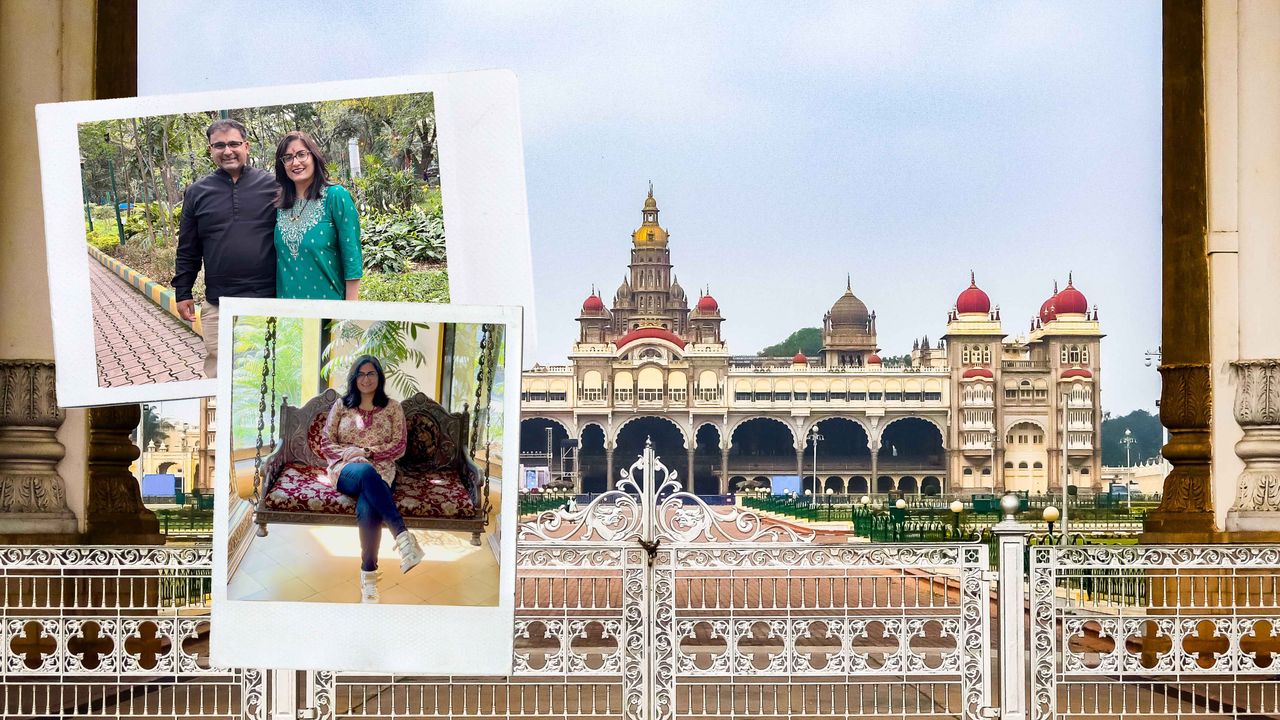
After spending nearly 25 years away, Tina Aswani-Omprakash, 43, finally traveled back to India, confronting long-held fears about traveling with Crohn’s disease. Along the way she reconnected with her roots, her family, and the food she had spent years afraid to eat. Following more than 20 surgeries and years of debilitating illness, going on the trip was a hard-won milestone for Aswani-Omprakash, made possible through careful preparation and her doctors’ support. Involving everything from exploring historic palaces and temples to meeting some relatives for the first time, the experience reminded her how travel can help us feel connected to culture and live life to the fullest. Here is Aswani-Omprakash’s story, as told to health writer Katie Camero.The tuk-tuk ride up the Chamundi Hills near Mysuru, India, took about half an hour. My husband, brother-in-law, and some of my colleagues were split between two rickshaws, winding our way up a massive hill toward the Chamundeshwari Temple. I used to love taking tuk-tuks as a kid, but at age 41 I found that the ride felt like so much more than a fun adventure.I could feel the air on my face, and I remember thinking, I can’t believe it, but I’m really doing this. After over 20 surgeries and some near-death experiences, I had somehow worked up the courage to travel and live my life again.Gopuram of Sri Chamundeshwari Temple, Chamundi Hill, Mysore, Karnataka, South India GettySince childhood I’ve experienced a lot of what doctors call extraintestinal manifestations, which are symptoms that occur when an inflammatory bowel disease (IBD) affects parts of the body outside the gut. I dealt with issues like severe joint pain and eye issues alongside constipation and GERD, but at the time doctors didn’t think to refer me to a gastroenterologist. The discomfort and unpredictability of my condition meant I was always scared to travel, even if it was just a road trip.The last time I visited my family in India was in 2000 at age 16. We took a day trip from New Delhi to the Taj Mahal and ended up eating street food because we were starving. We all got sick, but I fared so much worse than the others and lost about 20 pounds in the weeks that followed because I was so ill. I eventually was diagnosed with IBD—specifically, ulcerative colitis—in 2006. (Although later I learned I actually had a different type of IBD.) Nearly two years later, my husband, who was my boyfriend at the time, took me to Mexico and we both came down with traveler’s diarrhea after eating some sliced fruit. He threw it all up and recovered just fine, but it took me months to get better.What followed was a lot of pain, shame, and silence. I worked on Wall Street at the time as a financial-services compliance officer, and it was very tough to figure out the diagnosis, accept it, and try to get on medication while navigating such a stressful career. I was on disability for many years before I eventually had to stop working. I didn’t know what to do with my life because I truly thought this disease and the complications associated with it would kill me.Over two years, my condition went from mild to severe. During this time I experienced severe bleeding, weight loss, and other debilitating symptoms. I finally had my colon removed on July 4, 2008—which I often call my very own Independence Day. However, complications from this operation, as well as my IBD itself, required me to have dozens of additional operations including one to create a permanent ileostomy in 2011. It was through this process that I learned I actually have Crohn’s disease, another type of IBD.It wasn’t until late 2024 that my doctors finally gave me the green light to travel to India—and I was terrified. The extra-long flight plus cuisines that include many trigger foods for my condition created a hurdle I worried was impossible to overcome. Although I had taken a few trips around the U.S. and Europe since my diagnosis, I had not conquered my fears of traveling back to India and enjoying the foods my family and I love without getting sick.Tina Aswani-OmprakashAfter all this time, I thought I couldn’t do this because of my Crohn’s disease. Yet there I was almost 25 years later. I did it—albeit with lots of preparation.My doctors did an intestinal ultrasound and other tests to make sure nothing was brewing in my gut, and they gave me antibiotics, steroids, and probiotics in case I had a flare-up or bad case of traveler’s diarrhea. My husband and I also booked a hotel, which our relatives didn’t love, but it gave me easy access to filtered water (tap water could have been contaminated with harmful bacteria that could make me really sick) and a private bathroom in case I needed to make frequent trips overnight, along with other perks that kept us feeling safe and comfortable. I stayed clear of street vendors and only ate hot foods to reduce my chances of getting ill.Even with those restrictions I enjoyed delicious, authentic food. In Mysuru, there’s a restaurant called MTR that offers South Indian cuisine like dosas, which I love. Though the lentil soup they come with can be a little spicy (a common IBD trigger), you can ask for a plain dosa with potatoes inside, which actually works pretty well for people with IBD. It’s a good way for us to enjoy the local cuisine while avoiding a flare-up.Though it may seem like a lot of work, it honestly felt like such a huge accomplishment to go back to where my family is from and connect with my culture and relatives, some of whom I’d never met before, without getting sick.Tina Aswani-OmprakashHowever, it took a lot to get to that point. I faced many cultural challenges, not just during my journey to a diagnosis but also to starting treatment. My family survived the 1947 partition of India and Pakistan—my relatives were displaced from Pakistan and became refugees in India. As a result my family lost their trust in the West, and they certainly did not trust Western medicine. My condition got more severe than it needed to because my family was so against medicine or surgery. Marriageability and how others will perceive the family is also something my community worries about a lot. So I had to consider how my diagnosis would impact my sibling’s ability to find partners.I felt a lot of fear as well because my dad died when I was 8 years old from Crohn’s disease that turned into colorectal cancer. Despite having this family history, I had to do a ton of self-advocacy to finally get the colonoscopy that started to give me much-needed answers and treatment options.Through all of this I’ve learned that fear is just a mindset and we can accomplish whatever we want if we believe in ourselves. It also really takes a certain mindset to travel such a long distance and eat foods you haven’t been able to eat in so many years without feeling completely terrified you’re going to get sick.Tina Aswani-OmprakashBecause of the stigmas I faced in my own journey with IBD, I co-founded, alongside other patient advocates and clinicians, the Strategic Alliance for Intercultural Advocacy in GI, a nonprofit that offers culturally sensitive resources for patients with GI conditions, caregivers, and health care providers to improve treatment and access to care. Many patients I speak with ask why I push past my comfort zone through my travels. My answer is simple: It makes me feel alive. With everything I went through in my 20s and 30s with this disease, I felt like I wasn’t really living. But when you go through so much disability, all you want to do is feel alive again.Of course, trips like these aren’t feasible for everyone with inflammatory bowel disease. But if you start slowly, you might just surprise yourself. Growing with and owning your chronic illness is a process, and travel has helped me with that immeasurably.
How a Trip to India Helped Me Find Peace With a Life-Changing Diagnosis
Full Article
Original Source
Read the full article at Cntraveler →KhanList aggregates and links to publicly available news content. We do not host full articles from third-party sources. Always verify important information with original sources.