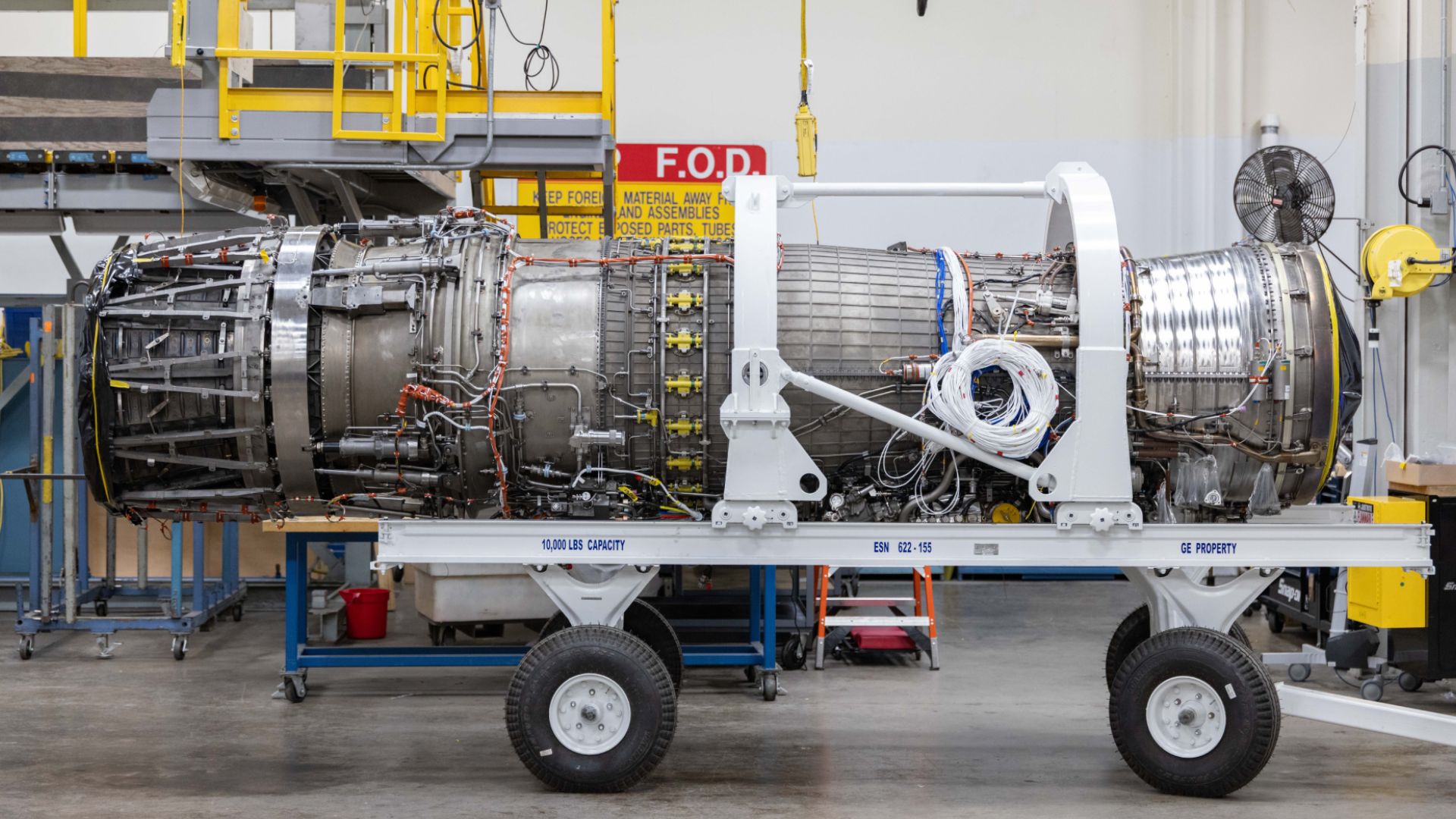
A piece of aerospace hardware developed and flight-tested more than three decades ago is being given a very different job: helping an autonomous aircraft take off and land vertically without a runway. Shield AI and GE Aerospace have integrated and tested an Axisymmetric Vectoring Exhaust Nozzle (AVEN) with the GE F110-GE-129E engine being used in the development of Shield AI’s X-BAT unmanned combat aircraft. The unusual part is that the AVEN hardware itself traces its origins to a 1990s thrust-vectoring research program and was refurbished and returned to operation for the X-BAT effort. The story is therefore not simply about reviving an old design. It is about taking flight-tested propulsion technology developed for one problem, improving fighter maneuverability, and adapting it to solve a very different one. Controlling an aircraft during vertical flight. Shield AI‘s X-Bat Drone is designed for Vertical takoff. From an F-16 test program to X-BAT AVEN, short for Axisymmetric Vectoring Exhaust Nozzle, was developed to investigate multi-axis thrust vectoring. The ability to redirect engine exhaust in multiple directions rather than simply producing thrust straight backward. Traditional aircraft primarily maneuver through aerodynamic control surfaces such as ailerons, elevators, and rudders. Thrust vectoring provides another source of control by changing the direction of engine thrust itself. This can be particularly useful when aerodynamic surfaces become less effective at extreme attitudes or low speeds. Earlier two-dimensional thrust-vectoring designs used relatively flat, rectangular nozzles that could redirect thrust primarily within a single plane. AVEN took a different approach. It retained the engine’s circular, axisymmetric exhaust flow while allowing thrust to be directed in multiple directions. The technology was developed and flight-tested on an F-16 as part of a multi-axis thrust-vectoring research program in the 1990s. According to Shield AI, the original system accumulated 135 flight hours across 95 sorties, providing engineers with a substantial body of test data and experience with the technology. The F-16 involved was a test platform, rather than an operational fighter equipped with AVEN as a standard capability. Why X-BAT needs it Shield AI’s X-BAT is being developed as an AI-piloted vertical takeoff and landing (VTOL) aircraft intended to operate without conventional runways. That creates a fundamentally different propulsion problem. During normal forward flight, wings and control surfaces provide much of an aircraft’s maneuvering authority. During vertical takeoff, hover, and landing, however, the aircraft has far less aerodynamic control authority. The propulsion system consequently becomes a critical part of controlling the aircraft’s attitude. This is where AVEN comes in. By redirecting the exhaust from the F110 engine, the nozzle can provide the aircraft with the thrust-vectoring authority required for vertical flight. X-BAT’s propulsion architecture places a single jet engine along the aircraft’s centerline, with the thrust-vectoring system providing control over the direction of that thrust. The concept is particularly relevant to X-BAT’s intended operating model. An aircraft that can take off and recover vertically does not necessarily need access to a conventional airbase runway, potentially allowing it to operate from more dispersed or austere locations. The unusual part: they brought back the original hardware Perhaps the most interesting engineering detail is that Shield AI and GE Aerospace did not begin entirely from scratch. Shield AI says the original AVEN hardware was retrieved from storage, refurbished and integrated with the F110-GE-129E engine for the X-BAT development program. The teams subsequently carried out integration, actuation and engine light-off testing at GE Aerospace’s Peebles Test Operation in Ohio. The companies describe the effort as the first fully integrated AVEN test campaign since the original program more than three decades ago. That does not mean X-BAT is simply flying around with an unchanged 1990s nozzle. The old hardware is effectively serving as a flight-tested technological baseline. Shield AI says the AVEN system will continue to evolve as the aircraft develops, with future versions expected to incorporate modern materials, guidance and control systems, and manufacturing techniques. An old nozzle facing a new challenge The original AVEN program was primarily concerned with demonstrating the potential of multi-axis thrust vectoring for enhanced maneuverability during forward flight. X-BAT asks considerably more of the technology. During VTOL operations, the nozzle must help maintain the aircraft’s attitude while the aircraft is effectively balancing on engine thrust. That means rapid and precise thrust-vectoring commands become central to controlling the aircraft. The fact that the original hardware had already been designed, built, and flight-tested gave Shield AI and GE Aerospace a starting point that a completely new nozzle would not have provided. But the current milestone should not be confused with a completed VTOL demonstration. The recent work involved ground-based integration and testing, including engine light-off and operation of the integrated propulsion system. Shield AI describes this testing as clearing the way toward future vertical flight testing. Giving a 1990s technology a new mission The AVEN story is an interesting example of how aerospace technology can acquire a second life. A propulsion system conceived decades ago to investigate the limits of fighter maneuverability is now being adapted for an aircraft built around autonomy, runway independence, and distributed operations. The original program established that multi-axis thrust vectoring could work on a fighter-sized aircraft. X-BAT is now attempting to use that same fundamental capability for something considerably different: giving an autonomous aircraft the ability to lift off vertically, transition into conventional flight and eventually return to the ground without a runway.For now, the AVEN hardware has completed another important step on that journey. The next major test will be taking what has been demonstrated on the ground and proving that the system can perform the much harder job it was brought back to do. Control X-BAT in the air.Recommended ArticlesKaif Shaikh is a journalist and writer passionate about turning complex information into clear, impactful stories. His writing covers technology, sustainability, geopolitics, and occasionally fiction. A graduate in Journalism and Mass Communication, his work has appeared in the Times of India and beyond. After a near-fatal experience, Kaif began seeing both stories and silences differently. Outside work, he juggles far too many projects and passions, but always makes time to read, reflect, and hold onto the thread of wonder.
How a 1990s thrust-vectoring technology is helping X-BAT drone to take off vertically
Full Article
Original Source
Read the full article at Interestingengineering →KhanList aggregates and links to publicly available news content. We do not host full articles from third-party sources. Always verify important information with original sources.