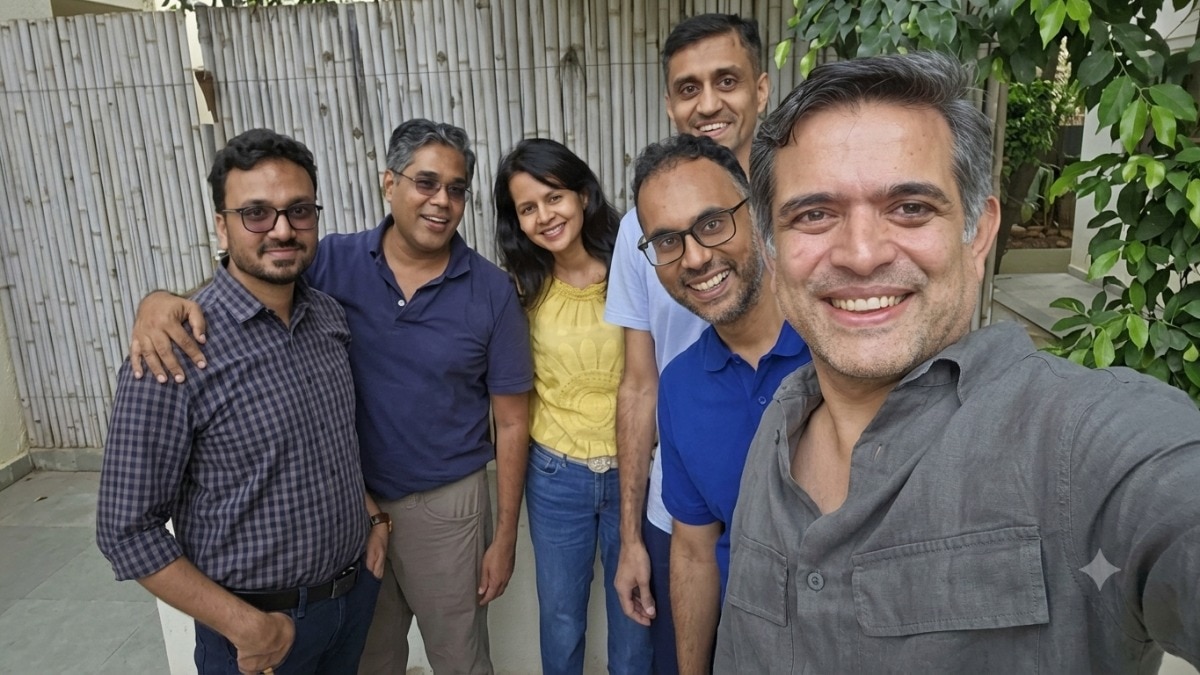
They spent over a decade designing chips, built and sold a semiconductor company, and then started from scratch to enter quantum computing. Now, Sujoy Chakravarty, Ravi Mehta and Biman Chattopadhyay are building one of India's few commercial quantum computers through their Bengaluru-based startup Quanfluence.How IIT Madras is helping 3 engineers build India's room-temperature quantum computer (In photo: 1st from R: Sujoy Chakravarty, 2nd: Biman Chattopadhyay, 3rd: Ravi Mehta, 1st from L: Sandeep Goyal, 2nd: Anil Prabhakar, 3rd: Aditi Vaidya) (AI-enhanced image)After years of working on semiconductor technology, Sujoy Chakravarty, Ravi Mehta and Biman Chattopadhyay had already achieved what many entrepreneurs dream of.Their semiconductor intellectual property company, Silicon and Beyond, was acquired by Synopsys, one of the world's leading electronic design automation companies, in 2018.For many founders, such an exit would have marked the end of a long entrepreneurial journey.For this trio, it raised a new question: could India build a quantum computer that businesses around the world would actually use? The answer led them to start Quanfluence, a Bengaluru-based deep-tech company now working on commercial quantum computing technology.A SIX-MONTH DETOUR THAT CHANGED THEIR CAREERSThe move into quantum computing was not a natural next step. Before Quanfluence, the three engineers had spent over a decade together at Texas Instruments, working in chip design and semiconductor engineering. They understood hardware, but quantum computing was an entirely new world.After their exit from Silicon and Beyond, they spent nearly six months studying different quantum technologies.They explored multiple approaches, from superconducting quantum computers to ion traps and photonics, trying to understand which technology could work best in the Indian ecosystem.Their conclusion was that photonics offered the most practical route.Unlike superconducting quantum computers, which need temperatures close to absolute zero, photonic systems use light-based technology and can operate at room temperature. The founders also saw an advantage in using telecom-grade components that India already manufactures.That decision became the foundation of Quanfluence.FROM ENGINEERING CLASSROOMS TO A QUANTUM STARTUPThe founders knew that building a quantum computer would require expertise beyond their own experience.They brought together researchers and industry professionals to create a team combining engineering, physics and product knowledge.Professor Anil Prabhakar from IIT Madras joined as a co-founder. His research on the Optical Ising Machine became central to Quanfluence's technology.Professor Sandeep Goyal from IISER Mohali contributed knowledge in quantum information theory, while Aditi Vaidya, a former product leader at Arista Networks, joined as Chief Product Officer.Together, the team began building a quantum computing platform designed for real-world applications.A DIFFERENT BET ON QUANTUM COMPUTINGWhile several global companies are investing in quantum systems based on individual quantum bits, Quanfluence has chosen a different approach.Its technology uses the electric field generated by groups of photons rather than relying on single photons as qubits.The company believes this approach can offer better reliability and scalability.Its current Optical Ising Machine can process 128 interconnected variables, while a future version is being developed to handle millions of possible combinations.The startup has also moved beyond research labs. Companies can access its technology through the cloud, and Quanfluence already has eight paying customers using its platform.The company reported around USD 400,000 in revenue in 2024 and has raised USD 2 million in seed funding.WHY THIS STORY MATTERS FOR INDIA’S TECH ECOSYSTEMQuantum computing is expected to influence industries ranging from healthcare and drug discovery to artificial intelligence, cybersecurity, logistics and financial modelling.However, building commercial quantum systems remains a challenge even for advanced technology economies.Quanfluence is among the small number of Indian companies attempting to build such systems locally.For students and young engineers, the founders' journey offers an important takeaway, expertise does not have to remain limited to one field.Chakravarty, Mehta and Chattopadhyay spent years building semiconductor technology before stepping into quantum computing. They had to learn again, question existing approaches and start from a completely new point.Their journey from chip design to quantum computing shows that some of the biggest innovations begin when experienced professionals are willing to become beginners once more.- EndsPublished By: Princy ShuklaPublished On: Jul 26, 2026 12:00 IST
How 3 engineers are chasing India's quantum computing dream with an IIT professor
Full Article
Original Source
Read the full article at Indiatoday →KhanList aggregates and links to publicly available news content. We do not host full articles from third-party sources. Always verify important information with original sources.