
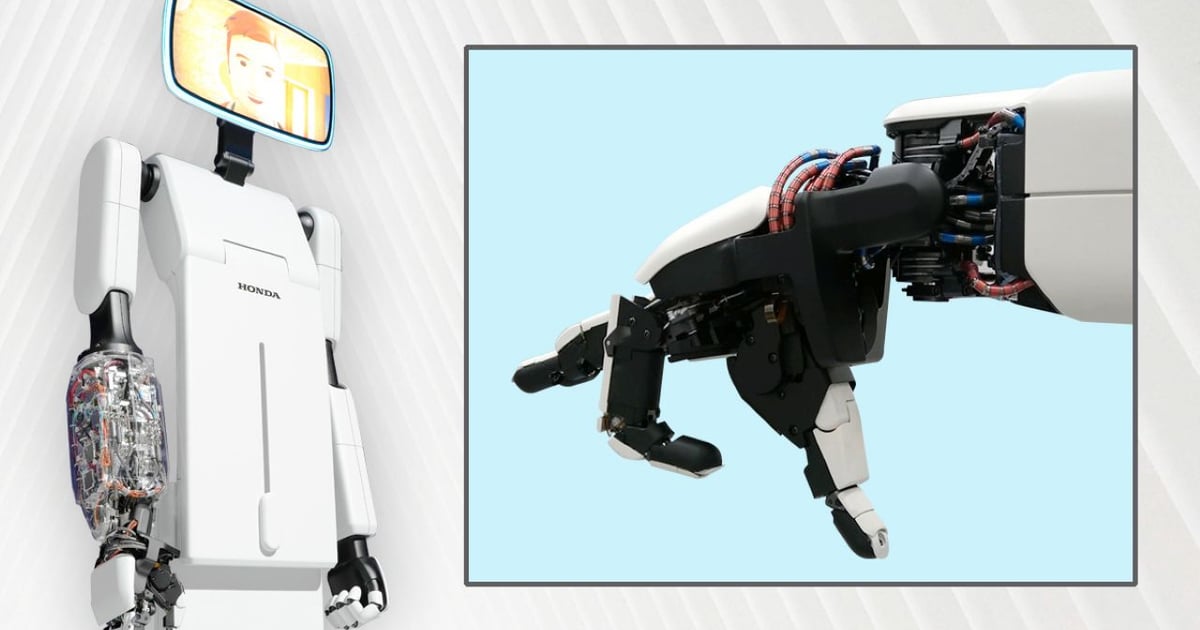
The international automobile company has demonstrated a new robotic system that enables users to perform complex tasks remotely, using a combination of dexterous robotic hands and AI-assisted controls.The company showed off its Honda Avatar Robot earlier this month at the CEATEC 2026 conference in Japan, with potential applications ranging from equipment maintenance and medical support to disaster response and space exploration.The robot is designed to closely imitate human dexterity, with 16 degrees of freedom in each of its two multi-fingered hands. Honda’s hand technology also features 16 actuated joints, up to 180 degrees per second.In previous demonstrations, the system performed intricate tasks including threading a needle, tightening a small screw and manipulating a bolt.The design aims to address a persistent manipulation problem in robotics. While machines are becoming smarter and more capable of navigating complex environments, the ability to perform intricate tasks or handle fragile objects remains a challenge for deployment.Related:Prompt: AI moves beyond the screenTeleoperation, which enables a human to control or direct a robot remotely, offers a way to bridge that gap as autonomous capabilities develop.George Chowdhury, an analyst at ABI Research, said teleoperation is “critical” for the commercial viability of humanoids.“The physical AI market today depends heavily on teleoperation due to the fragility of current AI models for robotics,” he said. “When autonomous systems fail, decision makers need the reassurance that a production line will not be down for an extended period.”And Honda’s approach could also open up applications where full autonomy is either too expensive or technically impractical, according to Abdil Tunca, an analyst at Gartner. Honda’s approach is not entirely new, he noted.“This is an unusual approach but not the first. However, Honda’s solution has more commercial potential,” he said.Potential early applications include aerospace manufacturing, electronics assembly and pharmaceutical laboratories, where complex manipulation tasks may require human judgment but do not necessarily require an operator to be physically present.However, Tunca said he doesn’t expect avatar robots to displace autonomous systems in high-volume manufacturing or warehouse operations, where repetitive, predictable tasks are more suited to automation.“My position is that the value of robotics should be measured by business outcomes, not autonomy levels alone,” he said.Teleoperation fills the gaps in autonomous roboticsHonda is not alone in relying on remote human input to make robots more practical.Related:How Boston is becoming a physical AI hubTeleoperation is already used across warehouse automation and humanoid robotics, where it can help systems recover from unexpected situations and support the collection of data used to improve autonomous performance.Chowdhury pointed to Plus One Robotics, 1X and Agility Robotics as examples.He said 1X, which plans to go live in the home setting with a robot this year, acknowledges that autonomous AI systems aren’t yet ready for these environments and intends to heavily teleoperate, capturing data as it goes, which the company will use to train foundation models.“Most humanoid vendors use teleoperation to capture training data for robotics foundation models and to ensure solution uptime,” he said. Agility Robotics, meanwhile, uses a system Chowdhury described as a “horse and rider” approach, in which a human directs the robot when it encounters an exception without necessarily taking direct control of its arms and hands.For Tunca, this shift toward human supervision rather than continuous manual control could prove crucial to making teleoperation commercially viable.“If Honda can prioritize shared control architectures where AI handles routine movements, and humans intervene only during exceptions, economics can change significantly,” he said. “The breakthrough would be moving from one operator controlling one robot to an operator controlling an entire fleet.”Related:Robot company bets touch, sound can give bots an edge over vision AIRemote operation raises labor and safety questionsThe concept of outsourcing work to remote operators, however, raises concerns about worker displacement and safety, as well as about how responsibility should be allocated when a remotely operated robot causes harm, Chowdhury said.“The concept of wage arbitration exists with teleoperation,” he said. “Say we can't get the AI to work and have to rely on teleoperation, but the latency is minimal and the humanoid is functional. It's possible that, for example, workers in Mexico could teleoperate robots in the U.S. – companies could take advantage of the lower labor costs.”Remote operation also introduces technical constraints. The time it takes for commands and sensor data to travel between an operator and a robot can affect how precisely it responds, particularly when manipulating delicate objects or working in environments where errors could cause damage.Despite these challenges, teleoperation could help bridge the gap between advances in physical AI and commercial deployment.Tunca predicted that fewer than 20 companies will scale humanoid robots into production for manufacturing and supply chain applications by 2028, again underscoring the challenges of moving beyond demonstrations to large-scale adoption.“This reinforces the need to distinguish technological progress from commercial readiness,” he said. “I believe teleoperation may play a critical role in bridging that gap, especially as a mechanism for training physical AI models through human demonstrations.”For Honda, the longer-term opportunity may extend beyond the robot itself. As Tunca put it, the company could create more long-term value from the manipulation data, AI capabilities and human-to-robot skill transfer than from the avatar robot hardware itself.About the AuthorContributing WriterScarlett Evans is a freelance writer with a focus on emerging technologies and the minerals industry. Previously, she served as assistant editor at IoT World Today, where she specialized in robotics and smart city technologies. Scarlett also has a background in the mining and resources sector, with experience at Mine Australia, Mine Technology and Power Technology. She joined Informa in April 2022 before transitioning to freelance work.
Honda demonstrates remote-controlled robot for complex physical tasks
Full Article
Original Source
Read the full article at Aibusiness →KhanList aggregates and links to publicly available news content. We do not host full articles from third-party sources. Always verify important information with original sources.