
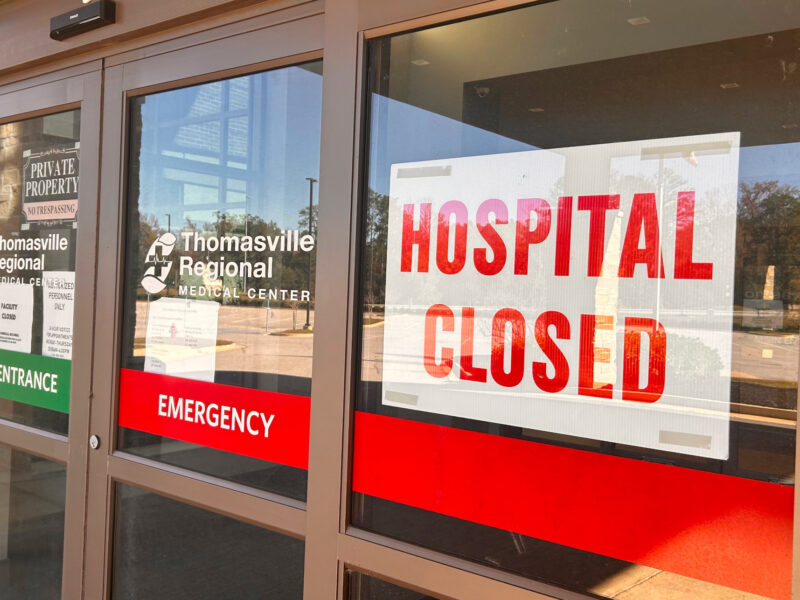
THOMASVILLE, Ala. (CN) — Pastor Jennifer Guidoni loved serving Thomasville United Methodist Church in this small town of around 3,600 in southwestern Alabama. The people were warm, the community tight-knit. She had planned to stay for the long haul.But her husband Joseph’s complex medical needs — including for cardiology, rheumatology, orthopedic and other specialists — required repeated trips to Mobile or farther. The travel costs, hotel stays, gas and specialist copays for the two-plus-hour drives steadily drained the family’s resources.“Little bit by little bit, that ate up our income,” Guidoni said, recalling their decision to uproot in a phone interview. “It was wearing on my soul that I couldn’t help him more.”Ambulance response times were a constant worry. On one occasion, help came from Andalusia, nearly an hour away.Specialists became less accessible, and facilities dwindled. In nearby Grove Hill, the main hospital no longer offers full acute care.Guidoni encountered the system’s gaps in other ways, too — like when her grandson, covered by Florida Medicaid, spiked a fever one night. The local hospital refused the out-of-state coverage, so she paid roughly $1,500 out of pocket for what turned out to be a common cold.Eventually, the couple concluded they had no choice but to move. “We had to leave, basically, to get health care,” she said.With church approval, Guidoni in July accepted an appointment at Tanner Williams United Methodist Church in Mobile County. The new location lets them reach care without the exhausting and expensive journeys.Surveying the medical situation in Thomasville, Guidoni said she’s especially concerned about mothers and children. With no obstetrician or pediatrician based in Thomasville, pregnant women could face a two-and-a-half-hour drive if they went into labor.“We’re going to have babies on the side of the road,” she said.Downtown Thomasville, Alabama, population around 3,600. (Altairisfar/Wikipedia via Courthouse News)Guidoni’s experience reflects a wider crisis playing out across Alabama and indeed much of the rural United States. Faced with mounting financial pressure, hospitals are reducing services and in some cases closing altogether.Of Alabama’s 52 rural hospitals, roughly half have faced severe financial threats due to low reimbursements, either from government payers like the Center for Medicare and Medicaid Services or residents who simply can’t afford basic medical bills. Around 15% of Alabamians live in poverty — one of the highest poverty rates in the country — and around 10% of residents aged 19 to 64 have no health insurance at all.Thomasville Regional Medical Center shut its doors in September 2024 after just four years in operation, leaving the town with no real hospital. The situation here mirrors a broader crisis across the country, where more than 100 rural hospitals have closed in the last decade and as many as 700 are at risk.Other parts of Alabama have seen similar challenges. Near the border with Florida, the 49-bed Atmore Community Hospital filed for Chapter 11 bankruptcy protection in July. It has pledged to keep operations running. In Montgomery, Jackson Hospital likewise survived closure this summer after reaching an agreement on reimbursements with Blue Cross Blue Shield of Alabama. Although technically an urban hospital, it serves as a regional safety net, providing care to patients in nearby rural areas.As each rural hospital closes or cuts back, nearby residents must weigh the risks and benefits of staying in an area with worsening health services.These decisions are particularly high stakes for older Americans, who might have deep ties to a place but are also more likely to need specialty care. Studies consistentlyshow that older Americans have worse health outcomes in rural areas, and many chose to move away as a result.In Mobile County, the Guidonis found better health care options — but the move carried real costs. Guidoni had to leave behind parishioners she still worries about, many of them elderly and driving long distances for appointments of their own.Guidoni says rural health care is a moral test. She says if officials care about rural Alabamians, “they will make compromises so that they get the health care they need in the areas they need.”“If they don’t, then that just tells you where their priority is,” she said. “You just look where the money goes.”Hospitals aren’t just about health care. They’re major economic drivers, providing medical and service jobs with higher wages and helping anchor rural communities.Over nearly three decades in public office, Thomasville Mayor Sheldon Day has treated health care as essential to economic development. Prospective employers regularly ask about it, he said. But the story of Thomasville Regional Medical Center shows that even with dedicated local officials, the challenges facing rural hospitals can be dire.Day helped assemble grants, tax credits and private investment to build the modern facility, which opened in March 2020.It struggled from the start. Since it lacked historical data, it struggled to receive Covid relief funds that helped cushion other facilities. “We could have gotten about $8 or $9 million,” Day said. “As it stands, we got very little.”The hospital closed just four years later. Day said the city is “getting fairly close” to securing a new owner and operator.In the meantime, residents must travel to Mobile, Selma or beyond for care. The hospitals in nearby Grove Hill and Camden have converted to “Rural Emergency Hospital” status, helping keep them afloat but limiting their ability to offer specialized services or keep patients overnight.Democratic U.S. Representative Terri Sewell, left, and Thomasville Mayor Sheldon Day, right, pose in front the Thomasville Regional Medical Center in 2019. At the time, the hospital was just about to open — but within years, it would close. (Office of Terri Sewell/Wikipedia via Courthouse News)At church services and funerals, Day said he regularly heard about families forced to drive long distances for basic care. There is “a rural healthcare crisis, not just in Thomasville but across the country,” he said.“In Alabama, we’ve got some of the largest OB-GYN deserts in the country,” he added. “Folks have to go hundreds of miles to have a baby because multiple hospitals don’t deliver babies anymore.”Experts disagree on the exact causes of this crisis. Day points to low Medicare reimbursement rates in Alabama.“An X-ray is an X-ray,” he said. “Why should Thomasville get 70 cents and somebody else gets 80 cents for the same X-ray?”Harold Miller, president and CEO of the think tank Center for Healthcare Quality and Payment Reform, says the problems go deeper and often come down to insufficient patient numbers in rural areas.“If you’re a smaller hospital and you have fewer patients, your revenue is lower, but your costs aren’t necessarily lower,” he said. “The hospital needs to be able to be staffed and have equipment to be able to serve everybody who comes in the door, regardless of whether they can pay or not.”Temporary federal COVID grants delayed many closures, but those funds have expired. Labor costs have risen, and cheaper Medicare Advantage plans often pay less or deny claims more aggressively than traditional Medicare.Lack of care creates a vicious cycle: When preventative medicine is harder to access, mortality and overall costs go up, as serious conditions are detected later.Another challenge in Alabama is the state’s Certificate of Need laws, argues Justin Bogie, senior director of fiscal policy at the Alabama Policy Institute.Introduced decades ago to control rising health care costs by allowing hospitals to block competitors and technological upgrades as unnecessary, these laws are now criticized for having the opposite effect. Opponents claim they make it harder for hospitals to expand, consolidate or offer new services, while limiting their ability to take full advantage of federal funds encouraging health care innovation.“You’re using this money to encourage hospitals to be more innovative, to do new things, to offer new services,” Bogie said. “But at the same time, you’ve got these [Certificate of Need] laws in place that are really keeping them from doing that.”Another cause of poor rural health care in the South is underinvestment and inequity worsened by federal policy, the Southern Poverty Law Center argued in a May report. The organization recommended reversing federal Medicaid and insurance-subsidy cuts, expanding and strengthening state Medicaid programs, directing more state funds to distressed rural hospitals and using federal money to shore up existing facilities rather than creating new ones.Jamie Troutman, president of the board of the Alabama Rural Hospital Foundation, sees promise in the Rural Hospital Investment program, a state tax credit created in 2025. Modeled on a successful Georgia initiative, it offers individuals and businesses a dollar-for-dollar tax deduction for donations to eligible rural hospitals.“Access to medical care affects the physical health of Alabamians in rural areas,” she said. “It also determines the economic health of the places they live.”Joseph and Jennifer Guidoni, who relocated from Thomasville to Mobile, Alabama, in 2026, are pictured after closing on a home closer to Joseph's medical providers. (Jennifer Guidoni via Courthouse News)Faced with these challenges, some rural Americans like the Guidonis are choosing to relocate to more urban areas, where health care is easier to access. But it’s a hard decision, and not everyone in a town like Thomasville has the means to do so.“How do they survive?” Guidoni asked of similarly situated residents. But the sad reality is that not everyone does. “More mortality is what you get, and that’s not a solution.”Now living in the Mobile area, Guidoni said she could offer her home as a free overnight stop for former congregants who must travel for medical care.While she hopes Day can secure a new owner for Thomasville Regional Medical Center, she believes lasting solutions will only come if state leaders treat rural access as a genuine priority. Meanwhile, her concerns about maternal health may be already coming true. Miller said, “we’re ending up seeing a lot more babies being delivered by the side of the road.”Subscribe to our free newslettersOur weekly newsletter Closing Arguments offers the latest about ongoing trials, major litigation and rulings in courthouses around the U.S. and the world, while the monthly Under the Lights dishes the legal dirt from Hollywood, sports, Big Tech and the arts.Additional Reads
Home or health? Rural hospital closures force families to choose
Full Article
Original Source
Read the full article at Courthousenews →KhanList aggregates and links to publicly available news content. We do not host full articles from third-party sources. Always verify important information with original sources.