
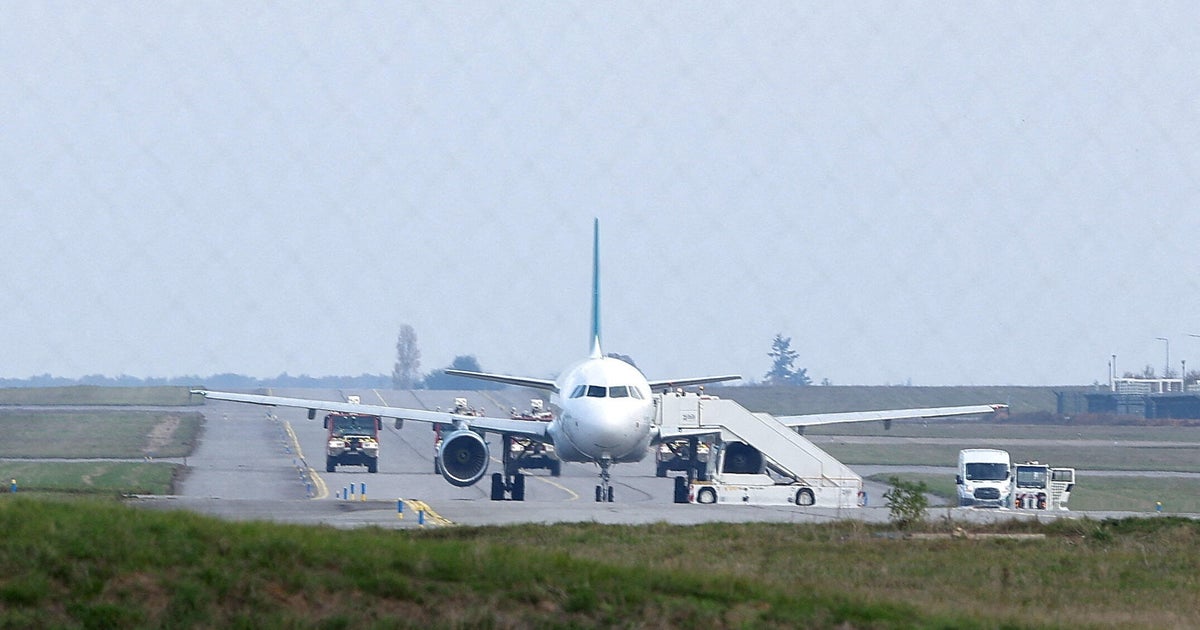
By Tucker Reals is CBSNews.com's foreign editor, based in the CBS News London bureau. He has worked for CBS News since 2006, prior to which he worked for The Associated Press in Washington, D.C., and London. Read Full Bio Joanne Stocker Verification producer Joanne Stocker is a verification producer for CBS News Confirmed. She was previously chief editor of Kurdistan 24 English and managing editor at The Defense Post. She has combined open-source investigation methods with on-the-ground reporting to cover conflict, terrorism, and misinformation for over 15 years. Read Full Bio Updated on: November 5, 2026 / 6:36 AM EST / CBS News Add CBS News on Google Paris — At least 15 commercial flights in Europe had to deal with bomb threats Thursday, with at least one being diverted to a military base in France. While authorities have reported no explosives discovered on any of the jets, and they all appeared to be hoaxes, Thursday's incidents add to a fast-growing number of journeys hit by similar threats this week, which one expert said suggested a "very deliberate act." British authorities dismissed threats to about seven flights earlier this week as hoaxes, but the number of impacted journeys soared over 20 on Thursday, meaning significant disruption for thousands of passengers and raising concerns about a possible coordinated effort to impact travel on the continent. So far, it remains unclear who, if anyone, is behind any such coordinated action, and no authorities have confirmed a link between any of the threats. An Aer Lingus Airbus A320 plane is seen at Evreux military air base after the flight from Dublin to Rome was diverted to France following a bomb threat, Nov. 5, 2026. Gonzalo Fuentes/REUTERS The flights impacted on Thursday included:A flight from Ireland to Italy that was diverted to an air base in western France Thursday because of a bomb threat, according to French Prime Minister Sebastien Lecornu's office. The flight landed safely and all 151 passengers and six crew members deplaned safely, while military bomb defusal teams got to work examining the plane. Flight tracking sites showed that the Aer Lingus Dublin-Rome flight turning sharply off its trajectory as it approached, and then making several loops before heading toward Evreux.A Finnair flight from Helsinki to Rome was escorted to the Italian capital by a fighter jet and was checked by bomb disposal experts, according to Italy's national news agency ANSA. Rome's Leonardo Da Vinci Airport stopped flights for 30 minutes. A second Finnair flight from Helsinki, operated by Jettime, landed as normal in Vienna, Reuters reported. A Wizz Air flight from Milan Malpensa airport to Warsaw was re-routed to Vienna after receiving a threat, also according to ANSA. A second Wizz Air flight bound for Bucharest also landed safely after being targeted, Reuters reported Romanian intelligence as saying.A flight operated by Polish Airlines LOT flying from Warsaw to Brussels landed safely in Brussels airport following security warnings. According to a statement from the airline, authorities carried out an onboard security check after it landed and "no hazardous or suspicious items were found."Three other planes, all Ryanair flights bound for Sofia, made emergency landings in Bulgaria Thursday after indications of potential danger on board, according to Bulgarian National Television (BNT). Flights from Madrid and Copenhagen landed at Vasil Levski Airport in the capital, and one from London Stansted diverted to an airport in Plovdiv. Reuters cited the Bulgarian transport ministry as saying no explosives or suspicious items were found on any of the planes.Officials in Prague said threats were issued against four flights headed to the Czech capital Thursday. Czech police said on X that all four planes landed and were assessed, and no explosives or suspicious devices were discovered. Italy's national news agency ANSA reported two more flights, scheduled to land Thursday at Milan's Malpensa Airport, landed safely after receiving "bomb alerts." Neither of the flights were diverted. They were Aegean Airlines flight A3552, which departed from Thessaloniki in Greece, and Ryanair flight FR8953, which arrived from Porto, Portugal. Explosives technicians were inspecting the aircraft, ANSA said. The threats to commercial airliners Thursday came after at least seven other flights across Europe received bomb threats this week that prompted aircraft searches, diversions and in at least one other case an escort by an Italian fighter jet.Some of the threats have been sent to airlines by email, but the nature of all of the messages has not been confirmed.Hoaxes, but on an unusual scaleThe British government described the incidents in a statement on Tuesday as hoaxes and stressed that the U.K. had "one of the most robust aviation security systems in the world, with well-tested processes for dealing with any potential threats, as well as malicious hoax threats, like those we've seen today," according to CBS News' partner network BBC. Air transport security expert Paul Mason told BBC that threats to passenger planes "don't happen that frequently," making this week's spate of incidents "unusual.""It sounds like they've been made in a credible manner across a broad range of airlines," Mason told the BBC's Radio 5 Live show. "That would suggest to me that it's been a very deliberate act by a typical actor rather than a load of coincidental, malicious calls.""There are a lot of processes" that airline crew members and ground staff go through "to validate the credibility of the threat," he said.While no individual or group has claimed responsibility for any of this week's threats, and no government or security official has pointed the finger at any, the incidents come amid rising concern in Europe about state actors, chiefly Russia and Iran, orchestrating low-level sabotage operations to undermine security on the continent. The growing "hybrid warfare" battlefieldIn October, the head of Britain's domestic spy agency MI5, Sir Ken McCallum, said security threats facing the U.K. and Europe were evolving, with malicious actors attacking not only things owned and controlled by the government, but also "aiming at people, businesses, communities." "Russia remains aggressor number one," McCallum said. "The Russian military and intelligence services are once again escalating their attempts at hybrid warfare," McCallum warned, adding that Moscow was "being careful to stay below the NATO Article 5 threshold" with its actions, which would trigger the alliance's collective defense principle."It'd be foolish for them to cross" that line, he said, and so far Russia was sticking to "tactics that stop short — though sometimes not much short — of conventional conflict."Poland launched a large-scale security operation this week along its border with the Russian exclave of Kaliningrad as the Polish prime minister said suspicious activity was seen on the Russian side, and that the fast security response may have prevented a "serious provocation."The flight threats also come amid a wave of cyberattacks targeting European grocery store chains' refrigerators and freezers, and even French blood banks. The hacks have forced thousands of pounds of food to be discarded in several countries, but French authorities said security systems prevented the loss of any blood stored in cooling units.Nobody has claimed responsibility for, or been blamed for the hacks on commercial refrigeration units as of Thursday. Experts told CBS News earlier this year that Russia and Iran were stepping up efforts to recruit sometimes-unwitting criminals to carry out sabotage attacks, often for small payouts.MI6 boss McCallum, in his remarks last month, said Iran in particular was "using criminal proxies to try to intimidate oppositionists, Iranian media organizations, and Israeli sites" across Europe. McCallum noted in particular "a wave of arson and sabotage incidents targeting Jewish communities in the U.K. and other European nations," but said Iran was also targeting "harder targets, like military sites."Many of these attacks were claimed by a group calling itself Harakat Ashab al-Yamin al-Islamiya (HAYI), or the Islamic Movement of the Companions of the Right, which U.K. authorities have sanctioned and said is tied directly to the elite Quds Force of Iran's Islamic Revolutionary Guard Corps, which Britain considers a terrorist organization. A CBS News investigation in March found the group appeared to have links to Iran, and a member said it would "keep threatening U.S. and Israeli interests worldwide until we've avenged every child in Gaza, Iran, Lebanon, and the resistance nations … We urge people to stay away from Zionist and American interests and individuals to keep themselves safe." Barry Andrews, an Irish Member of the European Parliament, referred to the diverted Aer Lingus flight to Rome on Thursday in a social media post, saying: "This after several hybrid threats and attacks across Europe, and ahead of the major European summit in #Dublin next week. Does anyone still deny Ireland faces serious security threats?" In: Federal Aviation Administration Iran Russia European Union Bomb Threat Airlines
Hoax bomb threats affect at least 20 European flights in a week
Full Article
Original Source
Read the full article at Cbsnews →KhanList aggregates and links to publicly available news content. We do not host full articles from third-party sources. Always verify important information with original sources.