
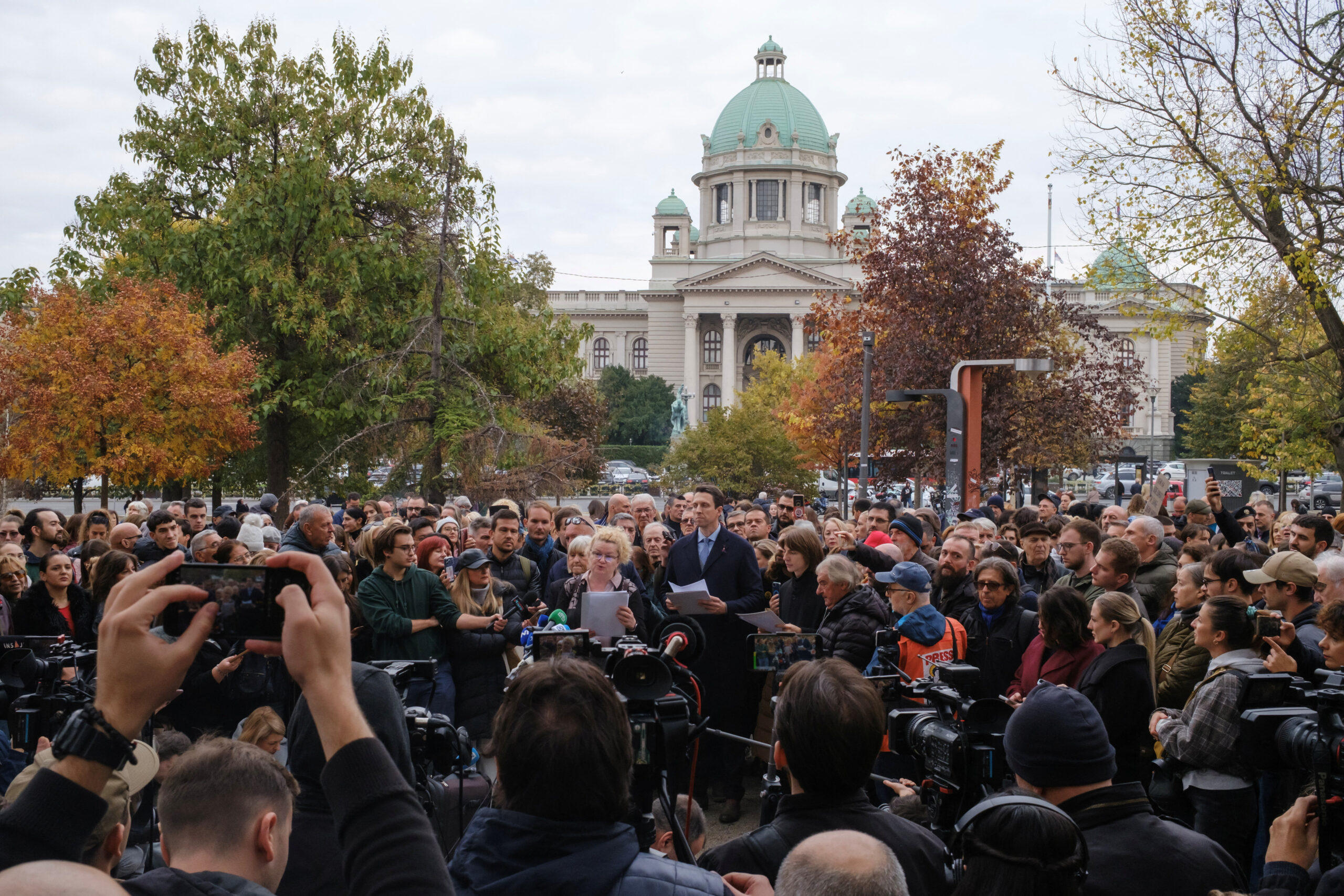
TIRANA—A generational shift is reshaping politics in Serbia and Albania. This has major implications beyond their borders, particularly for security in the wider Western Balkans and for EU enlargement. It offers the West—often wary of instability and change—a new opening to anchor the region around EU and NATO goals. What started two years ago as a nationwide student protest in Serbia after sixteen people were killed by a railway station collapse linked to corruption allegations has now produced one of the most consequential upsets in Balkan political history. On October 25, a student-created electoral list featuring many political newcomers convincingly won a snap parliamentary election despite restrictive democratic conditions. By framing the vote as a referendum on the political establishment and driving record turnout, the Student List improbably snapped former President Aleksandar Vučić’s fourteen-year dominance of Serbian politics, while also decimating all other traditional opposition parties. In nearby NATO member Albania, a peaceful Gen Z-led movement against luxury coastal developments and elite corruption recently evolved into broader (mostly) student-led protests, some of which have turned violent, calling for a shakeup of the political establishment—specifically, the decades-long duopoly of Prime Minister Edi Rama and opposition leader Sali Berisha. Unrest has gripped downtown Tirana for much of October. Rama’s government, now in its thirteenth year, has struggled to maintain control, despite its strong parliamentary majority. Serbia and Albania have very different political contexts, as well as very limited social and cultural ties with one another. Yet the upset in Belgrade is reverberating in Tirana. There is a geopolitical reason for this. For the past decade, Rama and Vučić have functioned somewhat as stewards of a Western Balkans détente, enabled by a Western policy of containment toward the region. With wider influence throughout the Balkans, they have served as the West’s anchors of regional stability in exchange for the West’s tacit support for their rule—a model of governance that scholars and observers have termed “stabilocracy.” The irony is that it is now Rama’s and Vučić’s opponents, a young generation of Albanians and Serbs, who may be sharing knowledge and solidarity. Serbia’s election offers Albania’s more nascent protest movement a blueprint for political action far more productive than if the movement becomes defined by directionless rioting. A woman holds an Albanian flag in front of riot police during an anti-government demonstration in Tirana, Albania on October 31, 2026. (Gent Shkullaku/ZUMA Press Wire via Reuters Connect) Beyond the geopolitical lens Too often, Western capitals view developments in the Balkans through a reductive and self-interested geopolitical lens. Of primary concern for many Western leaders is how much Moscow is exploiting or fueling events, but even when protests are homegrown, political upheaval raises concerns about regional instability, its implications for EU enlargement, and the security of strategic assets such as energy and transport corridors. The West has valid reasons for concern. While the Student List’s impressive achievement in Serbia may grant it international goodwill, it remains a heterogeneous and leaderless structure that mobilized a majority of voters around a lowest common denominator: beating Vučić. It now must resolve divisive issues and demonstrate that an anti-establishment body governed by committee can run state institutions, many of which remain dominated by loyalists of the former regime. On paper, the Student List has a foreign and security policy orientation largely identical to that of Vučić. It pursues military neutrality and EU accession alongside the incompatible goals of maintaining strong ties with Russia and China, including opposition to sanctions on Moscow. It also remains firmly within the realm of Serbian nationalism, which does not reassure Serbia’s neighbors. Yet these objectives did not feature prominently in the campaign and may not be emphasized in practice—especially if Serbia reengages meaningfully with the EU. Albania, by contrast, is a NATO member and aims to finish EU accession negotiations by the end of 2027. It has been moving fast in the process thanks largely to Western-backed anti-corruption reforms and the work of Albania’s Special Anti-Corruption Structure, known as SPAK, which has challenged the country’s culture of impunity by investigating and charging a number of powerful figures, including from Rama’s inner circle. In fact, the protest movement has been largely fueled by public grievances over high-level corruption exposed by SPAK’s investigations. As such, the protests can be seen as a sign of EU accession conditionality doing its transformative work. But the protests’ recent violent turn risks derailing Albania’s EU path if it merely generates instability without political pathways to sustain reforms. While the West has legitimate concerns about Gen Z stirring the Balkans pot at such a delicate moment, these concerns should not drive its policy. Young people are rebelling against paternalistic governance, not acting on behalf of Russia or China. Treating them as pawns in great-power competition would be tone deaf and counterproductive. Because the protesters’ core demand is political accountability, the EU is their natural ally. The West can help anchor these new democratic actors if it engages with them on their own terms. A sequence of litmus tests European Commission President Ursula von der Leyen’s immediate reaction to the result of the Serbian elections highlighted this clear point of convergence between the EU and the incoming Serbian government. In a post on social media, she specifically listed as priority items the EU’s “support for reforms on the rule of law, media freedom, the fight against corruption and strong democratic institutions.” Serbia may soon start making progress on its stalled EU accession process if the incoming government starts to deliver on this front. Some of these reforms would, for example, enable greater scrutiny of Chinese investments and could help rewrite the rules of engagement between Belgrade and Beijing. While it resets its relations with Serbia, the EU should not neglect the regional implications of the Student List’s foreign and security policy posture and its approach to Russia out of fear of upsetting the movement’s lack of consensus on these issues. The real litmus test of the country’s commitment to EU accession will be good neighborly relations. Specifically, what matters will be Serbia’s posture toward Montenegro as it approaches the finish line of EU accession, Milorad Dodik’s secessionist agenda in Bosnia and Herzegovina, and the normalization of relations with Kosovo. While an incoming Student List-led government may put off the more divisive foreign policy issues, good neighborly relations should be a bare-minimum expectation. And they are in Serbia’s interest as well, as sufficiently good relations can serve as a potential steppingstone for future Common Foreign and Security Policy (CFSP) alignment. The EU’s challenge in Albania is both simpler and more complicated. The crown jewel of the accession process, SPAK, has been a catalyst of political transformation whose protection from political interference should remain a litmus test of the EU’s engagement with actors in the country. EU reactions against rioting and calls to channel dissent through the political process are reasonable. But the EU should also continue to scrutinize a candidate state’s excessive measures to stifle legitimate dissent and violence against protesters. EU membership is a widely shared goal of Albanian society and not a monopoly that only one government can guarantee. The only way that Albania will join the EU is if it addresses the uneven political playing field in its democracy, which contributes to symptoms like political violence. And there’s one final consideration: Will the United States and the EU be in sync on this issue? Washington has been somewhat quiet in recent weeks, continuing the pattern of inconsistent and ad hoc engagement in the region over the past two years. The Trump administration did issue a statement condemning the riots in Albania, while its initial response to Serbia’s election came only via press queries; an official US Embassy statement followed five days later. Of course, Washington has its own separate bilateral agendas, strategic dialogues, and economic projects with both Serbia and Albania, none of which appear threatened, along with leverage it could deploy if it so chose. Yet its slow response to such important developments signals a lack of clear strategic focus and interest in the region. The stakes and opportunities of this transformative moment call for greater ambition.
As Gen Z asserts itself in Serbia and Albania, the upside for the West is far greater than the headaches
Full Article
Original Source
Read the full article at Atlanticcouncil →KhanList aggregates and links to publicly available news content. We do not host full articles from third-party sources. Always verify important information with original sources.