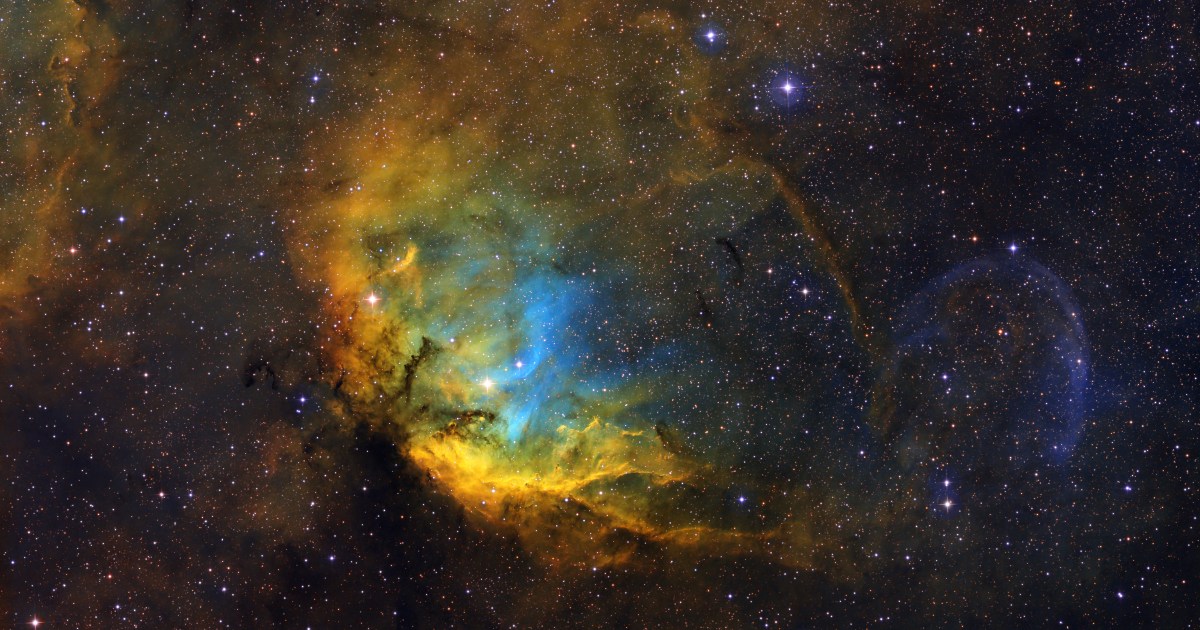
The Tulip Nebula (Sharpless 2–101) blooms amid the star-rich fields of Cygnus in this narrowband image. Cataloged by Stewart Sharpless in 1950, this emission nebula is an active star-forming region — and lies just 15' east of Cygnus X-1, the first confirmed stellar black hole. Credit: BTB-Astroteam Brentenriegel/ccdguide.com The sky is filled with great objects for observers. With today’s equipment and the sophistication of knowledge we have about clusters, nebulae, and galaxies, some 10,000 good-looking objects are within the range of backyard scopes. Of course, a dark, moonless sky helps a lot with seeing anything other than the Moon. And a site as far from city lights as is reasonably possible helps, too. But astronomy hobbyists have never had a better, more exciting time to go after live photons from distant objects tucked away in the cosmos. The situation is even more promising for budding astroimagers. With the generation of smart telescopes that has emerged over the past few years, imagers can capture objects that years ago would have been considered beyond their ability. Less-than-ideal skies can be subtracted with image-processing programs to reveal faint objects against inky black backgrounds, even as recorded from somewhat light-polluted locales. This quiet revolution in astroimaging is gaining steam, helping imagers to aim for a vast new array of exciting targets. The list below offers a year’s worth of targets to explore, particularly as your observing experience and expertise progress. Jump between images using j/k or the left and right arrows on your keyboard. Key Recommended for a 6-inch or smaller scope Recommended for an 8-inch or larger scope Hot astroimaging target In the summer sky For our first target, head northward to the prominent constellation Cygnus for Sharpless 2–101, an emission nebula dubbed the Tulip Nebula due to its distinctive shape. Cataloged by Stewart Sharpless in 1950, the cloud of gas is a star-forming region in the rich summer Milky Way. This is a challenging object for visual observers but far easier for imagers. It also happens to lie close to the first confirmed stellar black hole, Cygnus X-1, which is some 15' west of the nebula. NGC 7023. Credit: Tommy Nawratil/ccdguide.com Next, head farther north, where you’ll find the unusual reflection nebula NGC 7023 in Cepheus. Often called the Iris Nebula, this is a cloud of tiny, dusty particles reflecting the light from an embedded massive 7th-magnitude star. It lies 1,400 light-years away. The nebula spans 18', appearing as a glow surrounding the central star, but in space stretches across 6 light-years. Discovered by William Herschel in 1794, the Iris Nebula is understood by modern-day astronomers to be a dusty environment, a cocoon that presents a billowy range of bluish light. Pismis-Moreno 1. Credit: Jens Zippel/ccdguide.com A truly obscure open cluster lies in northern Cepheus. Pismis-Moreno 1, named for its discoverers, Armenian-Mexican astronomer Paris Pismis and Mexican astronomer Marco Moreno-Corral, is associated with the faint emission nebula Sharpless 2–140. The nebula’s gas is slowly giving birth to the open cluster, and the whole conglomeration lies about 3,000 light-years away. This area is a portion of the so-called Cepheus Bubble, an expanding shell of gas and dust that was likely born from a star that was once part of the nearby Cepheus OB2 Association. Pismis-Moreno 1 appears almost treelike in shape. Humason 1-2. Credit: Gary Imm Planetary nebulae form from the deaths of solar-mass stars. If you’d like a challenge, point your scope at planetary nebula Humason 1–2, discovered by American astronomer Milton Humason in 1920 and sometimes called the Baby Dumbbell. The Baby Dumbbell is tiny at just 32" across, and lies at a distance of almost 10,000 light-years, making its apparent magnitude 12.7. This little object is a challenge for observers with medium-size scopes. Its elongated shape gives rise to the nickname, which you’ll see on first blush. Veil Nebula. Credit: Franz Klauser/Manfred Wasshuber/ccdguide.com The next object is far easier to see, and takes me back to my earliest days as an observer. When I first got my 8-inch Celestron in 1976, I read somewhere that the Veil Nebula in Cygnus was out of the range of a scope that size. On a cold, crisp night, I looked anyway, and there were two slender veils of nebulosity, clear as a bell. The lesson — that much of the literature on deep-sky observing was flat-out wrong in the mid-1970s — was a big one. The Veil is a supernova remnant some 2,400 light-years away. It is so large on our sky that the two brightest parts, NGC 6960 and NGC 6992–5, take up a telescopic field each. In the middle lies another relatively bright detachment, NGC 6979. NGC 6960, the western half, appears to cut right through the bright star 52 Cygni. The eastern Veil, NGC 6992–5, is somewhat brighter and also contains somewhat sharper detail, appearing as a glowing, twisting band of cosmic rope. Using a nebula or Oxygen-III filter will help a lot. CTB-1. Credit: Markus Blauensteiner/ccdguide.com Heading to Cassiopeia brings another challenging nebula into view. This one is a circular supernova remnant, the result of a massive star’s catastrophic explosion at least 10,000 years ago. Discovered as a radio source in 1960, CTB 1 is really obscure. It lies some 10,000 light-years away and glows faintly, its light contrasting against a wash of background nebulosity. Also known as Abell 85, the cloud is sometimes called the Medulla Nebula. Good luck with this one — it is faint. NGC 40. Credit: Johannes Schedler/ccdguide.com Far easier to spot is the planetary nebula NGC 40 in Cepheus. This object glows at magnitude 11.2 and spans 38", making it a fine target for small- and medium-sized scopes under a dark sky. Lying some 5,200 light-years away, this object is sometimes called the Bow-Tie Nebula due to its elongated shape. The nebula’s gentle bluish light and central star, which glows at magnitude 11.5, are easy to see. If you’re frustrated with trying to spy some of the faint nebulae on this list visually, NGC 40 offers a satisfying antidote. In the fall sky NGC 457. Credit: Michael Breite/Stefan Heutz/Wolfgang Ries/ccdguide.com Even without a super-dark sky, the class of objects known as open clusters does not disappoint. One of the best that’s often overlooked is NGC 457 in Cassiopeia. While observing one night in the 1970s, I noticed the shape of an owl in this cluster, with the two brightest stars marking its eyes, a “body” of stars comprising the bulk of the cluster, and “wings” and “feet” extending from the main group. I dubbed it the Owl Cluster, and the name has stuck. The brightest star, a 5th-magnitude yellowish-white multiple star, is a beacon, while the ruddy supergiant V466 Cassiopeiae lies nearby. The cluster is some 8,000 light-years away and looks great through practically any scope. NGC 404. Credit: Bernhard Hubl/ccdguide.com Some deep-sky objects are lit up from behind, while others simply lie near brighter objects. The latter is the case with the small galaxy NGC 404, a nicely challenging object adjacent to a bright star in Andromeda. Discovered by William Herschel in 1784, NGC 404 is a lenticular (lens-shaped) galaxy lying some 10 million light-years away. The galaxy glows at magnitude 11.7. The challenge here is that it lies in the same telescopic field as Mirach (Beta [β] Andromedae), a magnitude 2.1 star that dazzles in brightness in the eyepiece. Moving the scope around a bit, looking with averted vision, and perhaps maneuvering the bright star just outside the field of view can all help with seeing this small galaxy. NGC 750/NGC 751. Credit: Walter Primik/ccdguide.com For an exotic duo of galaxies that’s not too tricky, target NGC 750/NGC 751. These interacting galaxies lie in Triangulum, and consist of an elliptical galaxy with a close companion that seems to form a double nucleus inside a common galactic halo. These objects lie at a distance of about 225 million light-years and glow at magnitudes 12 and 13, respectively, putting them within the reach of observers and imagers. Heart and Soul nebulae. Credit: Giuseppe Donatiello (Oria Amateur Astrophysical Observatory - OAAO) Our next targets are familiar to numerous astroimagers. Observers? Not as many. But these large emission nebulae, also giving rise to embedded open clusters, are visible under a dark sky to users of large scopes. The so-called Heart and Soul nebulae in Cassiopeia are among the largest emission nebulae in the northern sky. Lying in the Perseus Arm of our galaxy some 7,000 light-years away, these big star factories are busily generating a new generation of suns. The Heart Nebula (IC 1805) is a massive area of stars and nebulosity that really does look heart-shaped. It is so large, 21/2° across, that a large telescopic field is needed to differentiate the nebulosity from the sky brightness behind it. The Soul Nebula (IC 1848) is close to the Heart and is far more elongated in shape. Not only are these star-forming regions coalescing gas into infant suns, but the (relatively) nearby galaxies Maffei 1 and Maffei 2 lie near them in the sky. Pleiades. Credit: Giuseppe Donatiello Our next object, the Pleiades (M45), is one of the brightest open clusters in the sky. And at 444 light-years, it’s also one of the nearest. With seven naked-eye stars, thus the nickname Seven Sisters, it’s a prominent part of the constellation Taurus. So where does the observational challenge come in with the Pleiades? The cluster is moving through a cloud of dust in the galaxy, creating a reflection nebula that surrounds several of the brightest stars, most significantly Merope (23 Tauri). Large scopes on dark nights show some of it, although it’s a challenge because the starlight can make the faint glow of the nebulosity hard to spot. NGC 1514. Credit: Rudolf Riedl/ccdguide.com Staying in Taurus brings us to another great planetary nebula, and one that is often overlooked. Many planetaries have relatively high surface brightnesses, making details in them pretty observable, and this one is no exception. NGC 1514, sometimes called the Crystal Ball Nebula, shines at 10th magnitude and spans some 2.2'. It features a bright central star that glows at magnitude 9.5. Large scopes show a complex form of nebulosity with darker areas, all encapsulated within a large halo of faint gas. Purgathofer-Weinberger 1. Credit: Markus Blauensteiner/ccdguide.com Ready for a really obscure target? The second largest planetary in the sky, Purgathofer-Weinberger 1, is so faint that it wasn’t discovered until 1980. Lying some 1,300 light-years away in western Lynx, the object, often abbreviated PuWe 1, glows faintly at about 11th magnitude and spans 20'. This is a big challenge for visual observers, but imagers will have an easier time with it. IC 342. Credit: Giuseppe Donatiello If you can find the constellation Camelopardalis, you can observe IC 342, one of the nearest galaxies to us outside our Local Group. Lying some 10.7 million light-years away, IC 342 is a beautiful face-on barred spiral not too dissimilar to our own Milky Way. Found by William Denning in 1892, its recent discovery testifies to its obscuration behind a portion of the Milky Way itself. Nonetheless, it is visible to backyard observers as a glow slightly larger than 20' across with a total brightness equal to a 9th-magnitude star. The galaxy contains an estimated 100 billion stars and stretches over some 150,000 light-years, again making it similar to the Milky Way. In the winter sky NGC 2623. Credit: Walter Primik/ccdguide.com As the year begins, take a look at an interacting pair of galaxies that’s farther down the road — and midway through the act of a full merger. Although universal expansion is generally separating objects in the universe over time, on smaller scales gravity can bring galaxies together and join them in collisions, and that’s what’s happening here. NGC 2623 in the constellation Cancer was discovered by French astronomer Édouard Stephan in 1885. It lies 260 million light-years away, glows rather faintly at magnitude 13.4, and offers a merged system with a nucleus, hub, and disk that have fully joined, and spiral arms emanating in a chaotic twist away from the center. This object will be challenging to visual observers and easier for astroimagers. For both, its feeble light offers a view of a reclassification of order, with stars, star clouds, walls of nebulae, and dust being reshuffled on a grand scale as the two former galaxies slowly combine into one. MCG+07-23-019. Credit: Adam Block North of Cancer, in the constellation Ursa Major, you’ll find MCG+07–23–019, also known as Arp 148. In common use, however, it is known as Mayall’s Object. Discovered by American astronomer Nicholas Mayall in 1940 using the 36-inch telescope at Lick Observatory, this is an interacting pair of galaxies lying some 450 million light-years away. At first, Mayall and other astronomers believed the object to be a strange nebula. Now we know it consists of a ringlike galaxy with an edge-on galaxy appearing to poke into its center, creating something of a question-mark shape. Again, this is a faint and challenging object. Imagers should try their skill at this distant train wreck. NGC 4435 and NGC 4438. Credit: Johannes Schedler/ccdguide.com Much closer, brighter, and less challenging is the merging galaxy pair NGC 4435 and NGC 4438 in Virgo, sometimes called the Eyes. This pair glows at magnitudes 10.8 and 10.2, and lies about 52 million light-years away. The spiral, NGC 4438, is larger and more prominent than NGC 4435, which is a smaller lenticular galaxy. This duo offers one of the best views of an interacting galaxy system in the Virgo Cluster, and therefore one of the best interacting galaxy pairs in our local region of the universe. IC 2602. Credit: Konstantin von Poschinger/ccdguide.com The deep southern sky is really rich in nice deep-sky objects. An old friend, the celebrated astronomer Bart Bok, used to say that “all the good stuff’s in the southern sky.” One such object is the really bright (magnitude 1.9) cluster IC 2602. Nicknamed the Southern Pleiades, this group holds some 75 stars in a diameter of 50' and lies about 500 light-years away in Carina. It makes a great sight even through binoculars. In the spring sky Coma cluster. Credit: Johannes Schedler/ccdguide.com Galaxies sometimes appear alone, and sometimes we can peer into a group or cluster of them. Such is the case with the Coma Cluster of galaxies, one of the rich aggregations in our area of the cosmos. As its name suggests, you’ll find it in the constellation Coma Berenices. This collection boasts more than 1,000 galaxies lying some 300 million light-years away, so that this huge group appears pretty small. The cluster’s brightest members, NGC 4874 and NGC 4889, are supergiant ellipticals that glow feebly at magnitudes 12.9 and 11.4, respectively. With a large telescope or as an imaging project, this field of galaxies is really absorbing. NGC 4676A and NGC 4676B. Credit: Adam Block Much deeper into the cosmos, also in Coma Berenices, lies a pair of interacting galaxies that will astonish observers with large scopes. NGC 4676A and NGC 4676B, collectively known as the Mice, are a merging pair of galaxies lying about 345 million light-years away. Large scope users may see the twin disks of these two galaxies and also faint hints of the long, disrupted arms extending far from their centers. What’s even more exotic than galaxy mergers? Well, more than a century ago, Albert Einstein predicted gravitational lensing should occur in the cosmos as a consequence of his theory of relativity. We can see such lensing in objects like the Cloverleaf Quasar (also called H1413+117 and QSO J1415+1129), a distant, 17th-magnitude object in Boötes. Discovered in 1984, the object is the light of a background quasar, split into a mirage of four images by an intervening massive body between us and the quasar. Forget about spotting the Cloverleaf visually. This object is an extreme challenge for imagers. Even then, its multiple nature is not evident from the ground. Arp 302. Credit: Gary Imm You’ll also find an unusual galaxy pair in Böotes, lying at a distance of 450 million light-years. This is Arp 302, also called the Exclamation Point Galaxy. This object consists of two 15th-magnitude galaxies, VV 340 A and VV 340 B, which present a distorted, edge-on galaxy (A) appearing to sit atop a face-on spiral (B) to form the rough shape of an exclamation point. Again, this is a faint and challenging object that imagers will succeed with far more easily than will visual observers. Medusa Nebula. Credit: Michael Breite/Stefan Heutz/Wolfgang Ries/ccdguide.com The world of planetary nebulae offers an object more achievable for visual observers: Abell 21, the Medusa Nebula in Gemini. Discovered by George Abell in 1955, the nebula lies some 1,500 light-years away and is typical of big, low-surface-brightness nebulae, covering about 10'. A large scope under a dark sky shows this nebula quite well, and it’s relatively easy to image with the new generation of smartscopes. Barnard 72. Credit: Gerald Rhemann/ccdguide.com Many observers target a class of objects known as dark nebulae. Over a century ago, some astronomers believed these objects to be holes in the cosmos. Today we know they’re actually collections of dust and cold gas that block the light from objects behind them. Our final target is a prominent dark nebula with a distinctive shape that lies in Ophiuchus. Cataloged as Barnard 72, it is known to amateur astronomers as the Snake Nebula because it appears as a sinuous, S-shaped channel. The rich Milky Way star field behind it helps to outline the darkness of the nebula. Ready for the challenge? The night sky may look stark, but it’s also peaceful, providing a haven for contemplating the universe at large. It certainly offers a huge canvas of exciting stellar explosions, strange galactic forms, and interesting nebulae, all quieted because they take place on scales of distance and time that boggle the human mind. And they are within reach of observers and imagers with a telescope at the ready. So, head out sometime soon and observe some of them. David J. Eicher is editor emeritus of Astronomy. He has spoken widely to amateur astronomy groups, logged many hundreds of hours at the eyepiece, and written more than a dozen books on astronomy.
Hidden wonders of the universe
Full Article
Original Source
Read the full article at Astronomy →KhanList aggregates and links to publicly available news content. We do not host full articles from third-party sources. Always verify important information with original sources.