
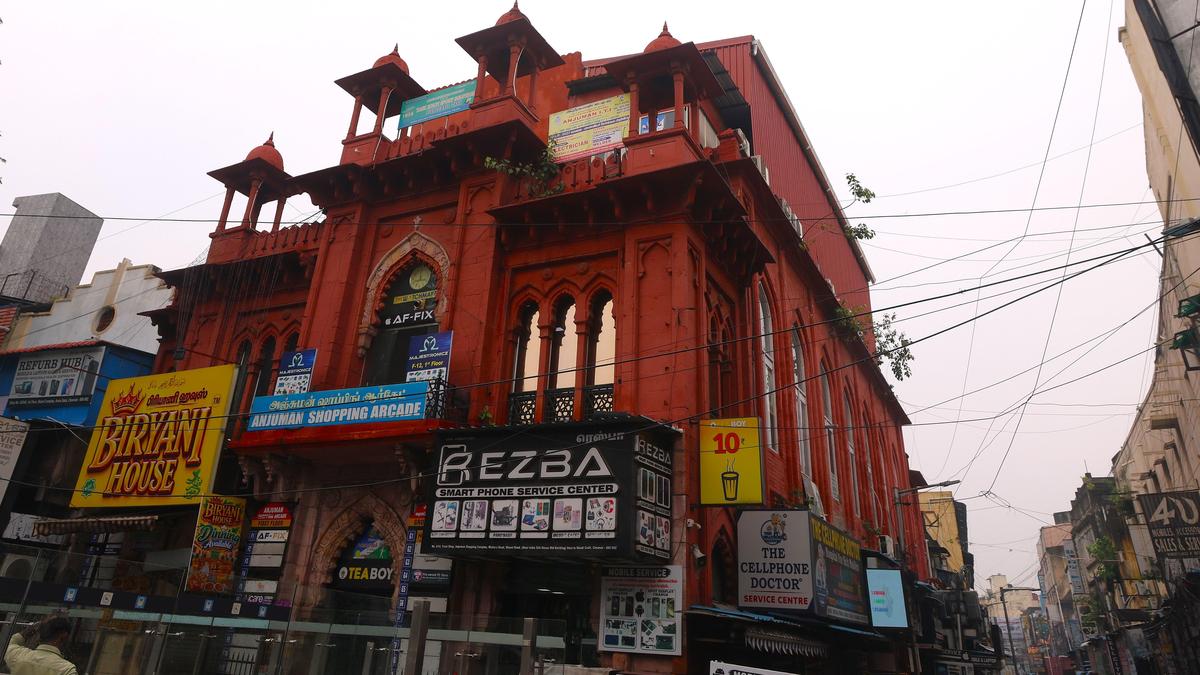
Anjuman Shopping Arcade on Mount Road, sitting in the crook formed by the intersection of the arterial road and Wallers Street (which is part of the Ritchie Street electronics market), on November 8, 2026. | Photo Credit: PRINCE FREDERICK The Anjuman Shopping Arcade sits in an angled recess formed by the handclasp of two almost antithetical roads, the gregarious and diverse Mount Road and the introverted and niche Wallers Street, the latter’s identity lost in a catch-all, convenient nomenclature, Ritchie Street, accorded to the cluster of lanes constituting what is indisputably Chennai’s electronics hub. Let us zoom in on that building. There is uniformity to how the shops in Ritchie Street present themselves, and this building follows a sartorial code all its own, one written according to a guide book on Indo-Saracenic architecture. Its best efforts to stay unnoticed in that crook of a space between these two roads is undone by its vibrant red robes, which contrast hugely with the ashen overalls of its immediate neighbours. Fire at Anjuman Shopping Arcade on November 16, 2015. | Photo Credit: SRIBHARATH G Human or building, possessing beauty does not spare one the heartburns of life. On the evening of November 16, 2015, this red-brick building turned a burnt reddish-brown, having suffered extensive burns, the accident having been sparked by an electrical short circuit. According to The Hindu Archives, a battery of fire engines, drawn from the “Tiruvallikeni, Vepery, K.K. Nagar and Triplicane” stations of the Tamil Nadu Fire and Rescue Services, rushed to the spot to bring the fire under control. At that time, the India Silk House was operating from the building, the enterprise’s connection with it dating back to the dawn of Independent India, 1947. This business entity has no presence in Anjuman Shopping Arcade now. Where edifices of architectural heritage are concerned, history usually derives from two opposite situations: immutability and variability. A heritage building would thrust itself into the collective public consciousness because of its unchanging anatomy that bears a mark of the past, a singular architectural character difficult to replicate. It also commands attention for the pageantry of groups that have made use of its spaces, sometimes the usage data straddling a diversity of purposes. The building arrived in the dawn of the 20th century. In its youth, it carried a different name, Lawely Hall, and displayed a different character, one committed to educational goals. It was named after the man who occupied Madras’s gubernatorial office from 1906 to 1911, Sir Arthur Lawley. For close to 25 years of its life, this building had served as an educational centre for Muslim students, under Anjuman-e-Himayat-e-Islam Trust, a charitable and educational organisation established in 1890, and which continues to hold and manage this building. The Trust would move the afore-mentioned educational programme to a different address in Madras, throwing open the doors of this building to commerce. The Trust is present at B.N. Reddy Road in T. Nagar (for details, visit https://www.anjhimayath.com).The spaces in the building are now let out to shops, and it reflects more of Ritchie Street than Mount Road, despite its facade overlooking the latter. A majority of the shops at Anjuman Shopping Arcade have to do with various types of electronic products, largely servicing and selling mobile phones, Ritchie Street blood gurgling through its veins. The building is so busy with commerce and the bustle of customers that it is 100 per cent echo-proof, but the one in the know would hear an echo, silent and sweet, that relays a literary heritage. It proceeds from the pen of the legendary R.K. Narayan, indirectly drawing the veil off this now commercial building’s past. In the imaginary parallel universe called Malgudi that famous pen evoked, Narayan displays a special liking for the name “Lawley”, naming a range of public infrastructure after it. This fictitious personage is Sir Frederick Lawley, a military governor mentioned in the short story Lawley Road from the Malgudi series. Published - November 22, 2026 07:56 am IST
Heritage Calendar: The Indo-Saracenic structure on a corner plot in Mount Road that survived a major fire
Full Article
Original Source
Read the full article at Thehindu →KhanList aggregates and links to publicly available news content. We do not host full articles from third-party sources. Always verify important information with original sources.