
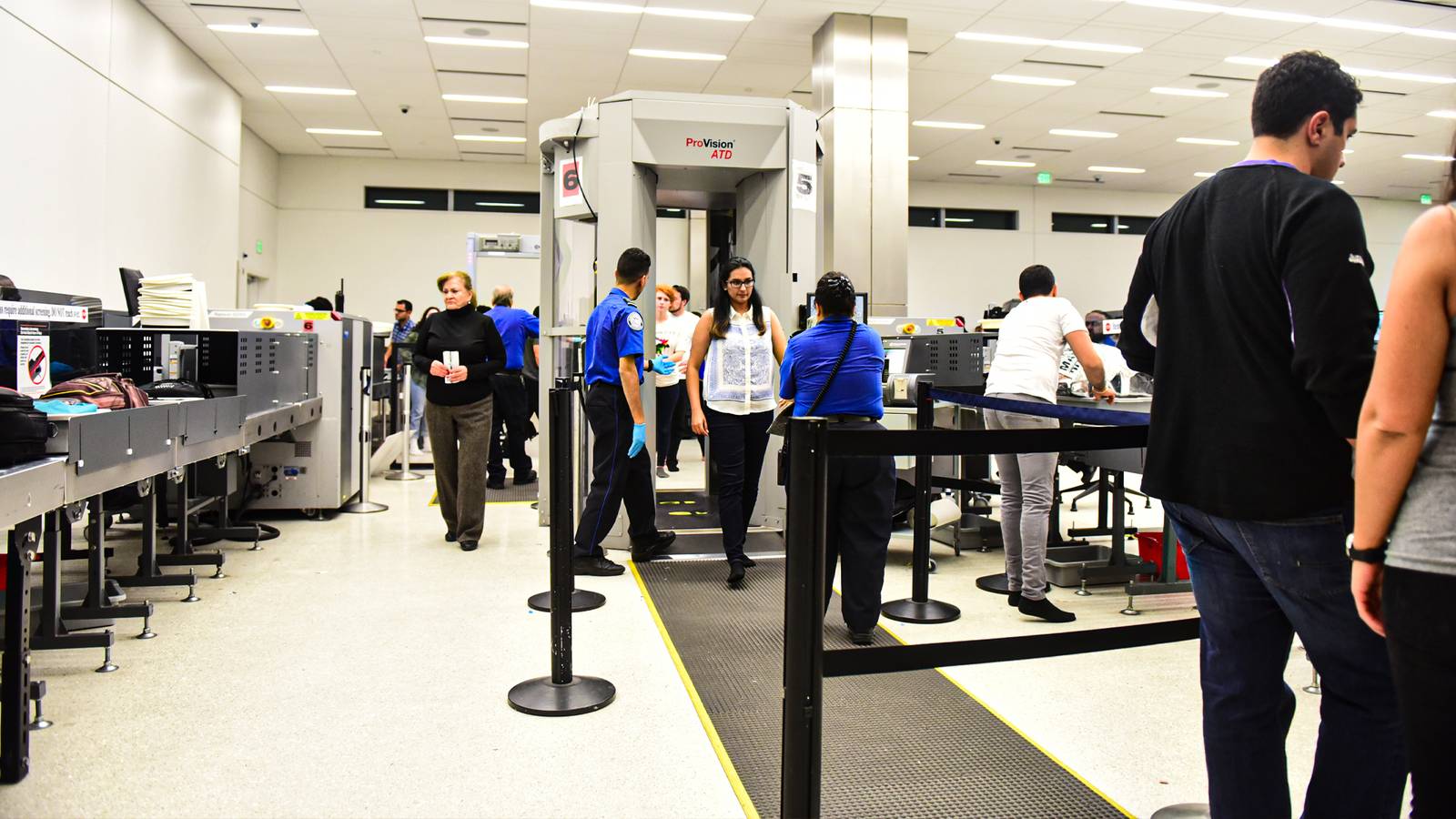
Credit: Hayk_Shalunts | Shutterstock, Simple Flying Published Nov 16, 2026, 10:00 AM EST Chris earned a Master’s degree in Defense and Strategic Studies (Highest Honors) from the University of Texas at El Paso. His graduate work concentrated on Global and National Security, Low-Intensity Conflict, Modern Warfare, and US grand strategy. He also undertook extensive regional studies, analyzing how key regions integrate into the broader US security architecture. This rigorous program provided him with a comprehensive understanding of U.S. military operations, global strategy, and weapons systems. Additionally, he gained a strong appreciation for great power competition.—an increasingly central force shaping international relations and conflict for the foreseeable future. Sign in to your Simple Flying account For years, removing shoes at airport security checkpoints was an unavoidable part of flying in the US. Introduced in the aftermath of the 2001 shoe-bombing attempt, the requirement became one of the more frustrating aspects of air travel, adding another step to an already time-consuming process. However, in July 2025, the Transportation Security Administration (TSA) ended the nationwide requirement, allowing most passengers to keep their shoes on as they pass through security. The policy change reflects improvements in screening technology and the multiple layers of security now in place at US airports. Nevertheless, travelers looking to make their journeys even more convenient have another option in TSA PreCheck, which offers expedited screening and fewer restrictions at security checkpoints. But is the five-year membership worth the cost, particularly for frequent business travelers? Great News: We Can Finally Keep Our Shoes On Much like death and taxes, the two certainties of this life, if you're a traveler awaiting an international or domestic flight, the one thing we can all count on is getting into line with the TSA, or the corresponding security agency at the airport you're flying out of. Once in line, we know the drill: we wait our turn, then put our carry-on luggage, wallets (or purses), belts, and maybe a computer into that ubiquitous dull gray plastic tray. Then we watch as it makes its journey down a series of metal rollers, and into the mouth of the cavernous X-ray machine. Then it's our shoes' turn — or it was. While this was not too much extra work, it was just another layer of frustration when all you wanted to do was walk to your concourse, maybe grab a snack or coffee, find your departure gate, and relax for a bit. Or, if you have young children (as the author does), you have to watch them and ensure they don't wander off while you furiously get your shoes back on and tie your laces. Fortunately, for those traveling for leisure or who must traverse the country or globe for business, the requirement to remove shoes was lifted as of July 8, 2025. Passengers at all airports across the US will now be able to keep their shoes on, saving time and reducing frustration. Regarding this development, former Department of Homeland Security Secretary Kristi Noem stated, "TSA will no longer require travelers to remove their shoes when they go through our security checkpoints,” she said. "We want to improve this travel experience, but while maintaining safety standards and making sure that we are keeping people safe," as reported by CNN. The new policy went into effect at all airports across the US. Why Was This Rule Implemented? On December 22, 2001, just months after the devastating attacks on the World Trade Center in New York, Richard Reid, a British national, arrived at Charles de Gaulle Airport in Paris. His intent was to board American Airlines Flight 63, bound for a connecting flight in Miami, Florida. He arrived at de Gaulle looking disheveled, carrying a green knapsack and passport, as well as a Koran, according to the Los Angeles Times. Due to his unkempt appearance and suspicious behavior, Reid was subjected to additional searches and questioning by authorities at de Gaulle. During the questioning, he reported that he intended to visit family on the Caribbean island of Antigua. As documented in Terrorism Since 9/11: The American Cases. “The thirteen witnesses interviewed regarding this inspection procedure—policemen, security agents and agents of American Airlines—indicated that they have been troubled, indeed perplexed, by the personality and the behavior of Richard Reid, described as filthy, very unkempt, emotionless, and not attempting to find out why he was being subjected to an inspection. He did not appear at all anxious.” With no other reason to hold him, he was allowed to board American Airlines Flight 63 the following day. What investigators did not realize was that they had just allowed a trained terrorist onto a plane carrying more than 200 passengers. Beginning in 1998, Reid spent the next two years in Pakistan and Afghanistan at training camps, one of which was called Khalden, where he was trained by al-Qaeda's “master bomb maker,” Midhat Mursi (also known as Abu Khabab al-Masri). Once aboard Flight 63, Reid sat alone near a window and attempted to light a fuse connected to an explosive device concealed in his shoe. One hundred grams of pentaerythritol tetranitrate (PETN), an explosive compound used in military-grade plastic explosives, were concealed within the hollow of his footwear. Once passengers noticed what he was trying to do, they threw water on him and subdued him. Had Reid been successful, his explosive device could have torn a hole in the aircraft, potentially causing severe damage or sending it into the ocean. What Was Behind The Policy Shift? The policy requiring passengers to remove their shoes at TSA checkpoints across US airports was put in place between August 13 and 14, 2006. Prior to the 2025 announcement, only travelers enrolled in TSA PreCheck were permitted to keep their shoes on. Enhanced screening methods and multiple layers of security have permitted this policy shift. Noem stated, "There will be individuals at times that will be asked to remove their shoes, if we think there is additional layers of screening that is necessary that may still happen to an individual." She continued, "But we are excited with the fact that we have the technology now that we have the multi layers of screening in place that we've built in over the recent several years, they give us the ability to allow our travelers to keep their shoes on," as reported by ABC 7 Eyewitness News. The layered security and highly capable technology that have finally allowed weary passengers to keep their shoes on start with the Computed Tomography (CT) baggage scanner, which produces a three-dimensional image of carry-on luggage. This device helps TSA personnel identify potential explosives and other prohibited items. The CT scanner has significantly strengthened baggage screening. The next layer is the Advanced Imaging Technology (AIT) scanner, which can detect concealed metallic and nonmetallic threats, including explosives, beneath clothing. Beyond this, additional TSA personnel are stationed at checkpoints, and REAL ID requirements help verify a passenger's identity and travel-document information. Without acceptable identification, a passenger may be required to undergo additional security measures, potentially including shoe removal. The overarching component of airline security is intelligence sharing between local, state, and federal agencies regarding potential threats. This effort occurs at fusion centers, where, according to the Department of Homeland Security, the agency operates a "National Network of Fusion Centers [that] provides an essential capability, enabling the receipt, analysis, gathering, and sharing of threat-related information among state, local, tribal, and territorial partners." This effort helps identify real or potential threats before they reach an airport. PreCheck: Is It Worth It? The process of navigating airport security takes time, precious time, but there is an option that can alleviate this headache. This option is TSA PreCheck, a US government program that allows travelers deemed to be a low security risk to go through an expedited screening process at more than 200 American airports, as reported by Investopedia. PreCheck allows passengers to reach their boarding gates more quickly, as they do not have to remove items such as laptops, and the removal of light jackets is not necessary. The site also reports that 99% of passengers wait less than 10 minutes to move through security. The question remains: Is this program worth it? The answer is that it depends on the nature and frequency of your travel habits. For frequent business travelers, the answer is generally yes. A five-year membership costs between $79.75 and $85.00, depending on the enrollment provider, averaging approximately $16 to $17 annually, as Travel Dudes has pointed out. TSA PreCheck Enrollment Provider Comparison Provider IDEMIA Telos CLEAR New enrollment $79.75 $85.00 $84.95 Active locations 500+ 500+ 348 Online renewal $58.75 $69.95 $72.95 In-person renewal $66.75 $58.75 $84.95 Enrollment options CVS, AAA, pop-up events Office Depot/OfficeMax, USPS Evening and weekend locations Appointment required? Varies Varies No Website IDEMIA Telos CLEAR Enrollment Locations Find locations Find locations Find locations For someone who takes six round trips each year, that amounts to roughly 60 airport security checkpoints over the membership period, bringing the cost to around $1.40 per checkpoint. However, the real benefit extends beyond the relatively modest expense. TSA PreCheck offers greater convenience and, above all, predictability. The service allows travelers to spend less time waiting in security lines and more time focusing on their journey, particularly when catching an early-morning flight before an important business meeting. TSA PreCheck is open to US citizens, nationals, and lawful permanent residents, although applicants must also meet the program's security eligibility requirements. To get started, applicants can visit the TSA website and select an authorized enrollment provider to begin the application process online. During pre-enrollment, they provide basic biographical information and can arrange an appointment at a convenient enrollment center. Applicants must subsequently visit an authorized location in person, bringing the required identity and citizenship or immigration documents. During this appointment, their fingerprints and photograph are collected, and the enrollment fee is paid. A Simpler Airport Security Experience The end of mandatory shoe removal marks a significant change in the airport security experience for travelers across the US. Advances in screening technology, intelligence sharing, and other security measures have helped the TSA move away from a requirement that had been in place for nearly two decades. While passengers may still be selected for additional screening, most can now move through checkpoints without having to remove their footwear. For travelers looking to make the process even more convenient, TSA PreCheck remains an option worth considering, particularly for those who frequently fly for business. Although it comes with an enrollment fee, the potential savings in time, reduced hassle, and greater predictability can make the five-year membership a worthwhile investment. Ultimately, whether it is worth the cost depends on how often someone flies and how much they value a smoother airport experience.
Here's Why TSA Changed Its Mind To Let Non-Paying Passengers Pass Through With Shoes On
Full Article
Original Source
Read the full article at Simpleflying →KhanList aggregates and links to publicly available news content. We do not host full articles from third-party sources. Always verify important information with original sources.