
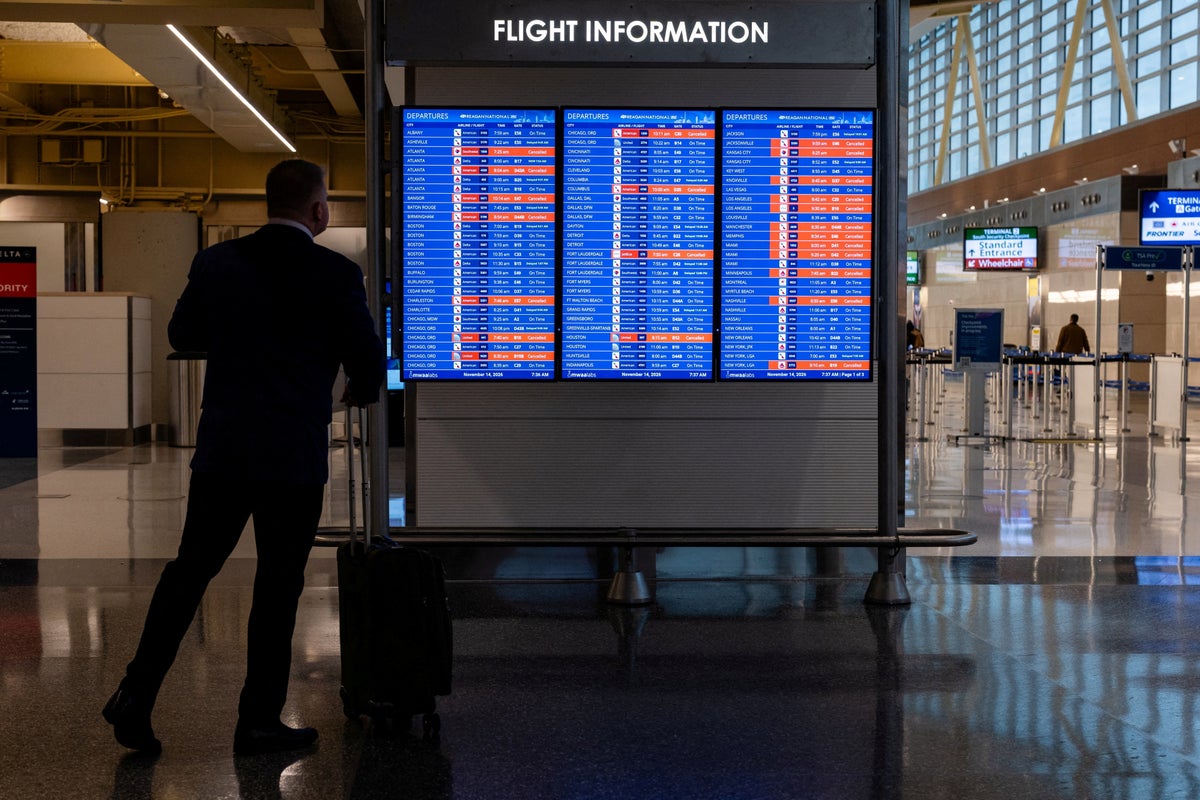
Flights across the U.S. are slowly returning to normal after a single router in Arkansas failed, triggering a nationwide ground stop and delaying or canceling thousands of flights. Air travel was picking back up again Monday morning, with just under 300 flights in the U.S. reported canceled and about 1,400 delayed, according to flight-tracking site FlightAware. That’s compared to about 2,300 cancellations and more than 10,000 delays on Sunday — and over 9,000 cancellations and about 7,400 delays on Friday when the widespread disruption began.Transportation Secretary Sean Duffy said Sunday that he was confident the issue would soon start to ease up, telling NBC News, “We’re going to start seeing things get better today, but I think back to normal tomorrow.” The disruption began Friday afternoon around 3:30 p.m. when the Federal Aviation Administration ordered a nationwide ground stop, keeping planes on the ground for more than four hours after noticing glitches in communications. As FAA employees began to try and troubleshoot the issue, they noticed that network gear at an FAA radio site in El Dorado, Arkansas, and possibly a radar site in Amarillo, Texas, overloaded the communications system that air-traffic controllers use, the Wall Street Journal first reported. Air travel was returning to normal on Monday, days after a nationwide ground stop that caused widespread disruptions (Reuters)“We saw two places that were actually pinging our network at a very high rate, a thousand connections over every four to five seconds,” Rebecca Guy, the FAA’s technology chief, said during a Saturday press conference. The FAA’s communications infrastructure is antiquated and has been undergoing a multibillion-dollar upgrade to modernize it. However, over the years, the system has suffered repeated failures while undergoing upgrades to the newer routing hardware.FAA officials told the Journal that they identified a feature on the router in Arkansas that appeared to be causing a data overload, and that it has since been disabled on all similar routers. However, the FAA still doesn’t know why the router went rogue. Duffy has said that officials found no evidence of a cyberattack and are focusing on what caused the mechanical problem with the router. FAA officials are looking into a router in Arkansas as a cause of the disruption (AFP/Getty)“This was an FAA system that didn’t meet the moment. Our contractor didn’t meet the moment. Or the equipment didn’t meet the moment,” he said. While the nationwide ground stop was lifted after about four hours on Friday evening, it has continued to impact flights throughout the weekend and into Monday morning.Chad Brightbill, from Colorado, was at Patrick Leahy Burlington International Airport in Burlington, Vermont, Friday when the ground stop was ordered — and saw firsthand how the chaos impacted fellow travelers. “Everybody’s sort of looking at each other and trying to figure out what’s going on. It was a little scary. I was around for 9/11, so it kind of felt like that,” Brightbill told WPTZ. “I was just getting ready to get on a plane that day. It was concerning.” Another passenger who had been sitting on a plane at Albuquerque International Sunport in New Mexico on Friday described the sudden change of plans. “They pulled us back into the gate, held us there for about 15 minutes, and then pulled the jet bridge up, and we deplaned,” the passenger told KOAT. “Yeah. Big, big, big inconvenience for you. Oh. Very much. My son’s birthday is tomorrow.” A track and field team from Wyoming was also stuck in New Mexico and left trying to figure out how to get back home. “We’re thinking about driving back because it’s about…it’s just a little bit longer to drive back. Just an inconvenience to get cars and stuff,” one member of the team told KOAT.
Nation’s flights return to normal after single router in Arkansas shut down the skies and caused travel chaos
Full Article
Original Source
Read the full article at Independent →KhanList aggregates and links to publicly available news content. We do not host full articles from third-party sources. Always verify important information with original sources.