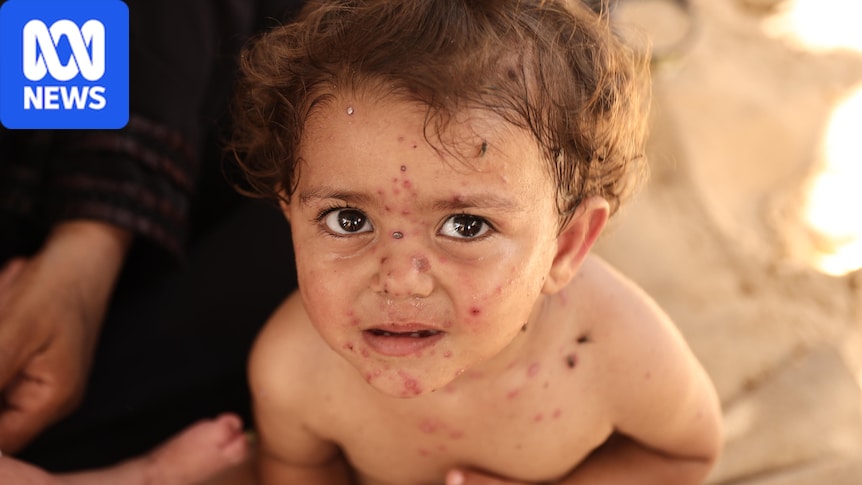
In Gaza's stifling summer heat, 19-month-old Retaj can do nothing but cry from the painful lesions that cover her tiny body.Warning: This story contains details and images that some readers may find distressing.The toddler has chickenpox, which have caused rashes, some the size of coins, to spread over her skin and form scabs on her back.Retaj's mother and grandmother have tried, in vain, to help her recovery, attempting to cool her down with a fan inside their small tent in a camp around Khan Younis.But the girl's discomfort remains."If you have a look at [Retaj's] back you will see her skin is bleeding," her grandmother Asma Ahmad Abu Ghali, 50, told the ABC.Retaj is still suffering from the pain of her chickenpox blisters. (ABC News)The little girl's skin is pockmarked by blisters and rashes caused by chickenpox. (ABC News)Retaj's younger sister, Tala, is just 25 days old and is also suffering from the virus."The mother of the two girls had given birth, [and a week later] the small baby contracted chickenpox," Asma said."After the mother was released from the hospital, the little baby was in the hospital for six days."Then she was released from the hospital with no success in treatment … then her [older] sister contracted chickenpox."Retaj's sister is also recovering from the chickenpox virus spreading in Gaza. (ABC News)In most cases, those who contract the virus experience mild symptoms and recover quickly.But battling an outbreak of a debilitating skin disease in Gaza has been made harder due to a lack of sanitation, summer heat and overcrowding.Hundreds of thousands of people were displaced from their homes throughout Israel's bombardment of the strip. They have been forced to relocate, some multiple times, and find new places to live in tent camps in the shrinking area in Gaza not under the control of the Israeli military.Israeli strikes on some of those camps continue, despite a ceasefire technically being in force since October last year.Gaza's health authorities say more than 1,200 people have been killed in Israeli attacks during that period, although it does not specify which are Hamas fighters and which are civilians.The chaos has all combined to create a perfect storm of conditions in the areas for such diseases to spread."This is alarming and a red flag," Dr Ahmed Al-Farra, head of paediatrics at the Nasser Hospital in Khan Younis, told the ABC.Retaj, her sister Tala and their mother in a Gazan tent. (ABC News)A Gazan toddler with chickenpox napping in a tent. (ABC News)Asma said it was difficult to maintain basic hygiene in the tent camps."When we were in our homes, we used to have [a] bath [two] to three times a day," Asma said."Here [in the tent camp] we bath the children once in two days, or once every day."The water that is available for bathing is not necessarily clean, and the camps are also riddled with fleas and mice.Retaj sits with her grandmother and mother as she recovers from chickenpox. (ABC News)Emergency plans activated in parts of GazaHumanitarian agencies have been sounding the alarm over surging chickenpox cases in Gaza for weeks.In early July, the United Nations recorded more than 9,300 new infections in only a fortnight and many of those cases were concentrated in tent communities around Khan Younis, in Gaza's south.Babies and young children have been particularly vulnerable to spread of chickenpox through Gaza. (ABC News)A Gazan baby with chickenpox is fed in hospital. (ABC News)The Danish Refugee Council said the number of cases in that narrow window was significantly higher than at other times during the war, and it had activated its emergency plans for five sites across Khan Younis.They included trucking in safe water to use for washing and cooking, distributing personal hygiene kits, and trying to bolster sewage collection in the area.Buckets of water set up near tents in a Gazan camp. (ABC News)In the neonatal ward of Nasser Hospital, Dr Al-Farra watched on as a 26-day-old baby was treated for chickenpox.His face was covered in small scabs, and he could barely keep his eyes open as staff fed him a bottle.A Gazan baby with chickenpox drinks from a bottle. (ABC News)Dr Al-Farra said that the lack of immunity in Gaza, the appalling conditions, and a shortage of vaccines for the population made chickenpox very dangerous."[This virus] can cause myocarditis, it can cause pneumonia, it can cause meningoencephalitis," Dr Al-Farra told the ABC."A lot of complications."The fatality rate or the mortality rate can reach 25 or 30 per cent if the treatment is not available for this virus."A nurse delivers care to a baby with chickenpox in a Gazan hospital. (ABC News)The ABC asked COGAT, the agency within the Israeli military responsible for aid deliveries into Gaza, a series of questions about the outbreak.They included what plans it had to allow aid into the strip to tackle the problem, and whether it took responsibility for the circumstances which led to the situation."COGAT is continuously monitoring developments together with the international community," it said in a statement."To date, no requests have been submitted for the entry of vaccines. Should such requests be submitted, they will be approved."It should be noted that in the past, we have approved and coordinated the entry of vaccines into the Strip, such as the polio vaccines that were brought in multiple times throughout the war."Diseases and viruses can spread quickly through the tent communities around Khan Younis. (ABC News)Tents set up in a camp around Khan Younis. (ABC News)The agency said there was enough water being supplied to Gaza, more than 70,000 cubic metres each day, adding it was "a volume that significantly exceeds the humanitarian threshold"."At the same time, Israel facilitates the entry of extensive equipment in the fields of water, sanitation, and hygiene," COGAT said."[It] coordinates ongoing repairs to water infrastructure, approves new waste collection sites, and advances responses to requests and projects from international organizations, including the approval of 10 unique requests for projects received from the international community."It is little comfort for Asma and her grandchildren as they deal the chickenpox outbreak.Calamine lotion, handed out by humanitarian agencies, is the only relief available in a strip where survival has become a daily battle.
'Her skin is bleeding': Devastating virus wreaks havoc in Gaza
Full Article
Original Source
Read the full article at Abc →KhanList aggregates and links to publicly available news content. We do not host full articles from third-party sources. Always verify important information with original sources.