
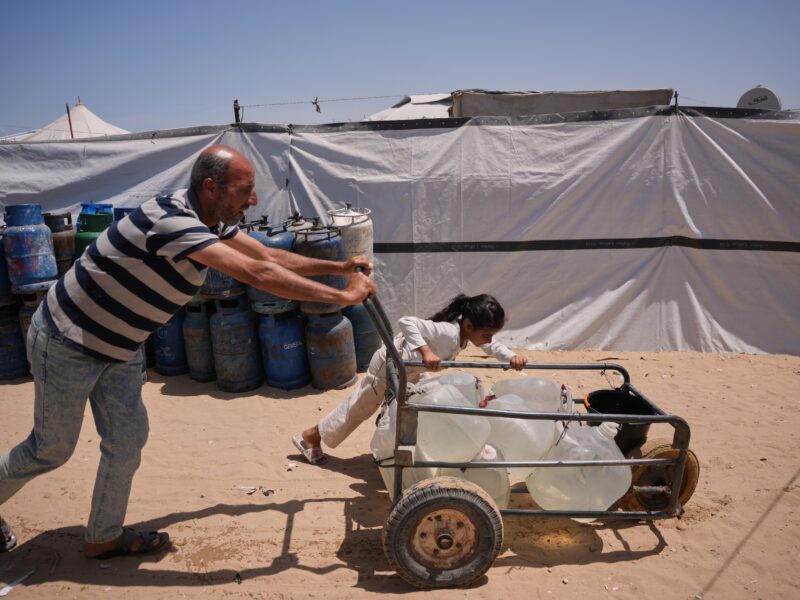
Despite a ceasefire, violence has not halted in the Gaza Strip, and Israel continues to impose significant restrictions on the entry of goods, including medical equipment and fuel.(AFP) — The approaching rainy season risks worsening a dire public health crisis in Gaza, where most people live in overcrowded tent camps amid rubble and overflowing sewage, the World Health Organization warned Tuesday.The WHO said water quality had already clearly deteriorated in recent months while the number of diarrhea cases had surged.“Whilst we fail to provide people with the minimum quantities of water, water quality and water contamination remains a major issue,” said Reinhilde Van de Weerdt, the WHO’s representative in the Palestinian territories.Gaza has been engulfed in a devastating health and humanitarian crisis since Israel launched its war in the territory following Hamas’ unprecedented Oct. 7, 2023, attack inside Israel.Despite a U.S.-backed ceasefire that took effect in October 2025, violence has not halted in the Gaza Strip, and Israel continues to impose significant restrictions on the entry of goods, including medical equipment and fuel.In April, Doctors Without Borders said Israel was using access to water as a “weapon” in Gaza, citing data from the United Nations, European Union and World Bank indicating that Israel had destroyed or damaged nearly 90% of the territory’s water and sanitation infrastructure.Israel rejected the report at the time.Testing of about 6,700 water samples during the first eight months of the year indicated that “microbiological contamination almost tripled,” Van de Weerdt told reporters in Geneva, speaking from the Gaza Strip.Contamination increased from less than 6% in January to more than 18% in August, the tests showed.Van de Weerdt said the lack of laboratory capacity in Gaza meant the tests could not detect all contaminants likely present in the water and environment.It was therefore not surprising, she said, that cases of acute watery diarrhea had nearly doubled since March, rising from about 27,000 to more than 48,000 in August.Van de Weerdt warned that the approaching rainy winter season was likely to deepen the health crisis.The “vast majority of people in Gaza still live in very overcrowded sites of flimsy tents” surrounded by “metres-high mounds of garbage” and with “overflowing sewage everywhere,” she said.“Flooding in these very overcrowded places will (send) the sewage, the waste and contaminated water into the places where people sleep, cook and care for their loved ones,” she warned.At the same time, “the standing water will further allow for breeding grounds for mosquitoes and other pests,” while tents “will be infested with mold.”Van de Weerdt said there was still time to prevent a public health disaster.She called for “unimpeded and expedited entry of humanitarian supplies,” including materials needed for permanent shelter, sustainable water supplies and waste management.More laboratory supplies were also needed to quickly confirm the causes of disease and improve responses to outbreaks, she said.Subscribe to our free newslettersOur weekly newsletter Closing Arguments offers the latest about ongoing trials, major litigation and rulings in courthouses around the U.S. and the world, while the monthly Under the Lights dishes the legal dirt from Hollywood, sports, Big Tech and the arts.Additional Reads
Health risks soaring in Gaza as rainy season nears: WHO
Full Article
Original Source
Read the full article at Courthousenews →KhanList aggregates and links to publicly available news content. We do not host full articles from third-party sources. Always verify important information with original sources.