
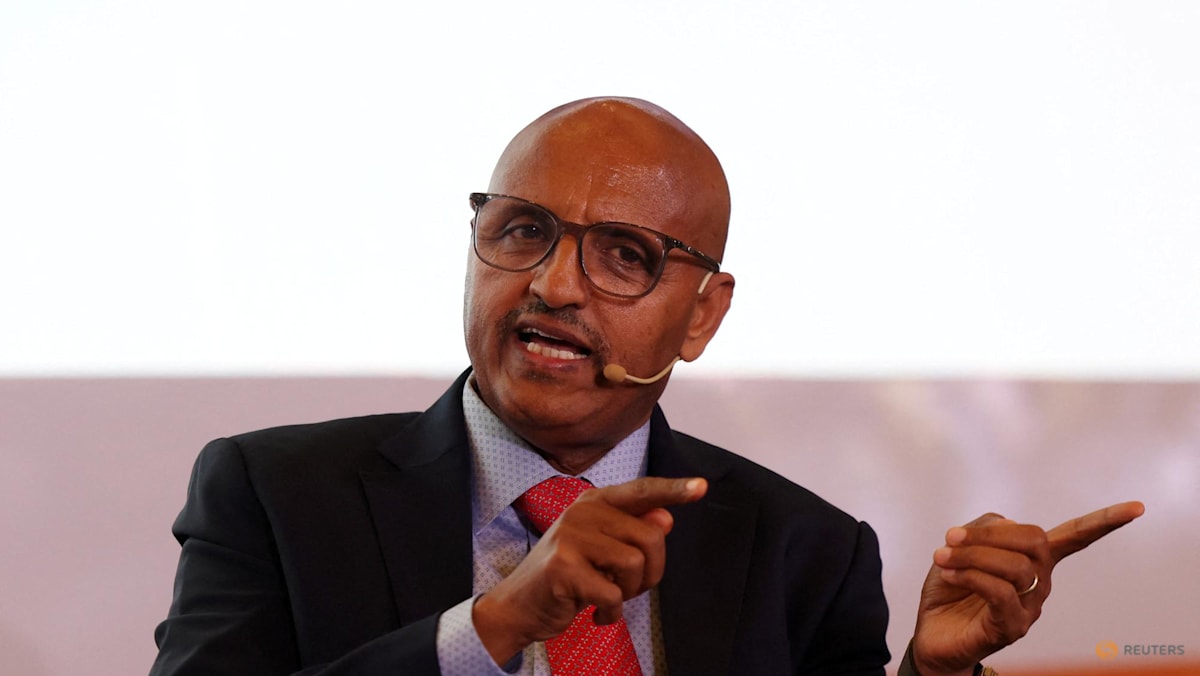
SINGAPORE: Turning around an airline that has struggled to make money for nearly two decades is no small feat. But the man now tasked with reviving Air India has built an aviation powerhouse before - and he is impatient to do it again. In his first major public appearance since his appointment in August, Air India CEO Tewolde Gebremariam outlined plans to turn around the loss-making carrier, saying he expects it to return to profitability “very soon”. “I am more impatient than the shareholders to see profitability,” Gebremariam told attendees at an aviation conference in New Delhi on Tuesday (Nov 3) - although he offered no timeline for achieving that goal. His ambitions are sweeping: Expand the airline’s international network, acquire more long-haul aircraft and develop major aviation hubs across India while cutting costs.The stakes also extend beyond India. Singapore Airlines (SIA) owns a 25.1 per cent stake in the carrier, an investment that has come under scrutiny as Air India's losses mount and its owners face calls to inject more capital. Gebremariam, however, has a track record of building an aviation powerhouse. During his 11 years at the helm of Ethiopian Airlines, revenue grew more than fourfold as the carrier expanded its fleet and international reach.But analysts say there is a crucial difference between his previous assignment and the one he has taken on now.Ethiopian Airlines was already profitable when Gebremariam became CEO in 2011. Air India, by contrast, is grappling with mounting losses, fierce competition and operational constraints.Analysts say his experience could help revive the struggling Indian carrier, but caution that the strategies that worked in Africa may not necessarily deliver the same results in India.“The two tenures are not comparable in challenges,” said Ameya Joshi, founder of aviation analytics website Network Thoughts. “Strategies cannot be copy-pasted as such.”TRANSFORMING ETHIOPIAN AIRLINESUnder Gebremariam’s tenure, Ethiopian Airlines grew into Africa’s largest carrier - with annual revenue surging from about US$1 billion in 2011 to US$4.5 billion by the time he stepped down in 2022. Its fleet rose from just 33 aircraft to 130, with annual passenger numbers also quadrupling to 12 million, as the airline expanded its international network and cemented the capital Addis Ababa’s position as a major aviation hub. Ethiopian Airlines former CEO, Tewolde Gebremariam, during an interview with AFP in Addis Ababa, Ethiopia, on Apr 21, 2020. (Photo: AFP/Michael Tewelde) Mark D Martin, founder and CEO of aviation consultancy Martin Consulting, attributed much of that success to Gebremariam’s grasp of airline finances and emphasis on operational efficiency over branding.“His two pillars are maintenance and flight service,” Martin said - pointing to Gebremariam's focus on flight crew procedures, aircraft upkeep and passenger experience.Ethiopian Airlines was already profitable when Gebremariam's took over from his predecessor Girma Wake in January 2011.His achievement was in scaling up an established, financially healthy airline rather than rescuing one in distress. Mayur Patel, an aviation analyst at aviation data firm OAG, said the struggles of other African national carriers created an opportunity for Ethiopian Airlines to establish Ethiopia’s capital Addis Ababa as a major aviation hub - connecting the continent with the rest of the world.The airline capitalised on that by establishing an extensive international network and making transit more convenient for passengers travelling through Addis Ababa. Martin shared his own positive experience flying with the airline from Delhi to Vienna via Addis Ababa earlier this year, which provided hotel accommodation, meals and airport transfers during an 11-hour layover.“It's like what travel was back in the 50s and 60s, where the airline also gave you hotel and transports during a layover,” he said.But conditions now are fundamentally different for Air India in the current landscape, Martin said.Gebremariam is “inheriting probably the toughest challenge that he can ever take up,” he added.CAN GEBREMARIAM’S ETHIOPIAN AIRLINES PLAYBOOK WORK IN INDIA? Gebremariam’s strategy for Air India bears some resemblance to the approach that helped Ethiopian Airlines become an African aviation powerhouse: Expand international operations, strengthen transit hubs and keep costs under control.His plans include acquiring more wide-body aircraft, opening up international routes and developing major Indian airports into hubs connecting passengers to destinations around the world. An Air India Airbus A350 aeroplane is displayed at Wings India 2024 aviation at Begumpet airport, Hyderabad, India, Jan 18, 2024. (Photo: Reuters/Almaas Masood) Analysts broadly support these ambitions, but warn that executing them will require substantial investment, time and a competitive edge in an already crowded market.A key part of Gebremariam’s strategy hinges on expanding Air India's fleet of wide-body aircraft, which can carry more passengers over longer distances.Ameya Joshi, founder of aviation analytics website Network Thoughts, said the airline needs more such aircraft to grow its international operations. But additional orders will require fresh capital and approval from investors, he added.Deliveries could also take years, he cautioned, by which time market conditions may have changed. And even with more aircraft, profitability would depend on Air India's ability to attract enough passengers to fill the additional seats.Funding is already proving to be a pressing issue.Reuters reported in August that Air India was seeking about US$1.5 billion in fresh equity from its owners, Tata Group and SIA.In September, Tata approved a US$1.1 billion capital infusion, representing its share of the proposed funding, while SIA announced that it was seeking stronger governance rights before committing more capital.Beyond securing aircraft and funding, Gebremariam must also decide where Air India can compete most effectively.Martin said the airline’s focus on international expansion was a step in the right direction and believes it should prioritise long-haul routes to destinations in Europe and the United States, where it could generate more foreign-currency revenue.But building a competitive international network will require more than additional flights, Martin said. He warned that the lack of dedicated airline hub facilities at Indian airports could hamper Air India’s ambitions. Such facilities allow airlines to consolidate operations within a terminal, making transfers between connecting flights more seamless.Closer cooperation with airport operators would therefore be crucial, he said.Air India’s international ambitions also face an obstacle largely beyond Gebremariam’s control: Pakistan’s airspace restrictions on Indian carriers, which have been in place since April 2025.The restrictions have forced Indian airlines to take longer routes on several westbound flights to Europe and North America, pushing up fuel consumption and operating costs.Together, Europe and North America accounted for more than a quarter of India's outbound international passenger traffic in 2024, or about 10.7 million passengers, according to the International Air Transport Association (IATA).With westbound operations becoming more expensive, Patel said eastbound markets such as Southeast Asia and Australia have become more attractive for Air India's expansion.Against this backdrop, Gebremariam has said the airline is exploring Bengaluru as a third hub alongside Delhi and Mumbai, as part of efforts to reshape its international network.Bengaluru could play an important role in connecting domestic passengers to international flights, said Patel - although developing such a network would take time. A ground staff member looks on as an Air India aircraft takes off at Kempegowda International Airport in Bengaluru on Jun 10, 2026. (Photo: AFP/Idrees Mohammed) Joshi noted that Air India already has an established hub in Delhi, which has long supported domestic and international connections. With more aircraft, competitive fares and an improved passenger experience, the airline could build on that foundation, he added.Both analysts pointed to India's vast domestic passenger market as a potential advantage.Rather than relying solely on attracting international transit passengers away from established hubs such as Dubai and Singapore, Air India could draw on domestic demand to fill its long-haul flights.That could give Gebremariam a valuable starting point as he attempts to build a more competitive international airline - even if replicating his Ethiopian Airlines success proves far from straightforward.AIR INDIA’S TOUGHEST CHALLENGE AHEADFor all his ambitions to expand Air India's international reach, Gebremariam faces a more immediate challenge: Stemming the airline’s mounting losses while grappling with a host of operational and safety concerns.Air India and its budget subsidiary Air India Express reported combined losses of about US$2.33 billion in the financial year ended March 2026, more than double the previous year's losses.The carrier is also dealing with the aftermath of the June 2025 crash of Flight AI171 in Ahmedabad, which killed 260 people and intensified scrutiny of its safety standards.India's Aircraft Accident Investigation Bureau has yet to release its final report on the cause of the crash. Wreckage of the Air India Boeing 787-8 Dreamliner plane outside Sardar Vallabhbhai Patel International Airport, in Ahmedabad, India, on Jul 12, 2025. (Photo: Reuters/Amit Dave) Martin said Gebremariam had inherited an exceptionally difficult assignment, including managing the fallout from the disaster and developments arising from the ongoing investigation.Beyond the crashes, the airline is also contending with challenges like higher fuel costs, delays in refurbishing its aircraft and regulatory scrutiny over safety and compliance lapses, according to reports.The airline also faces fierce competition from domestic market leader IndiGo and established international carriers, making it harder to raise fares to offset rising expenses.Patel said India's highly price-sensitive market leaves airlines with little room to pass rising costs onto passengers without affecting demand.He added that fuel expenses and longer flight routes caused by Pakistan's airspace restrictions also continue to weigh heavily on the airline.Given these challenges, Gebremariam's immediate priority should be to reduce losses rather than push for a swift return to profitability.The new CEO has already moved to tighten spending.Air India has set up a dedicated team to identify cost savings and introduced stricter spending approvals, according to an internal memo reported by Reuters in October.Bloomberg reported in September that Gebremariam was also considering merging Air India with its budget subsidiary, Air India Express, to streamline operations and reduce costs.Martin supported the idea, saying a merger could eliminate overlapping functions and improve efficiency.Patel said the airline's tighter approach to spending was already evident in its dealings with suppliers, with expenditure coming under greater scrutiny.But he questioned how much further costs could be cut, particularly when major expenses such as fuel remain largely beyond the airline's control.Ultimately, even a successful cost-cutting drive may not deliver the quick turnaround Gebremariam is seeking.Martin believes the former Ethiopian Airlines chief has the experience and strategy needed to restore Air India to profitability, but estimates that the process could take three to five years.“I think we need to be a little more patient,” he said.
He transformed Africa’s biggest airline. Can he turn around SIA-backed Air India?
Full Article
Original Source
Read the full article at Channelnewsasia →KhanList aggregates and links to publicly available news content. We do not host full articles from third-party sources. Always verify important information with original sources.