
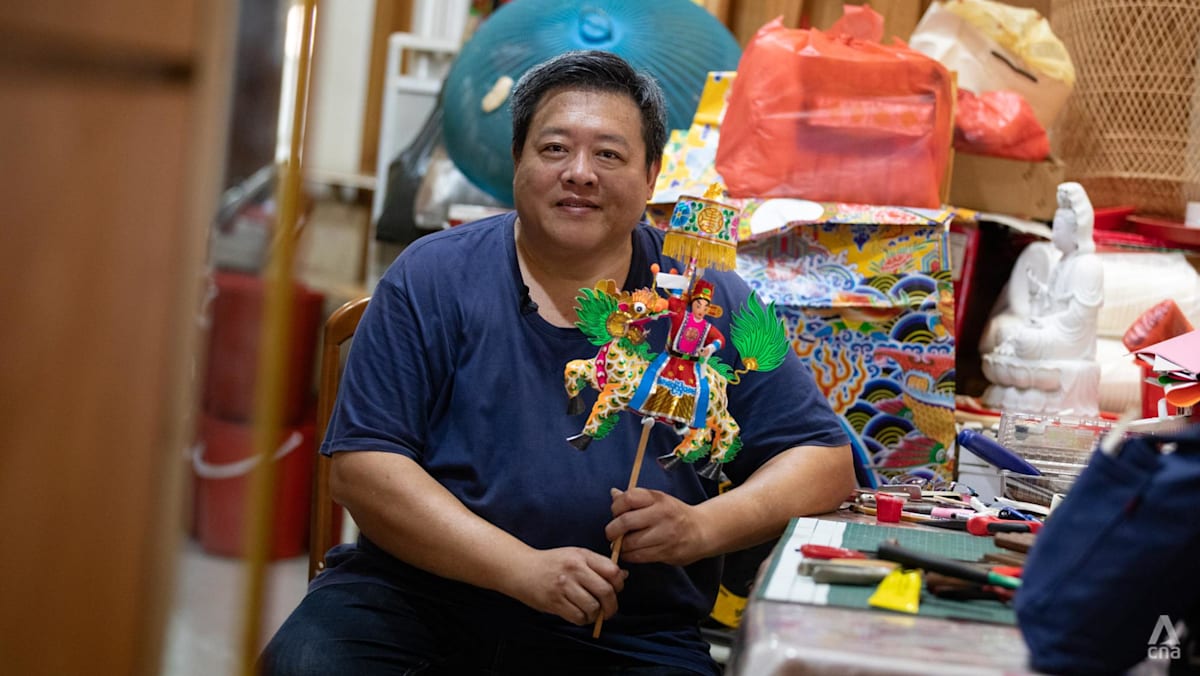
I had been in the living quarters of Sean Hua Zee Temple only for a few minutes, but I was already starting to sweat. Despite the afternoon heat, the ceiling fan remained off.It couldn't be helped, though. In the middle of the room, Mr Francis Tan Kwee Chye was hard at work, carefully rubbing gold leaf into a wooden signboard. Turning the fan on for some cooling relief would blow the delicate foil away.When I had arrived at the temple off Changi Road, which doubles as Mr Tan's home and studio, the 50-year-old welcomed me in before apologetically asking for a few minutes to finish the work in front of him.As a master of traditional Teochew crafts, he's spent over three decades handmaking wood carvings, temple lanterns, paper effigies and even refurbishing deity statues. Mr Tan is not especially talkative, but once the conversation turns to his work, he seems to light up. He readily reaches for photographs, old pieces or reference books, eager to explain how something was made or point out a detail that might otherwise escape my notice.At one point during my visit, he even broke open a container that had been sealed for about two decades to show me the miniature figurines kept inside, some of which he had made in primary school.Straightforward doesn't interest him – he prefers the challenge of elaborate flowers, birds and animals over simpler creations such as tables and chairs."I like to make special things," he said simply.Presented with proof after proof of Mr Tan's artistry, I was surprised to learn that his impressive skills were almost entirely self-taught.He has never formally apprenticed under a master, instead painstakingly honing his abilities through years of observation, failed attempts and fragments of guidance from other artists. LEARNING WITHOUT A TEACHERAt first glance, Sean Hua Zee Temple looks like a regular home, wedged into the middle of a row of landed houses. A red banner and signboard beckon devotees in to make their prayers and offerings. Growing up in a home temple made objects such as wood carvings and lanterns a familiar part of his surroundings. As a child, Mr Tan also often accompanied his mother to street opera performances. He understood little of what was being sung on stage, but was drawn to crafts used in the street opera that were similar to those displayed around the temples.In Primary 3, Mr Tan started trying to reproduce some of them himself.One of his earliest projects was a miniature joss paper dragon traditionally presented to deities during birthday celebrations.With no YouTube or internet tutorials to consult back then, Mr Tan photographed a full-sized version with a camera, scaled down its proportions, then drew and coloured in the smaller version himself.Proper materials were expensive for a nine-year-old, so he improvised. "Instead of buying gold foil, I used chocolate wrappers to get the same effect," he said. By around Primary 6, Mr Tan had also started trying his hand at wood carving. Still aged only 12, Mr Tan would run out after school to nearby factories to ask for unwanted wooden pallets. He would break them down with a hammer himself and carry the usable pieces home.Having no carving tools, he relied on a penknife, but the makeshift tool left his hands blistered, while mistakes were frequent. "When you first carve, you don't know how to control your strength," he said. "So it's either I cut it too deep or I scraped off the part which I wanted."With no teacher to instruct him, he spent several months on his first wood carving: a sea lion. Even now, about 40 years later, he still keeps some of those early pieces to measure his progress – a physical record from a time when taking photographs was costly and mobile phones did not yet exist. Mr Tan's first wood carving, a sea lion, which he made when he was in primary school. (Photo: Francis Tan) Mr Tan remembers his mother being "quite supportive, because I (wasn't) doing anything wrong or illegal". Nevertheless, he's aware that his dedication and persistence back then may have been seen as rather unusual by others, given his young age.At around 15, Mr Tan joined a lion dance troupe. After a friend in the troupe mentioned his craft hobby to an events company they worked with, Mr Tan was invited to make miniature Chinese opera masks in front of tour groups as a live demonstration."I was young, so I felt quite excited that my work was being recognised," he recalled.Despite that early recognition, Mr Tan never imagined that crafts would eventually become his livelihood. Mr Francis Tan, then aged 12, with his father. (Photo: Francis Tan) A CRAFT THAT NEVER LEFT HIMAfter his O-Levels, Mr Tan studied drafting at the Institute of Technical Education. After graduating, he worked as a draftsman for a few years before being unexpectedly retrenched. He later became a construction project coordinator at another company.All the while, though, he found himself unable to set aside traditional crafts. His construction boss allowed him to take discarded materials from work sites, so he continued taking on craft projects on the side, partly for extra income but also "because of passion". At the same time, he struggled to find senior craftsmen to teach him to perfect the skills he'd already developed. When Mr Tan was about 24, a relative who ran a joss paper shop asked him to refurbish a deity statue. Mr Tan turned him down because he didn't feel confident he could do the work.His relative persisted, assuring him that a professional could take over if needed. Mr Tan agreed, and upon completing his refurbishment, his relative showed it to experienced craftsmen without revealing who had done it.Mr Tan was present, allowing him a rare chance to listen to qualified critiques."I just sat there and listened to the feedback … just tried to improve from there."About six years after that, Mr Tan approached a joss paper shop owner hoping to learn from him, but was turned away for reasons he never learnt.With no one willing to teach him, Mr Tan has been honing his craft skills much as he did in childhood – by studying finished objects and, in a way, reverse engineering the techniques that went into creating them by himself. Even today, his workspace is crowded with reference books on Chinese opera characters, costumes and traditional weapons to fill the gaps in his formal knowledge.In his early 40s, Mr Tan concluded his career in construction, concerned about prolonged exposure to cement and sand dust. Having built up a small base of regular customers for his craft work, he decided it was time to make his part-time passion a full-time occupation. A joss paper dragon robe hanging on a wall at Sean Hua Zee Temple, which also serves as Mr Francis Tan’s home studio, on Aug 17, 2026. (Photo: CNA/Mak Jia Kee) AN OLD CRAFT IN MODERN SINGAPOREMr Tan's line of work is one that some people would rather keep at a distance. In his experience, some are reluctant even to touch joss paper or enter shops selling it because of the associations with the dead."But if you don't do it, who is going to do it? Somebody has to do this," he said.For some customers, Mr Tan's creations serve a deeply personal purpose.Several years ago, a couple approached him with an unusual request: Would he make them two joss paper replicas of the same portable handheld fan, each in a different colour?The request was made through a third party, who told Mr Tan that the couple had dreamt of their recently deceased daughter asking for the fans, and wanted joss paper versions that could be burnt as offerings for her.They had spent some time searching around Singapore and even making inquiries with Malaysia-based businesses, but no one seemed to be able or willing to take on their request.He did not know much else – not even the couple's ages, nor how old their daughter had been when she died.With only a photograph and no measurements provided, Mr Tan had to rely on online specifications for the fan's dimensions. After about six months of experimentation, he eventually made two fans out of joss paper. The customer had separately asked for a power bank and cable to accompany them.Mr Tan admitted to having felt daunted at first. He had even suggested the parents simply buy real fans for about S$20 (US$15.80) each, rather than pay him much more to create joss paper replicas."After listening to their story, to me it's a motivation," he said. "It pushed me to make (the fans) more detailed, and try to make the deceased happy."He has since gone on to recreate other contemporary objects out of traditional joss paper, including track shoes and dumbbells. Such customised orders often require extensive trial and error, so he takes them on only when he has time to spare. "To me, it's a form of respect to the deceased," he said. "Try to make it as real as possible, even though it's a joss paper product."After spending so much of his life in traditional crafts, Mr Tan said he is no longer uneasy about the trade's association with death. He sees it instead as a service to the deceased and, in turn, to the families commissioning the pieces, who may find some comfort in being able to fulfil a loved one's final or imagined wishes. KEEPING TRADITIONAL CRAFTS ALIVE IN SINGAPOREAs much as Mr Tan struggled to find master craftsmen to learn from in his young adulthood, that struggle may be even greater for young learners today. He said most traditional craftsmen in Singapore are already well into their 60s and older. And at the age of 50, he reckons he could be among the youngest of those still working today.Two years ago, Mr Tan began conducting traditional craft workshops and found that many participants recognised the objects he showed them without knowing how they were made or what they meant. Among locals, older participants also tended to outnumber younger adults.Some young people have nevertheless approached him wanting to learn directly from him, placing the self-taught craftsman in the unfamiliar role of potential teacher.While Mr Tan is willing, he has yet to accept an apprentice. Showing interest alone is not enough for him. "I'm still observing people. Before you teach someone, you have to see their character."The challenges don't end there for the micro-industry of traditional Teochew crafts. The already small pool of traditional craft makers and craft businesses is dwindling as older practitioners retire. The work also demands long hours and specialised skills, making it difficult to bring in temporary help during periods of heightened demand, such as the seventh month of the Chinese lunar calendar."You feel sad, but (you have) no choice," said Mr Tan. Paper effigies of hell officer deities made by Mr Francis Tan in 2016. (Photo: Francis Tan) At the same time, demand for handmade work is dipping in a sea of cheaper, ready-made alternatives easily available on e-commerce sites such as Shopee and Taobao. To less-informed customers, printed or machine-made products may look little different from handmade ones. These days, it's not unusual for Mr Tan to spend up to a week making an item that sells for only about S$100.Also at risk of disappearing are the rich history and knowledge behind these traditional artefacts – the symbolism and significance behind the colours, motifs and forms they bear, all of which Mr Tan has absorbed over decades of making them."It's art, but it's also connected with culture," he said. "After you do it for some time, you will understand more about Chinese culture."By now, little separates Mr Tan's work from the rest of his life. Sean Hua Zee Temple is both home and studio, filled with tools, reference books and pieces accumulated over decades. The craft was already part of that life when he met his wife through a dating service in 2013, while he was still working in construction. Before they married, he made clear what he did."I did tell her what I'm doing," he recalled. "If she accepts it, then we can get together. If she cannot accept it, then no choice."Certainly, Mr Tan's trade may seem an unconventional one compared to the office jobs that dominate the job market today. But Mr Tan said he prefers not to make such comparisons – nor does he appear to feel particularly isolated working in a small, shrinking trade. He's become accustomed to solving problems on his own, trying different ideas, materials or methods until something works.It is far from the future Mr Tan imagined at nine, when crafts were simply a hobby. At 50, he now sees himself continuing for as long as his strength and eyesight allow."Maybe I'll just continue until the day I am not very fit to do this type of traditional craft."If he has his way, even retirement won't part him from his art. Even after stepping back from work, he sees himself continuing to make paper crafts "as a memory, or just for myself".
He taught himself traditional Teochew crafts as a boy. More than 40 years later, he's still learning
Full Article
Original Source
Read the full article at Channelnewsasia →KhanList aggregates and links to publicly available news content. We do not host full articles from third-party sources. Always verify important information with original sources.