
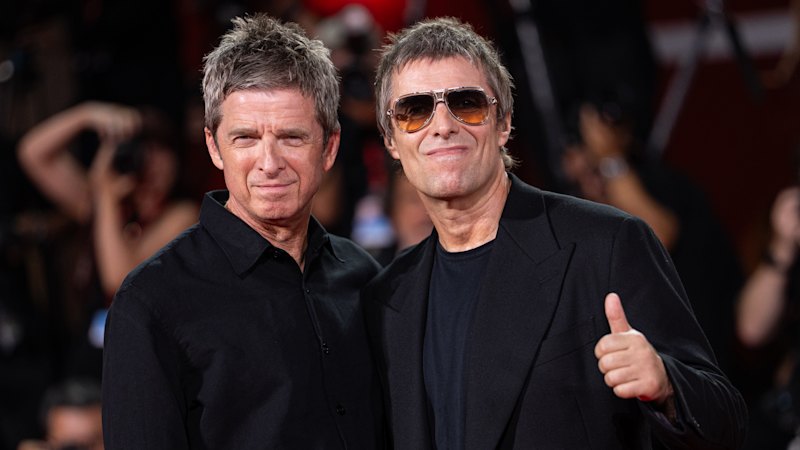
September 6, 2026 — 4:02pm“I wasn’t prepared for the outpouring of joy and tears, and the sense of what it meant to people,” says Noel Gallagher.He is interviewed somewhere in the middle of the mighty Oasis reunion tour of 2025, chronicled in a new documentary, Don’t Look Back in Anger, that screened at the Venice Film Festival.“The gravity of it took me by surprise. It knocked me back.”Noel and Liam Gallagher attend the Oasis: Don’t Look Back in Anger screening at the Venice Film Festival.Getty ImagesThe film, scripted by Peaky Blinders writer Stephen Knight and directed by Dylan Southern and Will Lovelace, is full of rolling tides of people in bucket hats and parka jackets surging into stadiums, weeping as they hear their favourites or simply laughing with glee.A Catholic bishop in Manchester gives a sermon comparing the streams of people heading for the concert to a pilgrimage. It isn’t just about the music, as one fan says. It’s the reconciliation of two of Manchester’s favourite sons that has moved the crowds across the world.Fifteen years after a final fight between the Gallagher brothers broke up the band, Noel tells the directors that touring with his estranged brother is “a chance to change the narrative of the band”.Famously, they hadn’t spoken since their blazing row in a Los Angeles dressing room, right before they were due on stage, leaving fans hanging. Liam, in a separate interview to camera, predicts simply – and true to form – that their first comeback show in Cardiff will be “f---ing carnage”. Both turn out to be right.The Gallaghers were in Venice for their premiere but – also true to form – didn’t come to the press conference. There was some speculation that they didn’t want to be pinned down on the prospects of another tour; more likely, it was just the Gallaghers being Gallaghers.Meanwhile, Knight, Southern and Lovelace fielded questions. Stephen Knight says how surprised he was to be asked by Liam Gallagher’s team “to create a documentary with a plot” around the tour, given he had previously written only fiction. He jumped at it. “Of course, who wouldn’t? I’m a big fan.”Meanwhile, he says, everyone connected to Oasis was surprised by the huge response to news that they would tour again, playing songs from their first two albums. The shows sold out immediately.“There was such a demand for tickets – not only from the generation that grew up with them, but the next generation who had a strong attachment to the music. The question was why had that happened? Why did this music endure?”The Gallagher brothers arrive in Venice.Getty ImagesThe rise and rise of Oasis, the battle of the brothers and the split is despatched quickly at the start of the film. “It’s called Don’t Look Back in Anger for a reason,” says Knight. “We’re not looking back at what happened. The spirit of this was intentionally, at a time of spite and social media meanness, about reconciliation.”The aim of the film, says Lovelace, was to capture that as it happened. “I think the whole world was interested in that 15 years apart, would it work and what was it going to be like.”At the beginning of Don’t Look Back in Anger, the filmmakers used 12 hidden cameras to record their rehearsals; the brothers speak where necessary, but barely look at each other.At least the music still works: the Gallaghers are both in their late 50s, but their voices are still true and Liam still attacks the microphone, as he says, “like I want to bite its head off”.On tour, the directors asked local cinematographers at stadium shows in several cities – Seoul, Manchester, Sao Paulo, Buenos Aires, with just a brief glimpse of Melbourne – to film what they wanted, on the stage or in front of it.Feud? What feud? Liam and Noel Gallagher embrace on stage during the Melbourne leg of their reunion tour last year.Richard CliffordThe performances are there – Oasis fans get plenty of bang for their bucks – but so are people trying to answer Knight’s initial questions. “As a writer of fiction, you get humbled by reality,” he says.“You hear why people are connected to a particular song, and it’s so eloquent. In South Korea, one woman said that when you fall down, some music picks you up but with Oasis, when you fall down, they fall down with you and then pick you up from the ground. I could never have written that.”Southern says: “On tour, it became as much about the crowd and how that influenced their relationship.” Fans cry – one man even falls to his knees and prays – but so do the band.Towards the end of the tour, Noel admits that he often had to turn his back on the audience. The film culminates in their first joint interview in decades, ribbing each other about how early they need to go to bed at their age. “It’s not scripted, so we didn’t know what was going to happen,” says Knight.“The relationship develops on tour, their kids become friends, and once again, it’s family. We were very fortunate because that’s exactly what we hoped would happen, because from the beginning we wanted to make this a film about reconciliation and forgiveness.”The brothers have seen it and, according to Knight, are “beyond satisfied”. No further fights are expected, says Lovelace. “They appear to be getting on pretty well.”Find out the next TV, streaming series and movies to add to your must-sees. Get The Watchlist delivered every Thursday.Stephanie Bunbury is a film and culture writer for The Age and The Sydney Morning Herald.From our partners
Hidden cameras, no script: Oasis documentary goes inside the Gallagher brothers’ split
Full Article
Original Source
Read the full article at Smh →KhanList aggregates and links to publicly available news content. We do not host full articles from third-party sources. Always verify important information with original sources.