
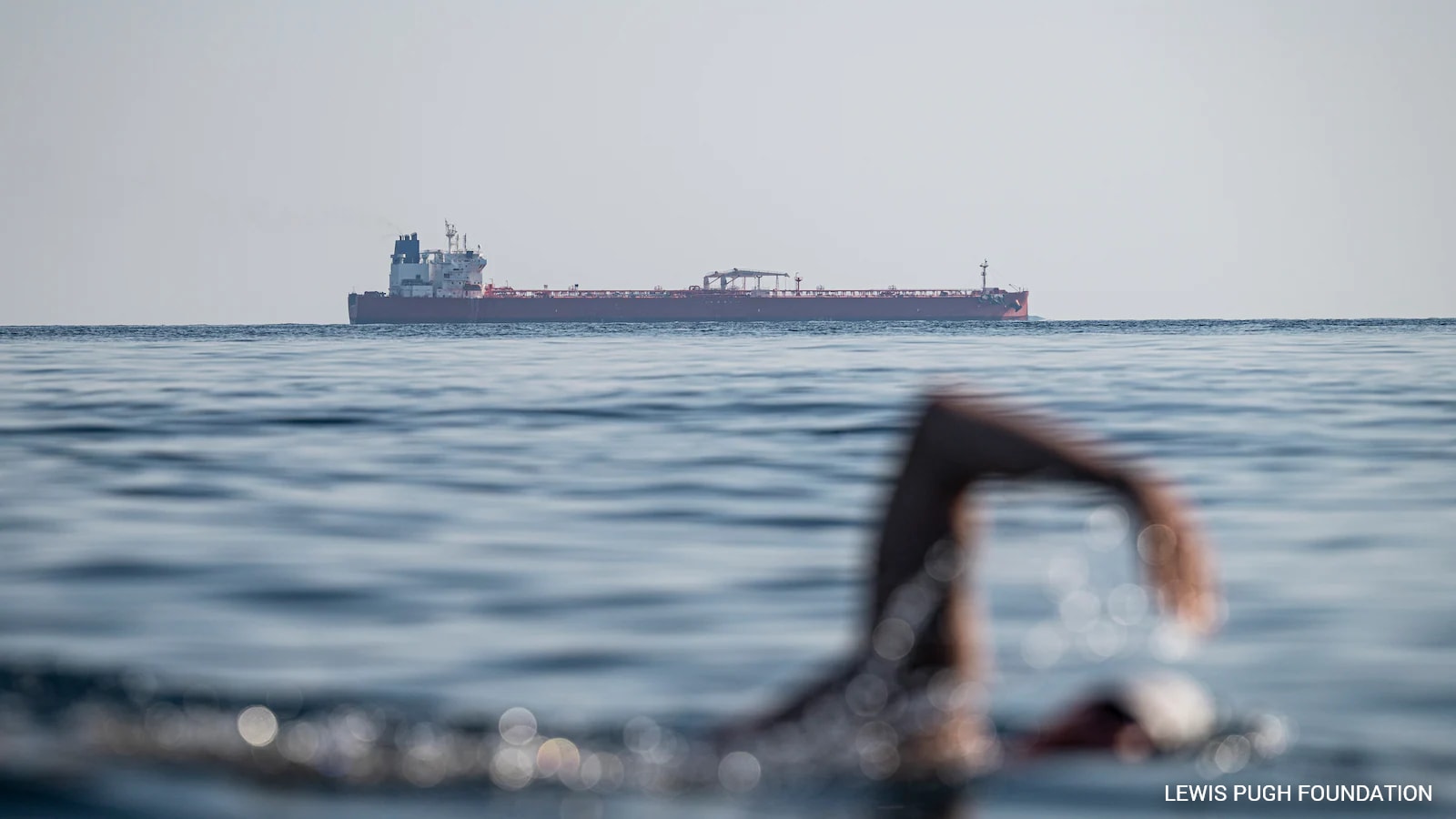
Thirty minutes into his swim, a tanker was hit.Lewis Pugh was in the water in the Strait of Hormuz when he heard the explosions. Fighter jets appeared overhead. The danger was no longer something happening somewhere beyond the horizon. It was unfolding around him.His team got out of the water and returned to shore.The next day, they went back.Pugh, the British endurance swimmer and UN Patron of the Oceans, had set out to complete a 15-kilometre swim over three days off Oman's Musandam Peninsula. He wanted to draw attention to the extraordinary marine environment of the region. Instead, he found himself swimming through an active conflict zone. Advertisement - Scroll to continue About an hour and a half into the second day's swim, he spotted a huge plume of smoke rising behind a mountain. The flames were so high, he recalled, that they could be seen above the 150-metre-high mountain.Lewis Pugh FoundationOn his way back, he passed what he described as an Indian gas carrier, the Tara Gas, which had been struck by a missile. The vessel was, in fact, Panama-flagged, but had 24 Indian seafarers on board.Advertisement - Scroll to continue"I've never witnessed anything like it before. The whole vessel was engulfed in flames," Pugh told NDTV in an exclusive interview.He described fireballs rising nearly 200 metres into the sky. The water around the ship appeared to be on fire. There was an intense smell of chemicals.As Pugh swam through the Strait, the contrast was almost surreal. To one side, there was conflict: explosions, fighter jets and ships under attack. To the other, the spectacular coastline of Oman's Musandam Peninsula, with its rugged mountains, fjords and clear blue waters. Dolphins moved through the water. An osprey swooped down to catch a fish. The natural beauty was all around him, even as the war unfolded within sight.It was this contrast that stayed with him. The Strait was not just a strategic shipping route caught in a war. It was a living ecosystem, and one that was now at risk.What Happens To Life Beneath Water?For Pugh, the Strait of Hormuz is not just a shipping lane or a strategic chokepoint. It is a marine ecosystem, home to dolphins, turtles, coral reefs and mangroves."People think of the Strait of Hormuz, and they think of a shipping lane. They think of geopolitics. They think of war. It's so much more than that," he said.His concern is that oil, heavy metals and toxic chemicals released during attacks on vessels could make their way into the marine food chain. Smaller organisms can absorb pollutants; fish feed on them, and larger marine animals feed on the fish. Contamination can travel well beyond the site of an incident.Pugh also worries about the impact on coastal communities. Much of the Gulf relies on desalination plants for freshwater. He warned that if seawater feeding these facilities were contaminated, the consequences could extend beyond marine life to drinking water supplies.Photo Credit: Lewis Pugh Foundation He recalled visiting an ancient village on Oman's Musandam Peninsula, where oil booms had been placed along the coast to protect the shoreline and a desalination facility. He described seeing oil on the barriers.For the people living there, the concern is immediate: the safety of their water, their livelihoods and the sea on which they depend.The full extent of the pollution remains unclear. Pugh said it was difficult to establish how many vessels had been attacked and how much oil or other material may have entered the water. The precise impact will require proper assessment.But he believes an environmental crisis is unfolding.'The Consequences Could Last Decades'Pugh fears that any significant oil or chemical contamination could outlast the war by years, potentially decades.Oil pollution and toxic chemicals can have lasting effects on marine habitats. Coral reefs and mangroves are particularly vulnerable, and the time needed for recovery depends on the type and extent of contamination.He has seen what conflict does to people. Recalling his childhood in a military hospital where his father worked as a doctor, he spoke of soldiers and sailors who had lost limbs in the First and Second World Wars. The physical consequences of war, he said, can stay with families for generations.Environmental damage has its own long aftermath.Photo Credit: Lewis Pugh Foundation "When we damage the environment, when we threaten the very foundations of life on Earth, it takes decades to recover," he said.The concern is not just what has happened to the water around the ships that were attacked. It is what may happen to the wider ecosystem, and to the communities that depend on it, in the months and years ahead.The Pause Before AnsweringThere was a long pause when Pugh was asked whether he had considered abandoning the swim.The first attack he witnessed had taken place barely half an hour after he entered the water. Fighter jets were overhead. His team had returned to shore and had to decide whether it was safe to continue.Pugh said he told the team he would understand if anyone wanted to stay on land. They discussed the risks before deciding to go back into the water, with greater caution.It was not the usual challenge of an endurance swim. There was no way of knowing what might happen next in a conflict zone.Yet the team continued.The Seafarers Caught In The ConflictThe attack on the Tara Gas brought another reality into sharp focus for Pugh: the people working aboard these vessels.Although the carrier sailed under the Panamanian flag, 24 of its crew members were Indian nationals. Many others working on commercial ships in the region come from countries such as China and the Philippines.They are civilians, far from home, navigating waters that have become dangerous.Pugh asked people to think about the families waiting for news of those on board, a wife wondering whether her husband is safe, a mother waiting to hear from her son.The crews of commercial vessels are not parties to the conflict, but they are exposed to its dangers.Who Pays For The Damage?Pugh wants the international community to ensure that the environmental damage is properly assessed and that the cleanup is funded. He believes the world must look beyond the immediate military and economic consequences of the war.He pointed to the 1990 to 1991 Gulf War as a warning of how long the environmental consequences of a conflict can last. As Iraqi forces retreated from Kuwait, they set fire to more than 700 Kuwaiti oil wells. The fires burned for months, sending huge quantities of smoke and pollutants into the atmosphere. Separately, oil was deliberately released into the Persian Gulf, causing extensive damage to marine life and coastal ecosystems.The international response established an important precedent. In April 1991, UN Security Council Resolution 687 affirmed Iraq's liability for direct losses and damage resulting from its invasion and occupation of Kuwait. This explicitly included environmental damage and the depletion of natural resources.The United Nations Compensation Commission, set up to process claims arising from the invasion, subsequently awarded approximately $5.3 billion for environmental damage. Of this, around $4.3 billion went to Kuwait, Iran, Jordan and Saudi Arabia for environmental remediation and restoration. Kuwait alone received approximately $3 billion in environmental awards.Photo Credit: Lewis Pugh Foundation This was a compensation mechanism administered by the UN, with money allocated to specific environmental restoration projects, rather than simply a general cleanup fund.Pugh believes a similar international effort must now be considered to assess and address the damage caused by the current conflict. The questions of responsibility and who should pay will be difficult, but he argues that they cannot be ignored.He is preparing to take his concerns to world leaders. His demands are straightforward: stop the fighting, reopen the Strait of Hormuz and clean up the pollution.For now, the scale of the environmental damage is still being established. But Pugh wants governments to act before the consequences become harder to contain.The 15-kilometre swim is over. But what remains in the water, and what it could mean for the Gulf's marine life and coastal communities, may take far longer to understand."We will never have lasting peace if we destroy the foundations of life on Earth," Pugh told NDTV.
He Swam Through A War Zone. What He Saw Could Haunt The Gulf For Decades
Full Article
Original Source
Read the full article at Ndtv →KhanList aggregates and links to publicly available news content. We do not host full articles from third-party sources. Always verify important information with original sources.