
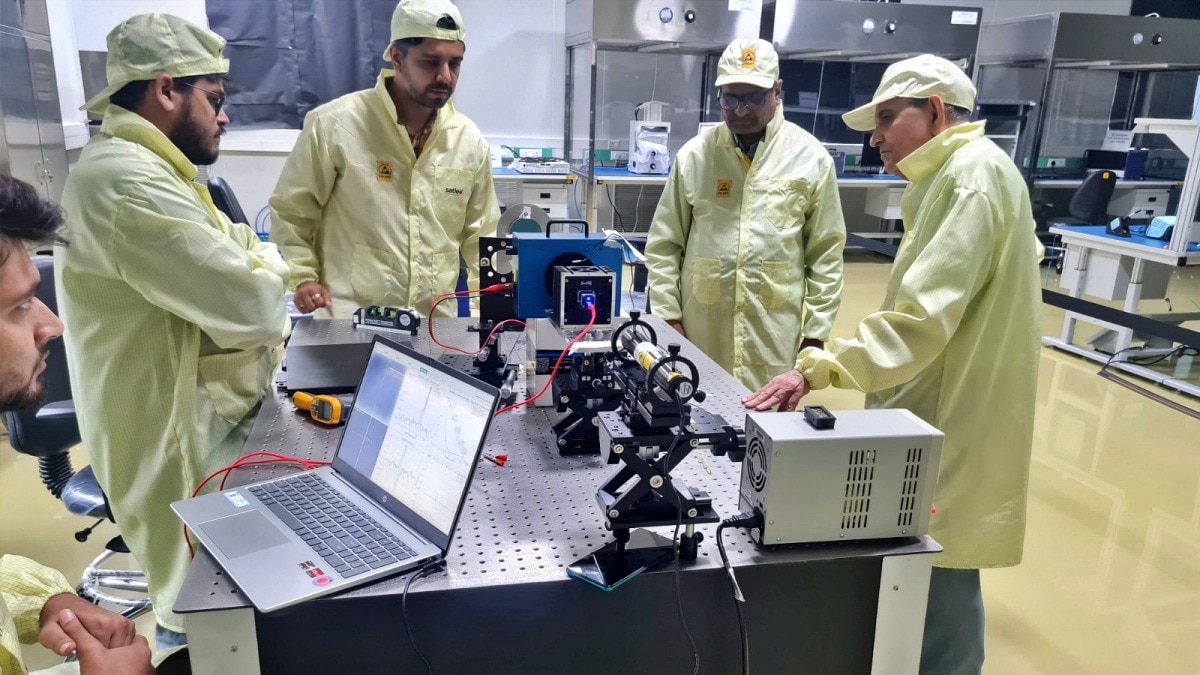
Temperature is one of the most fundamental forces shaping life on Earth. It determines when crops grow, how storms intensify, where forests burn and how cities become dangerously hot. Now, an Indian space startup wants to measure it from space, with a satellite designed to turn Earth's heat into data.On Thursday, as a SpaceX Falcon 9 rises from the launchpad carrying Tapas-1, Ahmedabad-based Satleo Labs will begin an unusual experiment: looking at the planet not simply as an image, but as a map of its temperature.The timing could hardly be more significant.The planet is experiencing intensifying climate extremes, El Nino is reshaping weather patterns, and India is increasingly dealing with heatwaves, erratic rainfall, wildfires and other climate-linked threats. Yet detailed, frequent measurements of temperature remain limited. A satellite capable of directly observing thermal information could offer a much more detailed picture of how heat is distributed. (Photo: Satleo Labs) SATLEO LABS WANTS TO MEASURE EARTH's FEVERFor co-founder Shravan Bhati, the journey to the launchpad is itself unusual. Before entering the satellite world, Bhati served in the Rajasthan Police. His career eventually moved from policing to the world of satellite applications, geospatial technology and Earth observation.His co-founder Urmil Bakhai is part of the team that has now taken that experience into space. Their proposition is deceptively simple: build a thermometer for Earth. Satleo Labs founders Urmil Bakhai, Dr. Ranendu Ghosh, and Shravan Singh Bhati. "The idea is that if humanity is to understand a warming planet, it needs to know not just that temperatures are rising, but where the heat is, how intense it is and how it changes over time," Shravan told IndiaToday.in in an exclusive conversation. He had just landed at Vanderberg to witness the launch of the payload his team designed.Today, ground-based weather stations provide temperature observations from specific locations. Data for areas between those stations can then be interpolated.A satellite capable of directly observing thermal information could offer a much more detailed picture of how heat is distributed.SEEING EARTH THROUGH HEATTapas-1 is designed as a technology demonstrator carrying a long-wave infrared sensor. It will operate in a sun-synchronous orbit and is intended to collect thermal information during both daytime and nighttime.The mission is being described by the company as India's first private commercial thermal-imaging mission.But Tapas-1 is only the beginning."The next stage will be Tapas-2, which is planned to combine thermal and optical capabilities and provide higher-resolution observations. The ultimate goal is Pyro, a full-scale commercial satellite that Satleo Labs is targeting for launch around 2028," co-founder Urmil Bakhai added.Unlike the technology-demonstration approach of Tapas-1, Pyro is envisioned as a more advanced system with multiple sensors and dual-band thermal imaging.The company is targeting sub-10-metre resolution for the Pyro mission.If successful, the system could create a new layer of information about Earth, one based not merely on what the planet looks like, but on how hot different parts of it are.FROM FARMS TO INVISIBLE HEAT THREATSThe applications could be wide-ranging.In agriculture, temperature is closely linked to crop stress, growth and maturity. Knowing the heat conditions across a field could help determine how crops respond to changing weather.In cities, the data could help identify urban heat islands, where buildings and other infrastructure trap heat and create pockets that can become significantly hotter than surrounding areas.The same thermal information could be useful for detecting forest fires, monitoring glaciers and studying extreme weather systems. The company wants to measure temperature buildups across the world. (Photo: Windy) The founders also see applications in aviation and defence, where atmospheric and thermal conditions can provide information that is difficult to obtain through conventional observations alone.The larger ambition is therefore not simply to sell satellite images.Satleo Labs is building a data-processing and analytics platform designed to convert raw thermal observations into usable information. The company says the first datasets will require calibration and processing after launch, with the initial phase potentially taking several weeks as the system is tested.Once the pipeline is stabilised, processed data could be available within hours, depending on the availability of ground stations.That could eventually allow temperature information to become a layer that other industries and agencies can build upon.The company says it wants to work with weather agencies, including the India Meteorological Department, as well as private weather companies and other organisations that could use high-resolution temperature data.For Bhati, the journey from Rajasthan Police to satellite technology has now reached a very different kind of frontier.On Thursday, his company will send its first thermometer into space.And if Tapas-1 works as planned, it could offer something increasingly valuable on a warming planet: a way to see the heat we cannot see with our eyes.- Ends
He served with Rajasthan Police. Now, his company is launching its first satellite
Full Article
Original Source
Read the full article at Indiatoday →KhanList aggregates and links to publicly available news content. We do not host full articles from third-party sources. Always verify important information with original sources.