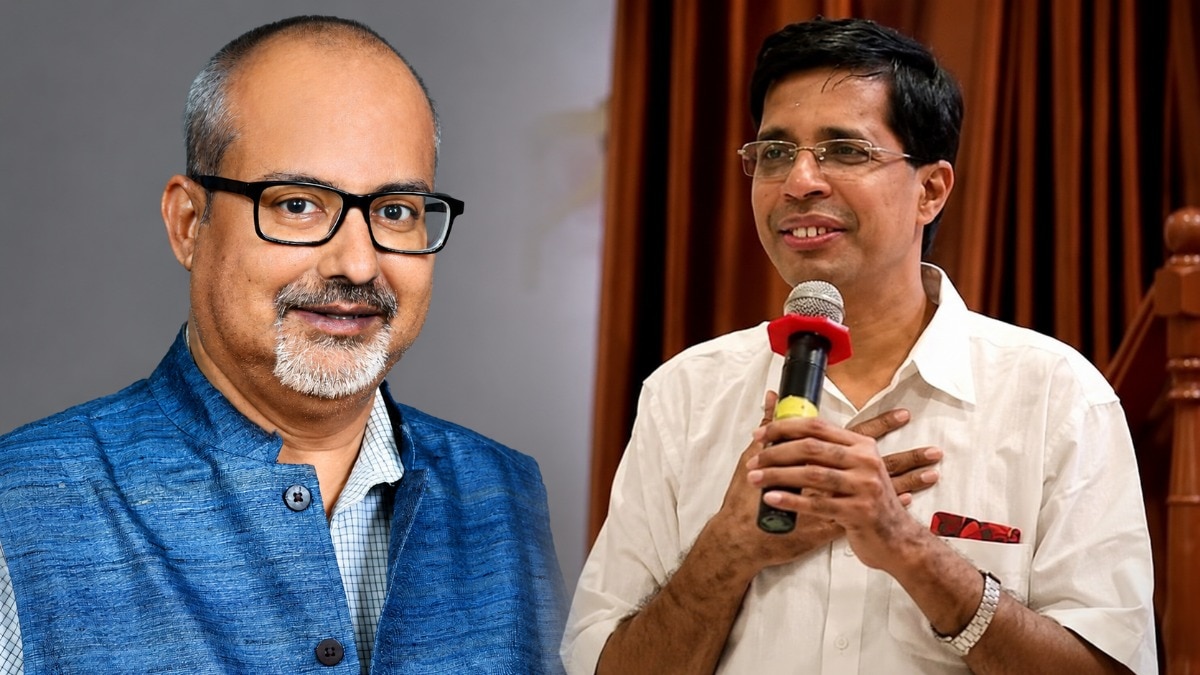
The IIT Madras Director spent decades helping build indigenous computer processors, mentoring researchers and pushing India's semiconductor ambitions, making him one of the country's best-known computer architects.IIIT Hyderabad Director Prof Sandeep K Shukla and IIT Madras Director Professor V Kamakoti India's semiconductor push has gathered pace in recent years, but according to IIIT Hyderabad Director Prof Sandeep K Shukla, IIT Madras Director Professor V Kamakoti has been working towards indigenous processor design long before it became a national priority."Prof Kamakoti started working on the SHAKTI processor - which is a RISC-V architecture-based processor, back in the early 2000s, and I recall that his team worked with Bluespec Inc to write the micro-architectural specification of the processor in Bluespec language," Prof Shukla told India Today."I did not follow the developments too closely but I believe that the version that was first taped out was coded and validated using Bluespec. I believe they got the processor fabricated at 180 nm technology. A startup was founded which is now going ahead with the SHAKTI processor and its derivatives. In the semiconductor mission of India, fabrication on Indian fab like that being built by the Tatas will be very important step towards having any Indian microprocessor."Reflecting on Prof Kamakoti's role in taking the project from the laboratory to the wider ecosystem, Prof Shukla said SHAKTI represents more than a successful processor project. Rather, he said, it demonstrates how long-term academic research can eventually translate into real-world impact. "Prof V Kamakoti's role is a good case study in how long-horizon academic research reaches deployment," he said.According to Prof Shukla, Prof Kamakoti's success with SHAKTI was not just about technical expertise but also about the way he approached long-term research and institution-building. He highlighted three characteristics that, in his view, defined Prof Kamakoti's leadership. First, patience with unfashionable work - processor design in an Indian academic setting had little glamour or funding pull in the early 2010s, and sustaining a team through years of RTL, verification, and tape-out cycles required conviction that this was strategically important before the policy environment caught up.Second, the open-source framing: releasing SHAKTI designs openly turned the project from a single lab's output into a platform others could build on, including startups (Mindgrove Technologies, founded by SHAKTI alumni, is a direct commercial descendant).Third, institution-building - he cultivated pipelines of students who became India's first generation of homegrown processor designers, which is arguably a more durable contribution than any single chip. His involvement with national security and policy bodies also helped connect the lab's work to government programmes like the Digital India RISC-V (DIR-V) initiative, and his later role as Director of IIT Madras gave the effort further institutional weight.For many people today, V Kamakoti is the IIT Madras Director who often finds himself at the centre of public debates.But in engineering circles, his reputation was built long before any controversy.For over two decades, Prof Kamakoti has been one of India's leading computer scientists, working on everything from cybersecurity and computer architecture to semiconductor design. His work has shaped national technology programmes, guided dozens of researchers and, perhaps most importantly, helped India take one of its biggest steps towards building computer processors of its own.That journey eventually led to SHAKTI, the project that many consider his defining contribution.A CAREER THAT STARTED AT IIT MADRASProf Kamakoti's story is closely tied to IIT Madras.He completed both his master's and PhD in Computer Science and Engineering at the institute before joining its faculty in 2001. Over the next two decades, he built his expertise in three areas that most people rarely think about but use every day: computer architecture, information security and VLSI design, the science of designing computer chips.Alongside teaching, he wore several hats. He headed IIT Madras' Microprocessor Development Programme and its Information Security Education and Awareness Programme, both funded by the Ministry of Electronics and Information Technology. He also served as Chairman of JEE at IIT Madras, Associate Dean for Industrial Consultancy and Sponsored Research, chaired the Union government's Artificial Intelligence Task Force and became a member of the National Security Advisory Board.By the time he took over as Director of IIT Madras in 2022, he had already established himself as one of the country's leading researchers in advanced computing.According to his official Padma Shri citation, Prof Kamakoti has guided around 20 PhD scholars and 30 master's researchers, while publishing more than 200 research papers over his career.THE PROJECT THAT PUT HIM ON INDIA'S TECH MAPAmong all his work, one project stands out: SHAKTI.To understand why it matters, think about the device you're reading this story on.Whether it's a phone, laptop, smart TV or even a modern car, every electronic device has a processor. It's the brain that tells the machine what to do.The catch is that most processors used around the world are designed by a handful of foreign companies. Countries that don't have this capability remain dependent on overseas technology.SHAKTI was India's attempt to change that.Led by researchers at IIT Madras under Prof Kamakoti's guidance, the project set out to prove that India could design its own processor instead of relying entirely on imported technology instead of relying entirely on imported technology. It wasn't about manufacturing millions of chips overnight. It was about mastering the knowledge needed to build them in the first place.For a country trying to become a global semiconductor hub, that knowledge is as valuable as the chips themselves.MORE THAN A RESEARCH PROJECTOver the years, SHAKTI grew far beyond an academic experiment.It became a platform that startups, researchers and industries could build on. Several deep-tech companies working in India's semiconductor space trace their roots to the ecosystem created around the project, including InCore Semiconductors, Mindgrove Technologies and others.This is something Prof Shukla also highlighted, saying the project's open-source approach enabled others to build on the work while creating a pipeline of indigenous processor designers.The programme has also contributed to India's broader Digital India RISC-V initiative, which aims to reduce dependence on imported processor technologies and build an indigenous chip ecosystem.A LEGACY THAT GOES BEYOND THE HEADLINESProf Kamakoti's work has earned him the Padma Shri, the DRDO Academic Excellence Award, the Abdul Kalam Technology Innovation National Fellowship, the IBM Faculty Award, the VASVIK Industrial Research Award and the Indian Electronics and Semiconductor Association's Techno Visionary Award.Public attention may often return to his controversial remarks. But for researchers working on India's semiconductor ambitions, his name has long been associated with something else: the effort to ensure that one day, the brains powering Indian computers can also be designed in India.- EndsPublished By: Mridusmita DekaPublished On: Jul 30, 2026 10:47 IST
He is a case study in deployment: IIT Hyderabad chief on V Kamakoti's achievements
Full Article
Original Source
Read the full article at Indiatoday →KhanList aggregates and links to publicly available news content. We do not host full articles from third-party sources. Always verify important information with original sources.