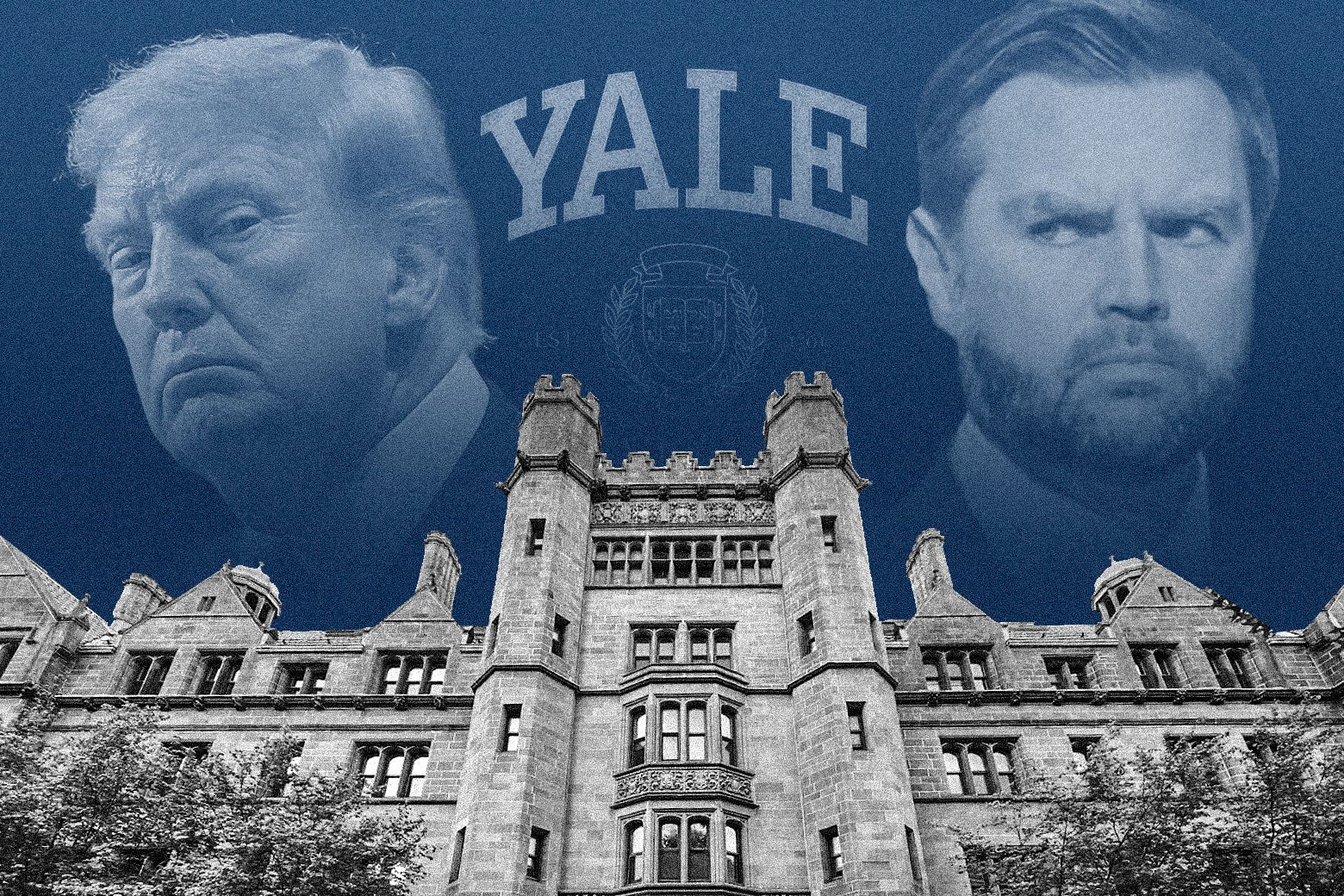
Jurisprudence Seeking to set a new course for the conservative movement, J.D. Vance in 2021 declared war on institutions of American higher education. Photo illustration by Slate. Photos by Wikipedia, Alex Wroblewski/AFP via Getty Images, and Andrew Harnik/Getty Images. Sign up for Executive Dysfunction, a newsletter that highlights one under-the-radar story each week about how Trump is changing the law—or how the law is pushing back. You’ll also receive updates on the latest from Slate’s Jurisprudence team. Seeking to set a new course for the conservative movement, J.D. Vance in 2021 declared war on institutions of American higher education. He proposed to the National Conservatism Conference that because universities teach “progressive orthodoxies” that consist of “deceit and lies,” conservatives must “honestly and aggressively attack the universities in this country.” “We are giving our children over to our enemies,” Vance declared, “and it is time we stopped doing it.” The second Trump administration has systematically pursued Vance’s agenda. Using as leverage the considerable funding supplied by the federal government for scientific research, one of Donald Trump’s first acts back in office was to seek to pressure American universities to refrain from teaching progressive ideas and instead to adopt conservative perspectives. Columbia collapsed under the attack, but Harvard resisted and achieved some notable success in the courts. Last year, the administration’s favored tactic was to use charges of antisemitism to justify large-scale funding cutoffs unless universities met conditions that had little if anything to do with the initial accusations. But the administration now seems to have changed its approach. It has charged Yale with giving preferential admission to Black and Hispanic applicants in violation of Title VI of the Civil Rights Act, which prohibits universities from receiving federal funds in programs that engage in racial discrimination. The charges are legally weak and in normal times would be readily contested. But, in contrast to Harvard, it appears that Yale is instead seeking to negotiate some kind of deal with the Trump administration. What might account for this stark contrast? The answer lies in a little-known but massively important regulation proposed by the Office of Management and Budget. The regulation requires that virtually all federal grants, which had heretofore been awarded on the basis of scientific merit, be henceforth subject to “pre-issuance review” and approval by “senior” political appointees to ensure that the grants “advance the President’s policy priorities.” The proposed regulation effectively endows the Trump administration with discretion to cut off federal grants wherever and however it wishes. It authorizes the Trump administration to hold hostage each and every federal grant to every university. Scientific research in universities has underwritten American dominance in technological, scientific, medical, military, and economic matters since World War II, when the federal government first began to extend support to STEM scholarship. But federal support was provided on the firm principle that distribution was to be determined by disinterested experts qualified to evaluate the merits of scientific and technological proposals. In a single ghastly stroke, the proposed OMB regulation seeks to upend that fundamental principle. Now federal funding is being hung over the heads of university administrators like a sword of Damocles, threatening to decapitate the research of any university bold enough to resist Trump administration demands. Like Josef Stalin in the old Soviet Union, the Trump administration claims the right to assert political control over scientific research. Stalin’s totalitarian power grab was catastrophic for Soviet science, and we can expect no less massive and shattering consequences from Trump’s effort to bring universities to heel. One easily foreseeable effect will be to stunt American scientific and technological development. But a second effect will be to subject American research universities to the domination of the Trump administration. No university can afford to ignore how the Trump administration will exercise its grim and overtly political discretion to direct the flow of scientific grants. As a Yale Sterling Professor and a former dean of Yale Law School, this issue is important to me. I am not now privy to the thinking of Yale administrators and trustees. But I would bet a small fortune that the potentially devastating impact of the proposed OMB rule is driving their highly controversial decision to negotiate with the Trump administration. It is an open question how Yale’s medical school can survive in its present form without income provided by federally supported research. It is no wonder that Yale took the remarkable step of hiring the McGuireWoods law firm, which played such a questionable role negotiating with the Trump administration when the widely respected president of the University of Virginia, James Ryan, was unceremoniously fired. Yale is almost certainly alarmed that the Trump administration has at last found a legal tool adequate to its ambition to “aggressively attack the universities in this country.” One measure of Yale’s terror is that, according to circulating reports, it is willing to grant Trump’s Department of Justice review over the admissions practices of its medical school, college, and law school (Vance’s alma mater). Trump’s DOJ has insisted that compliance with Title VI is to be measured by the standards set forth in the July 29, 2025, memorandum by then–Attorney General Pam Bondi, which offers an extreme interpretation of the Supreme Court’s decision in Students for Fair Admissions v. Harvard. In direct contradiction to Chief Justice John Roberts’ opinion in SFFA, for example, the Bondi memorandum would effectively forbid universities from considering applicant essays describing “obstacles they have overcome,” on the remarkable ground that such essays might become “a proxy” for “protected characteristics.” The Bondi memorandum is so full of vague and uncertain criteria that it could easily be leveraged by the Trump administration to wreak havoc on the admissions of Yale undergraduate, medical school, and law school programs. That Yale is willing to risk these jewels in her crown speaks volumes about the terrible power of the proposed OMB regulation. The regulation facilitates extortion, plain and simple. When the storm over Yale’s dealings with DOJ broke, the university’s president, Maurie McInnis, sent an email to the community designed to convey the impression that there was nothing unusual or noteworthy happening, that it was “standard … practice” for universities to negotiate with DOJ over allegations of Title VI violations. But McInnis is wrong. There is nothing “standard” about what the Trump administration is now doing. Trump runs an administration that has demonstrated a willingness to leverage federal grants to transform the nature of American universities. He runs an administration that regularly acts without apparent regard for legal procedures. Unlike any past president, he runs an administration that threatens to exact penalties and pain well beyond any prescribed or even allowed by law. If mighty Yale, with its many resources, is so afraid of the OMB regulation that it cannot muster the spine to resist legally weak accusations of violating Title VI, what hope can there be for any ordinary research university? If Yale settles, the stain on its honor will arise not only from its own appeasement of bully tactics, but also from releasing this wolf of an administration to prey upon the entire American research community. Still, we should keep our focus where it belongs—not on Yale alone, but on the proposed OMB regulation that has compelled Yale’s submission. The regulation is a club aimed at the head of American scientific research. Americans should fiercely oppose this regulation not merely in the courts, but also in Congress and in politics. We must explain the extreme and vindictive stupidity of a rule that promises to throw sand into the gears of the technological and scientific research that has proved such an astonishing engine of American prosperity in the post–World War II era. We must ask whether the Trump administration is so determined to win a culture war against American higher education that it is willing to risk the decline of American influence. Does enough real national pride remain in the American people to rise in opposition to such a self-defeating agenda? Get the best of Jurisprudence. Sign up for Slate’s legal newsletter. Academia College Constitution Donald Trump Education First Amendment Jurisprudence Law Research Science Yale J.D. Vance
Harvard Fought Trump’s Abuses. Yale May Fold. I Think I Know Why.
Full Article
Original Source
Read the full article at Slate →KhanList aggregates and links to publicly available news content. We do not host full articles from third-party sources. Always verify important information with original sources.