
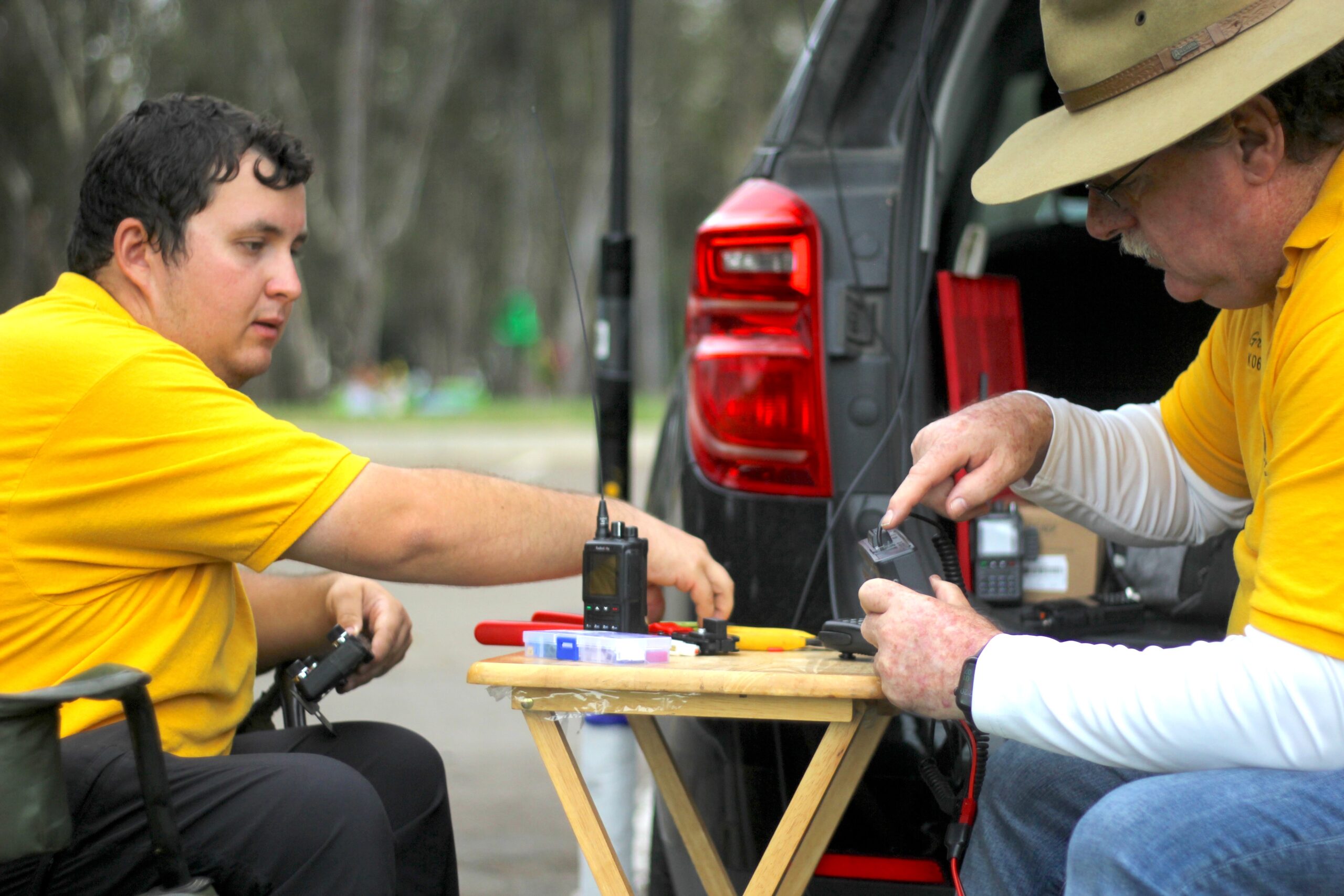
LA MESA, Calif. (CN) — The rain comes in bursts over Harry Griffen Regional Park, where a dozen ham radio operators huddle around antennas, portable batteries and transceivers on a cloudy Saturday morning.The weather is just another variable for the amateur radio enthusiasts who have come to train with local volunteer group San Diego Amateur Radio Emergency Response. The hams are here to brush up on their skills — and perhaps more importantly, to have some fun with their gadgets.The group prepares for worst-case scenarios — earthquakes, fires, floods, etc. — with the goal of keeping emergency communications going when conventional forms of communication go down.Patrick Gooden, a 75-year-old retired Navy sonar technician from nearby El Cajon, is the leader of this group and is holding court. He knows that when an emergency strikes, familiarity with the equipment can matter as much as the equipment itself.“By having fun with the radios, we’re trying to get people familiar with and accustomed to [using] those radios under pressure, so when an emergency event does occur, they’re not panicking,” Gooden says. “They’re able to pass certain emergency traffic as it is given to the next unit or next communication site. We try to train people in the basic setup and programming on those radios.”As the buzz of radios crackles in the air, Gooden digs into technical terms: kilohertz offsets, the velocity factor of electrons, atmospheric interference. He stresses that a good ham always ensures their equipment is in working order.“If you don’t check it, it’s going to fail,” he says. “Test all of your gear before you leave home.”Around him, the group nods in agreement.The etymology of the term “ham” is unclear.It may have started as a derogatory term for amateurs, but it’s since been embraced by enthusiasts. There are around 730,000 of them in the United States, judging by numbers from the Federal Communications Commission, which grants radio licenses.Guglielmo Marconi, who in 1895 transmitted a series of radio pulses a couple of miles across his family’s estate, was one of the first people to begin tinkering with radios.In 1901, he used Morse code to transmit the letter “S” across the Atlantic. Because “S” is represented by three short taps in Morse code, Marconi figured it would be the simplest letter to understand.Ham radios originated more than 100 years ago. Today, their use is regulated by the Federal Communications Commission, which licenses radio operators. (Quinn Welsch/Courthouse News)At a makeshift table, Grant Madden and David Kaplar prepare a 50-watt Yaesu transceiver for use with a meter-long antenna mounted on the back of Madden’s truck.Using this setup, the pair can theoretically send and receive signals in all directions within about 50 miles.Actual distance may vary, depending on factors like geography. Kaplar gestures to Mount Helix about a mile to the south, the only geological feature in the area big enough to block transmissions to and from that direction.Hoping to preserve what they see as a critical skill set, enthusiasts like Gooden are always looking to expand the ranks of the ham community.Kaplar, 24, is the youngest in the crowd by a couple of decades. He got into ham radio as a teenager through the Skywarn extreme weather reporting service.Kaplar says the hobby allows him to get more physical with technology.“I’ve built my own computers in the past,” he says. “So if you’re into technology … this is a perfect hobby because it encapsulates so much. It’s almost like a dozen different hobbies within the hobby.”Kaplar was recently inspired to enlist in the Navy after befriending many of the other hams in San Diego County, many of them current or retired service members.“It’s a lot more social than anyone had ever told me,” he adds. “Here in San Diego, it’s a really good group. Everyone is so nice and friendly and willing to help out.”Madden, 60, is a newer member of the group. A former police officer originally from Australia, he got into ham radio through working in emergency management and business continuity, a related field that involves helping companies maintain operations in the event of a disaster.A local doctor asked him how to keep hospital communications up and running in the event of a cybersecurity incident. If and when an attack like this happens, “from the outside the hospital looks great, but on the inside it’s on life support,” he says.The answer to concerns like these is ham radio, Madden says.“We relay the message,” he explains. “If we’re relaying triage status, we need to know what black, red, yellow and green mean. There’s a lot of decisions to be made there.”“It’s not sexy TV to watch amateur radio,” he says, “but they’re running communications behind the scenes.”David Kaplar, left, and Grant Madden tinker with a radio on Sept. 27, 2026. (Quinn Welsch/Courthouse News)Radio has come a long way from Marconi to technologies like Wi-Fi and Bluetooth.Much of that innovation is thanks to Hollywood actor and inventor Hedy Lamarr. During World War II, she helped develop frequency-hopping technology, laying the foundation for the spread-spectrum communications now used in modern wireless networks.“That was the genesis of what we have today,” Gooden says. “She was very innovative."More than a century later, ham radio’s staying power has less to do with nostalgia for a bygone era and more to do with its reliability when modern systems fail. The technology is old school and relatively simple, avoiding the complexities that can sometimes make advanced communication networks vulnerable, Gooden says.Cellphones and the internet rely on towers and undersea cables. A ham radio operator just needs a transceiver, an antenna and ideally a lawn chair. “That’s the reason it’s still around today.”Subscribe to our free newslettersOur weekly newsletter Closing Arguments offers the latest about ongoing trials, major litigation and rulings in courthouses around the U.S. and the world, while the monthly Under the Lights dishes the legal dirt from Hollywood, sports, Big Tech and the arts.Additional Reads
Ham radio enthusiasts tune up and tune in
Full Article
Original Source
Read the full article at Courthousenews →KhanList aggregates and links to publicly available news content. We do not host full articles from third-party sources. Always verify important information with original sources.