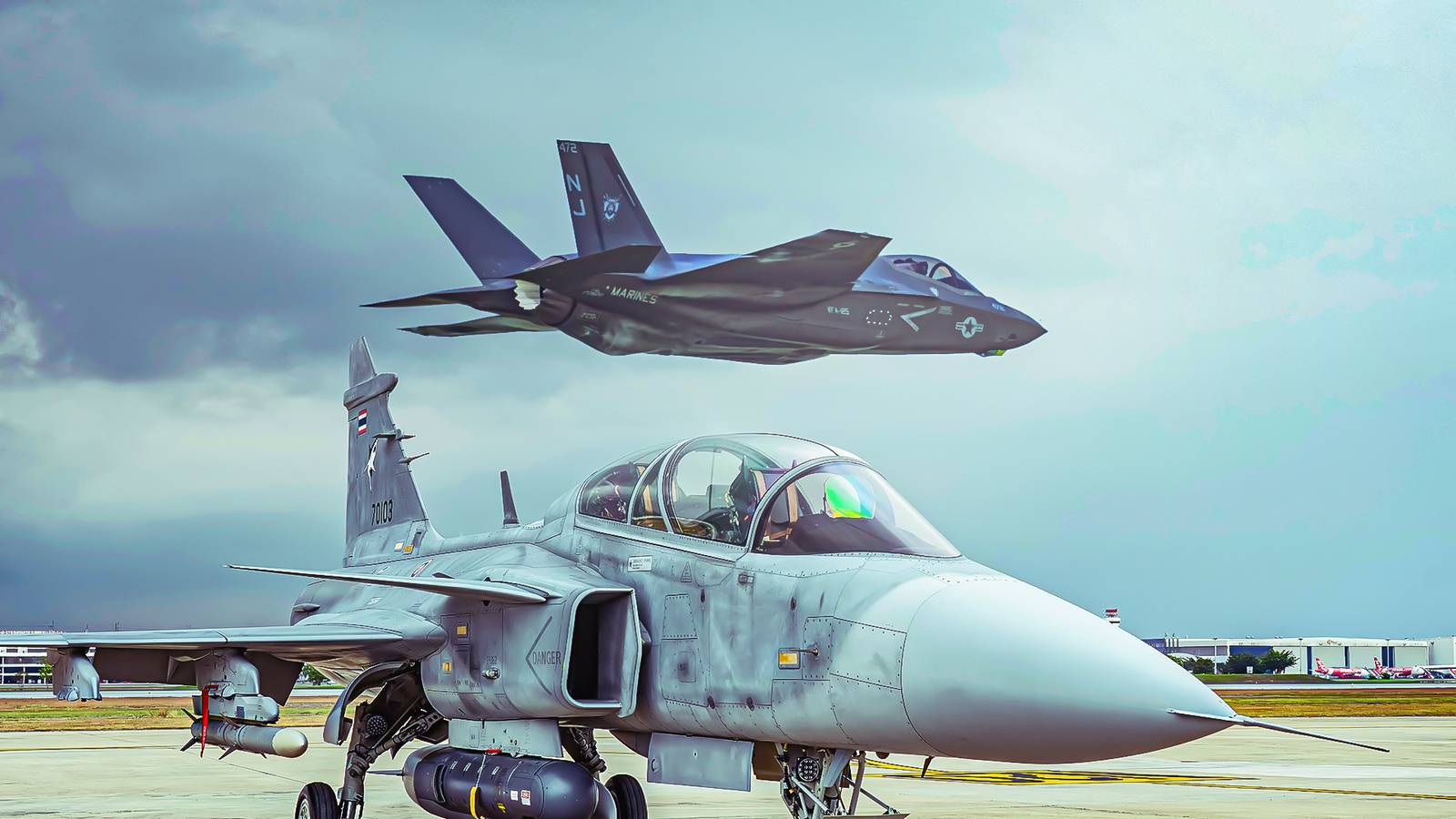
Credit: Shutterstock | Simple Flying Published Aug 19, 2026, 3:00 PM EDT Luke Diaz is a freelance military writer with experience with active duty experience in the US Navy as well as defense and industrial engineering. He is a former Naval Flight Officer who performed tactical air control on the carrier-based E-2 Hawkeye. Sign in to your Simple Flying account The Lockheed Martin F-35 Lightning II vs. Saab Gripen E dispute pits two diametrically opposed military ideologies. Some air forces believe that the JAS 39 E outperforms the F-35 Joint Strike Fighter. Even though it is a 4.5-generation fighter, it provides great performance and lethality for operators who do not require every 'bell and whistle' in their arsenal. The F-35, on the other hand, is more than simply a plane: it is an airborne data center and battlefield manager that also carries heavy weapons. While the fifth-generation F-35 is superior in stealth and high-end penetrating attack missions, the Gripen E shines as a highly proficient multirole platform in a battlespace with fewer sophisticated threats. The Saab is intended to defend its home territory and fight efficiently within an integrated air defense umbrella. The Gripen E's central argument is that a fighter plane is useless if you can't afford to fly it, can't repair it in a war zone, or can't use it without the manufacturer's consent. Meanwhile, the F-35 has nearly monopolized the Western fifth-generation fighter market by providing unparalleled capabilities at an unprecedented price point for a stealth aircraft. Sweden's Lightweight Up Against The American Heavyweight Credit: Department of Defense In contested airspace, the Gripen relies on the Arexis EW suite to jam and deceive enemy sensors rather than physical stealth. A notable strength of the Saab is that it is actually a more maneuverable aircraft in a dogfight. The Swedish fighter has a superior thrust-to-weight ratio, which gives it better acceleration as well as a higher top speed and makes it a superior interceptor from a perspective of pure performance. But that maneuverability won't save it from the most advanced air defenses or enemy aircraft like a Sukhoi Su-57 Felon or a Chengdu J-20 Mighty Dragon. If a military requires a true, radar-evading 5th-generation fighter that can survive in highly contested, anti-access/area-denial environments, the F-35 is virtually the only option available for export. Below is a table of key specifications for comparison: Specification Lockheed Martin F-35A Lightning II Saab JAS 39 Gripen E Procurement Cost $90-120 Million $85 Million Cost Per Flight Hour $32,000+ $4,700+ Total Payload Capacity 18,000 lb (8,165 kg) 15,900 lb (7,212 kg) Top Speed Mach 1.6 (1,960 km/h) Mach 2.0 (2,100 km/h) Combat Radius 680 miles (1,094 km) 810 miles (1,304 km) Weapon System Internal bays and external hardpoints External carriage only Currently, many allies of the US are likely to rely on America to be the 'tip of the spear,' which makes top-shelf A2D performance a 'nice to have' rather than a requirement. The sheer cost of every flight hour in an F-35 can be enough to critically drain the funding from smaller air forces compared to the US, which negatively impacts aircrew training, maintenance, and even munition reserves. Then there's the concern over the 'kill switch' aspect of the F-35. When a nation buys the F-35, it buys into an American ecosystem. The F-35 relies on the Operational Data Integrated Network, an automated logistics system that constantly sends data back to the US. If the Pentagon disagrees with a nation's foreign policy, they can theoretically cut off software access or parts, grounding the fleet. Saab gives operators total sovereign access to integrate its weapons, rewrite electronic warfare codes, and deploy without asking a foreign power for permission. No Sky Too Harsh: Made For The Fight Credit: Department of Defense The Saab Gripen E offers distinct advantages in deployment and maintenance, particularly when operating in the harsh, remote environments characteristic of the Canadian Arctic. The Gripen is designed to operate from short, unpaved runways, frozen lakes, or even 0.5-mile (800-meter) stretches of public highway. The Gripen fleet generally maintains an availability rate between 70% and 80%. Looking to the American stealth fighter, the F-35 is notoriously complex to maintain, heavily reliant on pristine hangars, and plagued by global parts shortages that often keep 40% or more of the fleet grounded. The Gripen’s software can also be updated rapidly and independently without affecting flight-critical systems, a notorious problem on the F-35. The Saab has open architecture systems and the Arexis EW suite to jam and deceive enemy sensors rather than physical stealth. Gripen E is optimized for austere defense thanks to its low maintenance, local industrial control, low operating costs, and high performance in a specific regional theater. The Gripen can take off and land on regular highways, frozen lakes, or short, improvised runways of less than 2,000 feet (610 meters). While it is true the F-35B 'jump jet' can perform vertical takeoff and landing, it is the most expensive variant and sacrifices payload and fuel for that quality. For a closer comparison, the F-35A requires 8,000-foot (2,438-meter) runways and climate-controlled hangars for maintenance. It's not fair to say that the plane is unable to perform under the same conditions, as the US Air Force and Scandinavian partners like Norway and Finland routinely practice landing F-35As on public highways and improvised austere airstrips during Agile Combat Employment exercises. The difference is the cost in resources required to make that possible. On The Business End Of The Gripen E Credit: Department of Defense The F-35 must carry its weapons internally to remain invisible to radar. To maximize this restricted space, the Block Four upgrade introduces a massive overhaul to the jet's internal bay and software. However, that has been delayed, with any capabilities not expected for some time, as the full package is delayed until 2031. For now, it relies heavily on the AIM-120 AMRAAM and AIM-9X for air dominance. For strikes, it uses the miniaturized StormBreaker smart bomb. Because the Gripen E does not have internal bays, it carries everything externally. The Gripen E is natively optimized for the MBDA Meteor, widely considered the most dangerous Beyond-Visual-Range Air-to-Air Missile. The 'No Escape Zone' of the Meteor is supposedly three times greater than that of the AIM-120D since it can save fuel and re-accelerate during its final approach. Even at the limit of its 125-mile (200-km) range, the Meteor retains excellent agility. The fact that no F-35 can currently carry Meteor is a major detractor. The F-35 arsenal will eventually be exceptionally deep and sophisticated, but many weapons are still being integrated. Saab can integrate almost any weapon a customer requests, including AIM-120 AMRAAM, AIM-9, and IRIS-T in addition to Meteor. With GPS-assisted navigation and trajectory shaping, the AMRAAM D's range is estimated to be over 100 miles (160 km). However, about halfway to the target, it loses its initial 'boost' energy, making it far less able to pursue a moving target. It quickly loses kinetic energy when it moves at high altitudes. Given its open architecture, the Gripen E is a primary testbed for future European smart munitions. A nation can buy a brand-new missile from any country, write the software code locally, and append it to the jet without needing permission from Saab. So while the F-35 will eventually have superior firepower, whether it will be available to the operator is a question mark. Saab's Rugged Warbird Versus Skunk Works' Luxury Fighter Credit: US Air Force Although the American stealth fighter is a powerhouse of weapons technology, the smaller, lighter, simpler, and more ruggedized Saab offers significant value to many operators. A single qualified technician and a few non-specialized ground crew can fully service a Gripen. The F-35A typically requires a larger, highly specialized ground crew for maintenance. The Gripen E can be refueled and rearmed in roughly 15 minutes. The Gripen was designed from the ground up for Sweden's 'Base 90' doctrine, meaning it can be refueled, rearmed, and launched from an unprepared 0.5-mile (800-meter) stretch of highway in under 10 minutes by a small crew of conscripts. The F-35 demands extensive, highly specialized base infrastructure. Because of its mechanical simplicity, the Gripen regularly maintains a mission-capable readiness rate of 80% to 90%. The F-35 has historically struggled with a lower mission-capable rate, hovering around 50% to 60% due to complex electronics and parts shortages. One of the primary roadblocks that every operator has had with the introduction of the F-35 is the vast investment required in infrastructure for the complex and highly classified fighter jet. Despite the fact that the program is meant to simplify the logistical supply chain for the US and its allies by sharing a single platform across many armed forces, its incredibly sensitive technology and high maintenance requirements are also a significant burden both financially and logistically. Still, there are some benefits to the American 'Hangar Queen.' Yet, buying a non-stealth fighter today means investing in technology that is already hitting its operational ceiling. The F-35 features a modular open systems architecture, and when Technology Refresh Three Block Four rolls out with faster, more efficient software, more electrical power, and superior computing power, it will deliver an insurance policy against the threats of the 2030s, 2040s, and beyond. Affordable Air Power Versus Exquisite Tech Credit: US Air Force The F-35 is notoriously expensive to maintain, costing between $33,000 and $50,000 per flight hour. It requires highly specialized climate-controlled hangars to preserve its stealth coatings. By contrast, the Gripen E costs roughly $10,000 to $22,000 per flight hour. For smaller air forces with fixed budgets, like Portugal or Spain, choosing the Gripen frees up billions of euros that can be reinvested into other defense gaps like air defense systems, munitions stocks, and cyber defense. Operating the F-35 places a nation inside a tight, US-centric spare parts pool and software loop. The US controls the core source code, mission data files, and upgrade schedules. This dependency has sparked concerns among international buyers about potential political leverage or capability restrictions. On the other hand, the F-35 plugs a nation into a massive, interconnected global logistics and intelligence network. In a joint-force conflict, an F-35 from one country can land at a base run by another country, use their spare parts, and seamlessly share data over the same data link. Saab allows buying nations unprecedented access to the aircraft’s software codes. This means a country can integrate its own domestic weapons, electronic warfare libraries, and hardware without needing permission or data-sharing with a foreign government.
Gripen E Vs. F-35: Stealth Supremacy Or Maintenance Freedom?
Full Article
Original Source
Read the full article at Simpleflying →KhanList aggregates and links to publicly available news content. We do not host full articles from third-party sources. Always verify important information with original sources.