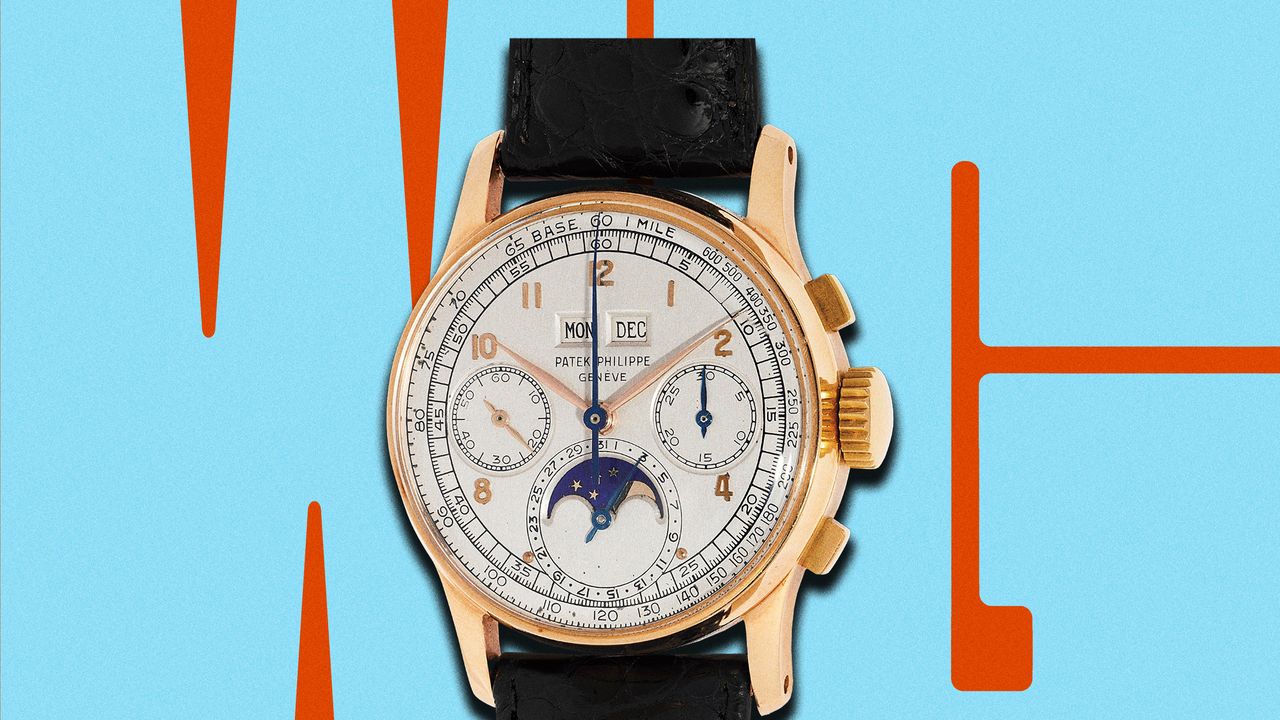
Welcome to GQ’s 201-level Watch Glossary, breaking down the advanced terms and specific references that are essential knowledge for every serious collector.In 1941, in a show of Katie Ledecky-style dominance, Patek Philippe became the first to release a serially produced watch that combined two of the trickiest functions in watchmaking: the perpetual calendar and a chronograph. In the 85 years since, the brand has perfected this alchemy, and examining the many iterations of this watch is a crash course in how the watch industry has functioned and what collectors have sought out over the decades.Ref. 1518: The breakthrough (1941)The ref. 1518 was only produced in roughly 281 examples, but it started a long lineage of signature pieces at Patek Philippe and laid the foundation for a series of timepieces that remains an important component of the maison’s Grand Complications to this day.Constructing a perpetual calendar is difficult enough: the gearing necessary for a mechanical object to track months (let alone years) of different lengths is difficult to synchronize and miniaturize, and thus QP (“quantième perpétuel” or, in anglais, perpetual calendar) watches prior to the 1518 were generally one-off commissions for ultra-wealthy clients. But to combine one with a chronograph complication—in the midst of the Second World War, no less—was to push the horological envelope in a direction that few other large watchmakers could follow. And that’s not florid language—it would literally take some decades before others were able to serially produce QP wristwatches, let alone QP chronograph wristwatches.Diving into the production of such a complex movement provides great insight into the traditional way watches were developed in those days. The 1940s were the days of établissage. Rather than hyping up in-house movements, this system—for centuries the norm in Switzerland—divvied up the production of a watch's components, from the movement to the dial, among different manufacturers and individual, specialized makers in a literal cottage industry.Even the best firms in the world—Patek, Vacheron Constantin, Cartier, etc.—would purchase movements from dedicated movement specialists and decorate or modify these to their specifications. Indeed, this is the genesis of the ref. 1518, in which Patek took an ébauche (movement base) from Valjoux and modified it into the cal. 13'''130 Q. You could argue that this system only makes Patek’s accomplishment that much more impressive. The other brands in Switzerland had access to the same ébauche, but none managed to convert it into a serially produced perpetual calendar-chronograph.Measuring about 35mm in diameter and produced from roughly 1941 through 1954, the ref. 1518 represents the genesis of the brand’s perpetual calendar-chronograph production, and has become one of the most sought-after and expensive watches in the world. A version in stainless steel nearly set the record for the most expensive vintage wristwatch ever sold at auction in 2025.Ref. 2499: Perfection achieved (1950)In 1950, Patek began producing the 1518’s sequel, the ref. 2499. After a revolutionary technological breakthrough, the brand got to work perfecting its look, establishing the design that would be associated with Patek’s perpetual calendar-chronographs for decades to come. The 2499 is a collector favorite and widely considered one of the best wristwatches ever made.This timepiece was produced in four distinct series, and tracking their evolution shows how the chronograph case was modernized over the years. What began as a watch with flat pushers progressed into one with round pump pushers, while Arabic markers gave way to baton indices and acrylic crystals became sapphire.Upsized to 37.5mm from the 35mm diameter of the ref. 1518, the ref. 2499 continued to use Patek's Valjoux-derived perpetual calendar-chronograph movement—subsequently designated cal. 27-70 Q—and remained in production for nearly 35 years, from 1950 through 1985. Despite its long production run, very few were actually made, and only roughly 349 examples are known to collectors.Ref. 3970: The rebellious successor to a legend (1986)Rather than cave to the pressures of the Quartz Crisis, Patek Philippe continued to tread the more difficult mechanical path and released the ref. 3970 in 1986.The 3970 scaled the case down to approximately 36mm from the 2499’s 37.5mm. It replaced the Valjoux-derived movement of the 1518/2499 with Patek's extensively modified Lemania-based cal. CH 27-70 Q. Here we see that it was still totally acceptable to use movements produced outside the company, but the magic of Patek is that it was able to take a shared resource and turn it into something singular.The new Lemania movement enabled Patek to add a modern leap-year and 24-hour/day-night indications to the 3970’s dial, thereby bridging the gap between the vintage and modern eras of perpetual calendar-chronograph design. Produced in roughly 4,000 examples between 1986 and 2004, the wonderfully sized 3970 is likewise a beloved Patek reference—even if its larger production run often means lower prices at auction.Ref. 5970: The choice of a new generation (2004)The ref. 5970 is less of a mechanical statement than an aesthetic one. In 2004, Patek released the next generation of the QP chronograph, the ref. 5970. The brand released this watch during the era of oversized watches like the IWC Big Pilot and Panerai Luminor, so it’s little surprise that the 5970 featured a case upsized to 40mm. Despite its beefy, modern proportions, the watch’s reliance on the 3970’s Lemania-derived cal. CH 27-70 Q and its use of square pushers meant the piece retained a healthy degree of vintage character. Produced from just 2004 to 2011, the 5970 was made in roughly 2,800 examples.Ref. 5270: Patek goes in-house (2011)Finally, in 2011, Patek released the ref. 5270, its first perpetual calendar-chronograph using an in-house movement. Just as the larger case size of the 5970 reflected the tastes of collectors from its era, this mechanical advancement shows what matters to today’s clients. By 2011, an in-house movement had become an increasingly important marker of prestige among watch heads. This, of course, is a huge difference compared to the days of the établissage system, when it was largely accepted that brands would source the best of the best from outside experts.When Patek released the 5270, it was powered by the brand's own cal. CH 29-535 PS Q. The watch is a millimeter larger overall than the 5970, making it wear very differently from something like the 1518. However, leaf-shaped hands and rectangular chronograph pushers once again contribute to a distinctly vintage-inspired character, while multiple metal, dial, and other configurations mean that a variety of tastes are served. Want one in yellow gold with a simple silver dial? You got it. Prefer one in platinum with a lacquered red dial and a bezel absolutely dripping in rubies like in The Cave of Wonders from Aladdin? Done.While Patek has built split-second perpetual calendar-chronographs alongside the past several generations of perpetual calendar-chronographs, the latter remains emblematic of the brand’s place at the forefront of complications development among Switzerland's most important watchmakers. From the stunning eight-figure auction results of stainless steel 1518s to the frequent appearances on famous wrists (John Mayer, Sylvester Stallone, Kevin Hart, Jay-Z) of modern references such as the 5270, the Patek Philippe perpetual calendar-chronograph is a thing of horological legend.Though other significant manufacturers—Vacheron Constantin, Audemars Piguet, Breguet, IWC, and A. Lange & Söhne, to name a few—have since caught up and now serially produce their own versions, Patek remains associated with this august complication-combination due not only to the beauty of its watches, but for a simpler reason: its massive head start.
What Patek Philippe Does Way Better Than Any Other Watchmaker
Full Article
Original Source
Read the full article at Gq →KhanList aggregates and links to publicly available news content. We do not host full articles from third-party sources. Always verify important information with original sources.