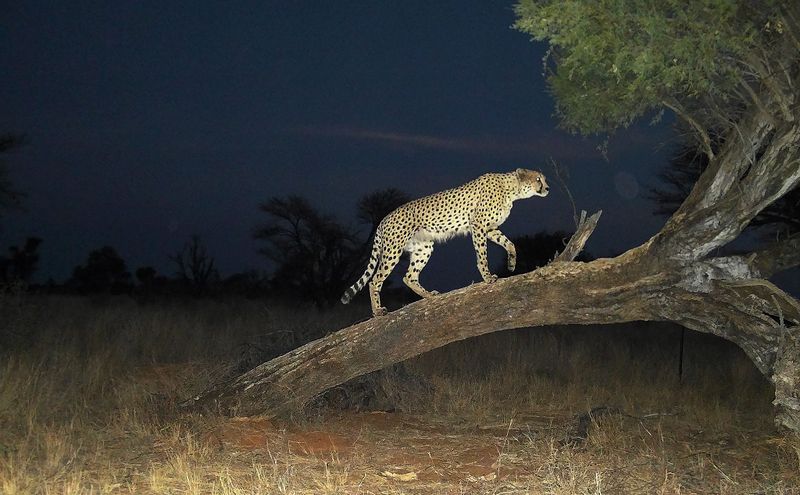
For years, South Africa’s free-roaming cheetah population had a reassuringly round number attached to it: about 300 mature animals living beyond national parks and fenced reserves. It turns out that number was less a count than an educated shrug.“Nobody ever really knew for sure,” says Marna Smit, project coordinator at Ashia Cheetah Conservation. “The 300 was a guess from people who worked in the field, and they kind of just went with that for lack of any better evidence.”Now there is better evidence, and it is grim. The first national Free-Roaming Cheetah Census found a minimum of 83 mature adults across almost 100,000 square kilometres of the Northern Cape, North West and Limpopo. Add cubs and subadults and the verified total reached 119 animals. During the study, 17 mature adults died.That doesn’t necessarily mean the population suddenly crashed from 300 to 83. It may mean South Africa never had a solid idea of how many cheetahs were left.“This is the first correct, or the most correct, baseline that we’ve ever had,” Smit says. “Maybe we’ve always had low numbers and the estimates were ridiculously high.”Earlier estimates came from isolated regional studies, some of them conducted in cheetah hotspots. Researchers may have looked at places where the cats were doing relatively well and assumed the rest of the country looked much the same.“Now that we have a baseline, we can start figuring out if there is an intense decline,” she says. “Or maybe this is just the number that can be held in South Africa with the fragmentation going on. Maybe there’s just not enough space for them.”The three-and-a-half-year census involved 389 camera traps, three field teams, farmer interviews, genetic samples, GPS collars and 5.2 million images. Teams spent three months at a time on the road. Floods cut off sites, poachers appeared in the frames and cameras were stolen, taking months of information with them.Photo delugeThen somebody had to look at the pictures. Image-recognition software helped, but, as Smit puts it, “AI is great, but it’s only great about 70% of the time”. Humans still had to check its work and match individual cheetahs by their unique spot patterns.The scale of the effort gives Smit confidence that the census did not miss hundreds of cats. “I’m sure there are some that we’ve missed,” she says. “But considering the effort that we put in, I wouldn’t say we missed a lot. Even if there’s another 50% of that number, that’s still only about 120 mature animals, which is not a lot.”Curious livestock watch a cheetah investigating scent marks left on a tree. (Photo: Ashia Cheetah Conservation & Cheetah Outreach Trust) A male cheetah investigates scent markings on a tree in the Northern Cape. (Photo: Ashia Cheetah Conservation & Cheetah Outreach Trust) The animals live in the least-glamorous part of conservation: farms, roads, fences, settlements and scraps of open land between formal reserves. Here, a cheetah is not a tourism mascot. It is a predator that may be blamed for eating someone’s income.Often, Smit says, the blame is misplaced. Cheetahs are visible during the day, unlike caracals and leopards, and that visibility works against them.“The caracals and jackals are usually the main culprits with smaller livestock, and leopards with bigger livestock,” she says. “Cheetahs get blamed because you see them more often.”A hungry cheetah may take livestock, particularly a calf, but Smit says it is not the norm.Talking to farmersThe relationship with farmers was better than outsiders might expect. About 90% were willing to speak, although farmers, Smit says, have “a healthy scepticism” of researchers who arrive, collect data and vanish.Anonymous questionnaires allowed landowners to report cheetahs that had previously been shot, captured or moved without permits. Smit encountered less outright hatred than financial pressure.Field team member Louis Heyns secures the safety box for a camera trap in Limpopo. (Photo: Ashia Cheetah Conservation & Cheetah Outreach Trust) Deon Cilliers of the Cheetah Outreach Trust takes biological samples and measurements of a free-roaming female cheetah in Limpopo. (Photo: Ashia Cheetah Conservation & Cheetah Outreach Trust) “When a person’s livelihood is at stake, and you have a family relying on you and bills that need to be paid, those will always be a priority for some people rather than the cheetah.”Goodwill does not pay for a dead sheep or game animal. Guardian dogs can help stock farmers, she says, but game farmers raise the very wildlife cheetahs want to eat. Compensation becomes tangled in proof, paperwork and the question of who pays.The team has even discussed a predator version of carbon credits, rewarding landowners for keeping big cats alive.“We know the numbers and we know what the issues are,” Smit says. “Now is the time we have to start figuring out what we do going forward.”Prosecution problemOne finding stands out for all the wrong reasons: there has apparently never been a successful prosecution for the illegal killing of a free-roaming cheetah in South Africa.“Imagine somebody going out and just shooting a rhino,” Smit says. “But not one prosecution for a single cheetah, unfortunately.”Proving intent is difficult. A farmer can say the shooting was accidental or that the animal was mistaken for another predator.“It’s not for lack of trying,” she says. “Sometimes it’s just for lack of knowing how to do it properly.”A cheetah caught in a gin trap. (Photo: Ashia Cheetah Conservation & Cheetah Outreach Trust) Study area. (Map: Ashia Cheetah Conservation & Cheetah Outreach Trust) Meanwhile, collared cheetahs vanish. Some are caught in snares. Some are shot. In at least one case, Smit says, a cheetah was deliberately driven off the road by a vehicle. Others simply stop appearing.With bonded male coalitions, the disappearance of one animal can be especially telling. “If you start capturing only one male after it was a coalition of two, that other male is most likely to end up dead,” she says. “They don’t actually split apart and leave each other behind.”The sadnessThe hardest messages arrive through WhatsApp.“Your day is going super well and then suddenly you get an update saying, ‘This cheetah female that we’ve known for two years is caught in a snare and we can’t do anything’.”One case has stayed with her. A mother was shot, leaving two cubs in the veld. A fieldworker spent a week trying to lure them into a capture cage. They approached, showed interest, but never entered.“They would then have died if they were very young without their mother,” Smit says. “The amount of desperation those cats must have gone through will stick with me for a while.”No linked corridorThe population is also being split in two. The northwestern group still connects into Botswana and Namibia, where free-roaming cheetahs remain comparatively healthy. The Limpopo group is increasingly boxed in by roads, settlements, people and fences.“At this point we think they are completely disconnected,” Smit says. “If a cat makes it through that human belt, it might be one in every 100 that tries.”For an animal built to travel, isolation is a trap. Cheetahs need to disperse, find mates and exchange genes between populations. The genetic damage may only become obvious decades after the movement corridors have closed.A camera trap image of three young cheetah with their mother in North West. (Photo: Ashia Cheetah Conservation & Cheetah Outreach Trust) Asked whether the study made her angry, Smit chooses “frustrated”. She can see the farmer’s problem as well as the cheetah’s.“They just want to survive as well,” she says of landowners. “They don’t have a hatred for these animals. They have a frustration as well.”ResponsesHer list of possible responses includes wildlife bridges, realistic incentives for landowners, better cooperation between conservation organisations and reclassifying free-roaming cheetahs from vulnerable to endangered.She also allows herself one stubborn hope: South Africa is large and the cameras found cheetahs in places where the team expected none.“There are areas where we just haven’t looked yet,” she says. “I’m hopeful there are some spots where we might find some life later on.”But, asked what happens if nothing changes, she does not dodge. “Logically, it’s probably going to be a downward track,” she says.Settlements will expand, infrastructure will spread and climate change will push people into places that were once open country.“We can maybe just halt it a little bit.”Then she laughs at the size of the job ahead.“Now we just need a roadmap.” DM
GRIM PICTURE: The South African cheetah census that broke the population illusion
Full Article
📰 Original Source
Read full article at Dailymaverick →KhanList aggregates and links to publicly available news content. We do not host full articles from third-party sources. Always verify important information with original sources.