
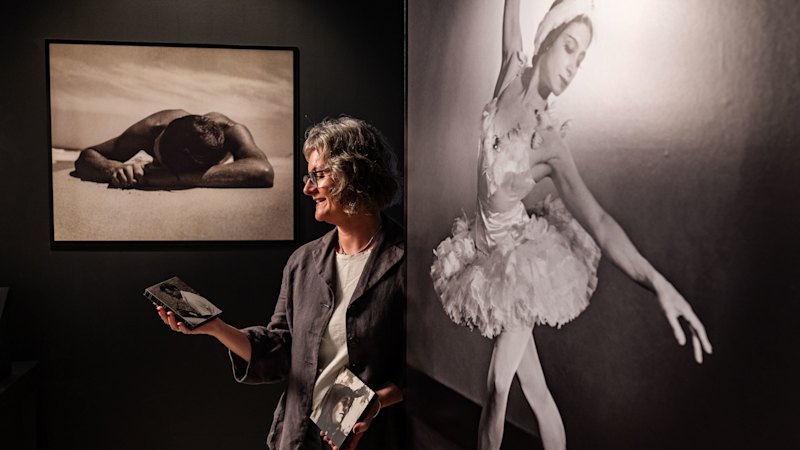
Australia’s best-known modernist photographer Max Dupain was famous for his idealised images of bronzed youths, fashion models, nude shots of photographer Olive Cotton (his first wife) and the sails of Jorn Utzon’s Opera House.His favourite image, though, was far from glam. It was Meat Queue, women lining up to buy meat during rationing after World War II, said State Library of NSW curator Avryl Whitnall.As for his most famous photograph taken in 1938, The Sunbaker, which resurged in popularity in the 1970s and 1980s to decorate walls of beach shacks and homes across Australia, Dupain hated it.If Max Dupain had a favourite image, Meat Queue, 1946 was it. Max Dupain 1946The Sunbaker, c. 1938. This version of Dupain’s most famous photograph was not his preferred shot of Harold ‘Hal’ Salvage sunbaking. Max Dupain“That bloody Sunbaker. Don’t they think I took anything else?” he said.Whitnall knows he did. She spent five years trawling through his entire negative archive of more than 270,000 images, nearly all digitised and now together for the first time in the library’s collection, and his papers and albums.The exhibition, Definitive Dupain, includes more than 200 images, punctuated by quotes from Dupain and others about his work.“Bottom line, there’s something for everyone here. If you don’t find something that makes you swoon, well, maybe you don’t like photography,” Whitnall said.State Library of NSW curator Avryl Whitnall in the exhibition, which opens today.Sam MooyOpening at the State Library of NSW on Monday, August 24, it includes many photos either new or rarely seen. They include shots from Paris where Dupain documented the opening of the Harry Seidler-designed Australian embassy; his first published works in Home magazine, 1934, including two nudes, and experimental works using sunlight to develop an image.It includes evidence of Dupain’s lesser-known passion for photographing nature – shells, trees, and flowers, from monstera deliciosa to eucalyptus.Three self-portraits, never seen before, track his life.Whitnall calls a sultry self-portrait from 1936 Max du Babe. Another is an older Dupain reflected in his car’s bumper bar in 1956. Four years before he died, his self-portrait includes his Hasselblad camera.Whitnall wonders, too, about Dupain’s photograph called Death by Candlelight, taken a few years before he died. A dead magpie lies across an article in The Sydney Morning Herald titled Short Shrift.Dupain loved to shoot flowers. This image, taken in 1985 and rarely seen, is of West Australian Eucalyptus macrocarpa.Max DupainDupain self-portrait.Max DupainWhether he was the best of the best of Australia’s 20th century photographers is still being debated, but Dupain is the only person in the library’s history to be celebrated with seven exhibitions.State Librarian Dr Caroline Butler-Bowdon said Dupain’s negative archive forms the nation’s most historically important photographic record of the mid- to late-20th century.Said to be one of Australia’s most outstanding photographers, and the best architectural photographer Opera House architect Utzon knew, Dupain was modest.“There’s nothing world-shattering in any of these shots,” Dupain said. “They are just a simple and largely emotional response. Just little things, grass growing on sand … it might be a person, a landscape at dusk, it might be an industrial operation at night. But this is my world.”Max Dupain’s self-portrait as a young man. Max DupainMany photos in a new exhibition about Max Dupain haven’t been seen before including this shot of the Kurnell Refinery under construction, Australian Oil Refining Pty. Limited (AOR), c 1954. It is part of the new exhibition, Definitive Dupain, a major retrospective at the State Library of NSW 24 August 2026 to 2 May 2027.Max Dupain c 1954Dupain was born in Ashfield in 1911 and died in Castlecrag in 1992. An only child from a middle-class family, he was sent to Sydney Boys Grammar where he excelled at rowing and drawing. He wished he could have been an architect, but he was always bad at maths.Before World War II, Whitnall said he was focused on getting known, studying photography, doing commercial work, and submitting images to photo exhibitions around the world.The exhibition starts with this image of a gate opening at a Newport beach holiday house in 1936. Max Dupain, 1936His work was popular in what was then a thriving local market for magazines. They helped Whitnall choose the images for the show. “I couldn’t talk to him because he’s dead,” she said. So she looked through the magazines and books that published his work during his life because “he would have picked the images that best represented his work”.Dupain served in the war, including Papua New Guinea, as a camouflage officer.This photograph of the Sydney Opera House under construction in 1965 was found in photographer Max Dupain’s negative archiives. It is included in Definitive Dupain. A major retrospective exhibition at the State Library of NSW 24 August 2026 to 2 May 2027. Max Dupain The experience prompted a shift away from fashion and commercial work. He turned to documentary photography with works such as Meat Queue, shots of the new Kurnell refinery, and the destruction of laneways and heritage buildings across Sydney to make way for modern skyscrapers.This image by Max Dupain of women on the bus at an open day in Kurnell Refinery is rarely seen. Max Dupain, 1956The exhibition starts with a 1936 shot of an open gate and ends with another of a closed gate taken a few months before his death.Definitive Dupain. A major retrospective exhibition at the State Library of NSW includes this image by Max Dupain, Death by candlelight, 1990. The magpie is lying across a page from The Sydney Morning Herald titled Short Shrift. Dupain died in 1992. Max Dupain RAAF Avro Anson aircraft shadow, photograph by Max Dupain. Max Dupain 1942Garden gate, Kangaloon, Southern Highlands, NSW, April 1992.Max Dupain
Going to the Max: Sydney’s ultimate Dupain exhibition should make anyone swoon
Full Article
Original Source
Read the full article at Smh →KhanList aggregates and links to publicly available news content. We do not host full articles from third-party sources. Always verify important information with original sources.