
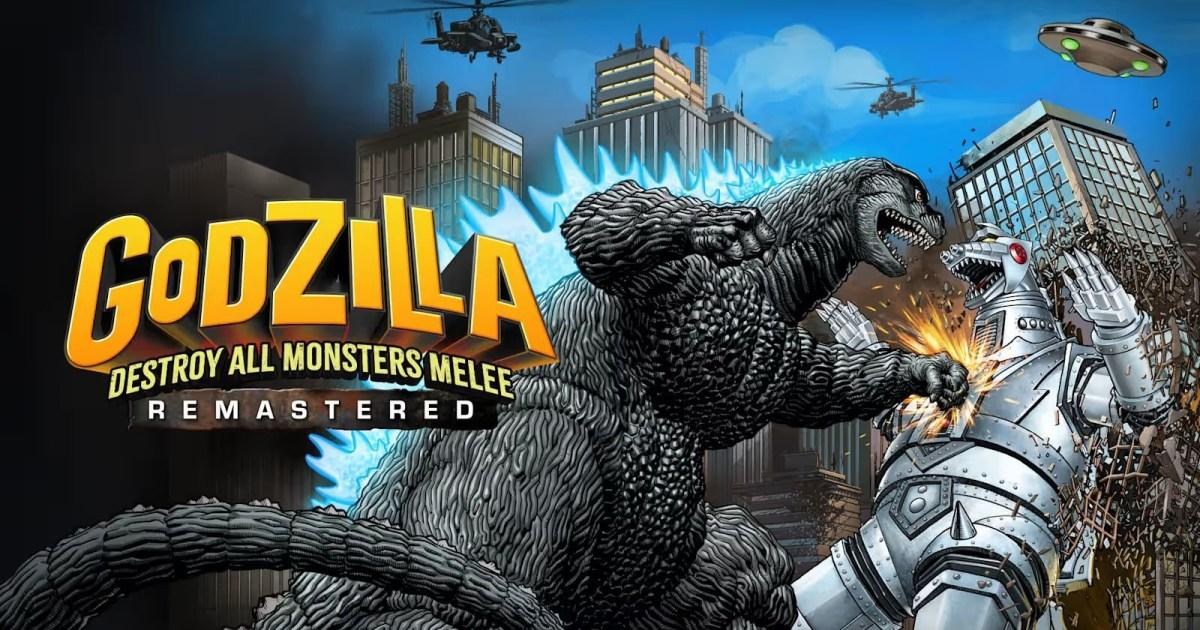
Godzilla: Destroy All Monsters Melee Remastered – return of the king (Atari) An atomic breath blast from past sees the return of the best Godzilla game ever made, as the old GameCube fighter is remastered for the modern generation. Describing this as the best Godzilla game ever is probably the mildest comment it’s possible to give. Despite the Big G being over 70 years old, and hailing from the spiritual home of video games, almost all his tie-ins have been absolutely dreadful (2015’s Godzilla title from Bandai Namco being but one of many such examples). There is one exception though, ironically from a Western developer, and somewhat unexpectedly it’s back. Godzilla: Destroy All Monsters Melee was originally released for the GameCube in 2002 and a year later for the original Xbox. You’d assume from the name that it was some sort of Super Smash Bros. clone but it’s not at all. Instead, it’s closer to a slower paced version of GC favourite Power Stone, with up to four kaiju battling it out at once in the middle of various luckless cities, as you throw cargo ships at each other and knock one another through buildings. The original was a modest hit and received two sequels, each of which managed to make everything a little bit worse, until the series seemingly concluded with the obscure Godzilla: Unleashed on Wii. Surprisingly, original developer Pipeworks is still going, albeit as a subsidiary of Virtuos, and so they’ve been afforded this chance to remaster the game for modern formats. The best unofficial Godzilla game, where you’re battling kaiju, is undoubtedly the Earth Defense Force series, whose name is taken from the similar military force appearing in the Godzilla movies. In terms of games where you are the monster, there’s Atari coin-op Rampage and SNK’s two King Of The Monsters games, which this closely resembles. For those unfamiliar with any of those titles, this is a fighting game but with full freedom of movement in 3D. That necessarily limits the number and complexity of the moves you can perform but there’s a big emphasis on using the environment, to look for weapons and power-ups or simply get out of the way. For better and worse it really does look and feel as if you’re controlling a man in a big giant rubber monster suit, with gameplay that fits the subject matter perfectly. Want GTA 6 news? Sign up to the GameCentral newsletter for the latest GTA 6 news, reviews of new games you should play and exclusive analysis of the biggest stories of the week. The ability to pick up everything from tanks to skyscrapers, and fling them at your opponents, is great but many of the monsters also have special powers, such as beam attacks, flight or tunnelling underground. On the flip side, Godzilla isn’t known for his speed or martial arts skills, so the gameplay can be a bit slow but given the licence we’re not sure what else could be expected. It’s a bit disappointing that none of the monster designs predate the 1990s, although equally none of them are based on the new movies or American Monsterverse – just what was around in 2002. The one exception is that the remaster now includes the OG Mechagodzilla from the 70s, rather than Mechagodzilla 2 who was in the original. Either way you’ve still got 12 playable monsters in total, including Gigan, Rodan, and Anguirus, along with Destoroyah, two versions of Godzilla, two of King Ghidorah, and Mechagodzilla 3. In case you’re wondering, Mothra is not playable (although she was in the sequel) but she can be brought in as an assist character, with Hedorah also appearing to slow down your energy regeneration (used for special moves). It’s not the biggest roster imaginable, and we had hoped they’d combine it with the one from the sequel, but it’s still not bad. In terms of gameplay, this is a pretty straightforward remaster and plays almost identically to the GameCube version. The graphics have been nicely updated for the monsters but the maps are still very basic looking. More problematic is that the animation and physics is just as simplistic, and attacks often only vaguely seem to connect and yet still manage to send you flying. In that sense, this may be the least technical fighting game ever and yet we still can’t help but love it, at least when you’re playing with other people. It’s an absolute bore in any of the numerous single-player modes but if you can get four people together around the same TV (for which you need only two Switch 2s) it’s a very enjoyable way to waste away a few hours of gloomy autumn afternoon. Good luck unlocking Mecha-King Ghidorah (Atari) There’s also an online mode, that the original didn’t have, but like any such game it’s much less fun when you can’t see the person you’re swatting with a block of flats. Foolishly, only four of the monsters are unlocked when you start and you have to grind through the single-player modes to get the rest, which is an atrociously silly idea. In the original game you just played through the main Adventure mode a few times but here you’ve got to worry about earning experience points, research points, and investigating rumours – which are achievement-like objectives. You also have to unlock new maps and additional single-player modes in the same manner, all of which takes forever. It’s an absolutely baffling decision, especially considering most other fighting games realised years ago that if you’re buying a primarily multiplayer game you want access to most things from the start. There is a way around the problem but it involves toggling on the Tournament Mode option in the Settings menu, something that the game does not tell you about and most players are going to completely miss. And even then it only works offline and you still have to unlock things the hard way if you want to play online. We can’t remember the last time a game put so much effort into sabotaging itself but if you can ignore those problems this is a decent remaster of a flawed but enjoyable fighting game. If its purpose is to gauge interest in a brand new entry then it does work in that regard, but only if the next game avoids the monstrous mistake of what may be the worst unlock system ever in a video game. Godzilla: Destroy All Monsters Melee Remastered review summary In Short: A fun, unusual, fighting game that fits its subject matter perfectly and which is almost ruined by locking the majority of the playable characters behind some highly repetitive single-player modes. Pros: The core gameplay is pitched perfectly in terms of accessible arcade action and a loving tribute to the source material. Four-player local co-op is great and the new online mode is welcome. Cons: The unlock system is absolutely insane and incredibly time-consuming and repetitive. The combat is very simple, with a fair amount of jank when it comes to the animation and physics. Score: 6/10 Formats: Nintendo Switch 2 (reviewed), PlayStation 5, Xbox Series X/S, and PCPrice: £26.75Publisher: AtariDeveloper: PipeworksRelease Date: 3rd November 2026Age Rating: 12 You get not one but two Mechagodzillas (Atari) Email gamecentral@metro.co.uk, leave a comment below, follow us on Twitter. To submit Inbox letters and Reader’s Features more easily, without the need to send an email, just use our Submit Stuff page here. For more stories like this, check our Gaming page. Arrow MORE: Star Wars Jedi 3 to be announced ‘soon’ as fans find final Easter egg Arrow MORE: Zelda: Ocarina Of Time developer confirmed and it has a first time director Arrow MORE: Days Gone dev planning new game in 2027 after eight years of silence says report GameCentral Get the latest GTA 6 news, reviews of new games you should play and exclusive analysis of the biggest stories of the week.
Godzilla: Destroy All Monsters Melee Remastered review – Power Stone Kaiju Wars
Full Article
Original Source
Read the full article at Metro →KhanList aggregates and links to publicly available news content. We do not host full articles from third-party sources. Always verify important information with original sources.