
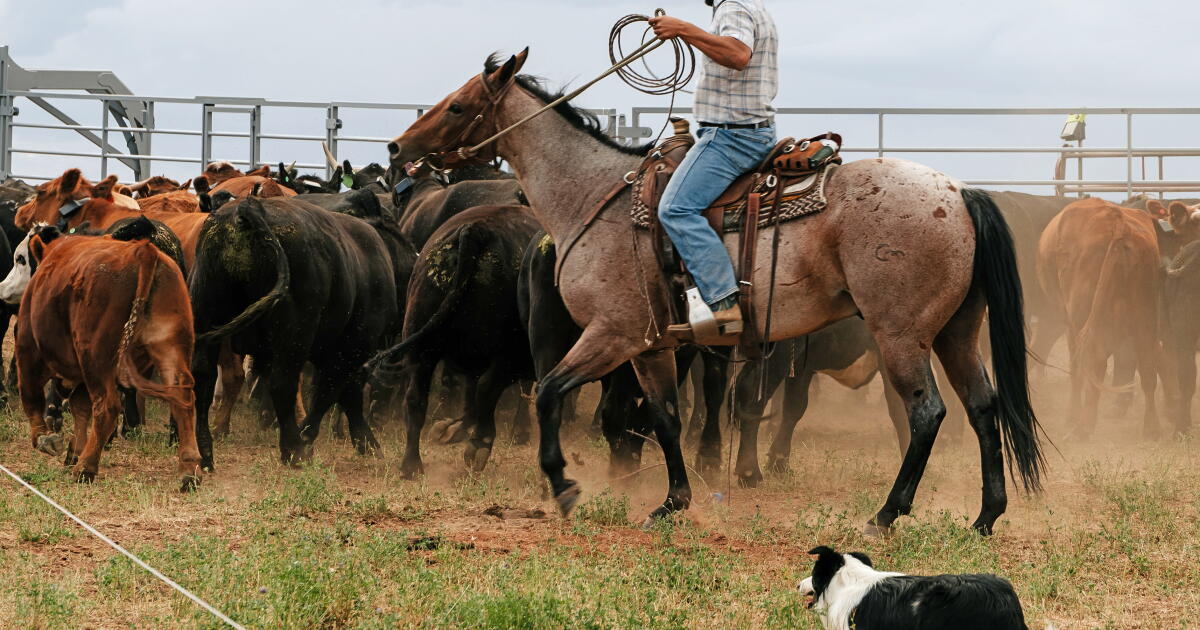
In the Rocky Mountains, years of extreme heat and drought have baked the landscape, drying up streams that feed the Colorado River and desiccating pastures where cattle graze.The unrelenting dryness has brought hardship upon cattle ranchers, who say their livelihoods increasingly are under threat.As the U.S. Supreme Court considers a case in which major oil companies are being sued for the effects of global warming, a group of Colorado ranchers is voicing support for the the idea that the fossil fuel industry should be held to account. “It’s affecting us directly,” rancher Caleb Valdez said. “I hope the lawsuit holds the largest contributors accountable for the consequences.” Colorado rancher Caleb Valdez with his horse, Streak. (Sue Dukeminier/For The Times) The Supreme Court case stems from a lawsuit the city and county of Boulder, Colo., filed against Suncor Energy and Exxon Mobil in 2018. It argues that the oil companies have for decades concealed and misrepresented the dangers of fossil fuels and that they should help pay the rising costs of more intense wildfires, drought and heat waves, among other problems linked to climate change.The defendants have appealed to the Supreme Court in hopes of blocking the lawsuit, which they say threatens to create financial chaos for their industry, among other issues. The group of seven ranchers filed a friend-of-the-court brief supporting the city and county, saying they are “living through the impacts of anthropogenic climate change that scientists have warned about for years,” and that rising temperatures driven by the use of fossil fuels threaten “the economic viability of a way of life that has been central to communities for generations.”Their public stand is unusual. Many western ranchers are skeptical about climate science and remain unconvinced that global warming is a major driver of drought and shifting weather patterns. But for Valdez, who owns about 200 cattle in southwestern Colorado, the connection is clear. Cattle roam in a pasture on Caleb Valdez’s ranch in Cortez, Colo. (Sue Dukeminier/For The Times) The ranchers depend on snowmelt that feeds the Colorado River and its tributaries to nourish grasses and hay pastures for their herds. But this year the Rockies had the least snow on record, and they’ve watched springs dry up and creeks dwindle.The lack of water has ravaged grasslands and left ranchers unable to grow enough hay, forcing them to buy feed for their cows at high prices.It’s been so dry that Valdez no longer can get water in his irrigation system for his animals to drink. He has turned to buying water and hauling it with a tanker truck to fill troughs for the cows.“My livelihood is directly dependent on the environment,” he said. “Increasingly inconsistent weather patterns — including hotter summers, mild winters and a lack of summer moisture — make an already dynamic and complex job more unpredictable and difficult to navigate.”The stakes are high not only for small ranchers like him but also for the nation, he said. “If we end up going out of business,” he said, “that’s not good for the country. … It’s not good for food security.” A water sprinkler sprays a cattle pasture near Carbondale, Colo. The ranch gets water from the Crystal River, a tributary of the Colorado River. (Robert Gauthier/Los Angeles Times) In their lawsuit, the city and county say the financial damage caused by climate change is immense. “Colorado’s economy depends on snow, water and cool weather,” the plaintiffs said in their complaint. “For example, the state’s $41-billion agriculture industry is imperiled by rising temperatures and drought, while the $5-billion ski industry is in jeopardy as a result of ‘low-snow’ winters and shorter seasons.”They said local taxpayers should not have to “pay the full costs of all that is needed to attempt to mitigate the harm.”Last year, Colorado’s Supreme Court ruled in Boulder’s favor, finding the case can proceed under state law.Then Suncor and Exxon Mobil appealed to the U.S. Supreme Court, arguing that federal law precludes such claims in state courts “for injuries allegedly caused by the effects of interstate greenhouse-gas emissions on the global climate.”The companies said in a recent brief that nearly 60 other local governments and states have brought similar suits, and that damages in any single case “could reach into the billions.”“Giving even a single jury the power to impose ruinous liability on selected members of the energy industry is a recipe for chaos,” the companies said in the document. “Unleashing juries nationwide is a recipe for disaster.”The Supreme Court is scheduled to hear arguments in Suncor Energy vs. County Commissioners of Boulder County on Oct. 5. Its ruling could affect dozens of other pending lawsuits by cities and states against oil and gas companies.The ranchers decided to write an amicus brief after seeing that eight counties were setting aside money to write a brief in support of the oil companies. A tractor sprays herbicide on a field near Loma, Colo. The field has been left unplanted this year because of lack of water. (Robert Gauthier/Los Angeles Times) Deirdre Macnab, a rancher in northwestern Colorado, was outraged when she read in her local newspaper that leaders of Rio Blanco County would back the oil companies. She enlisted six other ranchers to join the legal brief and tell the court how climate change is affecting them.“It’s really important for the Supreme Court, and the public, to know that ranchers are extremely concerned and under tremendous pressure,” she said. “It’s pushing many people completely out of ranching, and many people have had to significantly reduce their herd sizes.”Rancher Jay Fetcher said that with climate change, the snow is melting much earlier in the spring on his high-elevation pastures. He worries about what will happen as global temperatures continue to rise.“Are those little streams that we’ve relied on all these years going to change so that there’s no water for the cows?” he said. “Then what do I do?”The ranchers point out in their legal brief that average temperatures have climbed 2.3 degrees since 1980 in Colorado, and that since 2000 the Southwest has been plagued by a megadrought that has dramatically shrunk the flow of the Colorado River.The river’s reservoirs have declined to their lowest levels on record.“The West is being dewatered in this entire climate crisis,” said Kathleen Kelley, whose ranch burned last year in one of the largest wildfires in Colorado history. “We are all vulnerable.”The flames also came close to Macnab’s ranch. She said fossil fuel companies need to help mitigate the disasters and pay for the harm to communities.Macnab likened this climate case to the successful series of lawsuits against big tobacco companies in the 1990s.“We’re in an urgent crisis,” she said. “And the fossil fuel companies have got to come to the table and be part of the solution, and they have to be held responsible.”To deal with the water shortages along the Colorado River, others have suggested policies that encourage farmers to grow less hay — which consumes nearly half of the water diverted from the river. At the same time, the drought has driven hay prices higher.Cattle and other ruminant livestock contribute to climate change by releasing methane as they digest plants. Researchers and climate advocates have suggested that eating less meat is one way to reduce emissions of greenhouse gases and benefit the environment.But the Colorado ranchers insist that with their land-management practices, they are benefiting the ecosystem, nourishing the soil and capturing carbon in their grazing lands. Colorado rancher Caleb Valdez with his horse, Streak, and dog, Sam. (Sue Dukeminier/For The Times) “I hope ranchers will be recognized as part of the solution to climate change,” Valdez said.They also say consumers can help reduce transportation emissions by buying beef from local producers.Kathryn Bedell, a veterinarian who owns a small ranch near Grand Junction, sells her beef directly to customers. But with the water shortage leaving a dearth of forage grass and hay, she said it’s getting much harder to earn a living. Buying hay for the animals to last through the winter would be expensive. So around the end of October, she plans to sell most of her herd, about 70 animals.“I’ve seen climate change with my own eyes,” she said. “Climate change is bankrupting ranchers.” More to Read
Global warming is ruining their way of life. These Colorado ranchers demand accountability
Full Article
Original Source
Read the full article at Latimes →KhanList aggregates and links to publicly available news content. We do not host full articles from third-party sources. Always verify important information with original sources.