
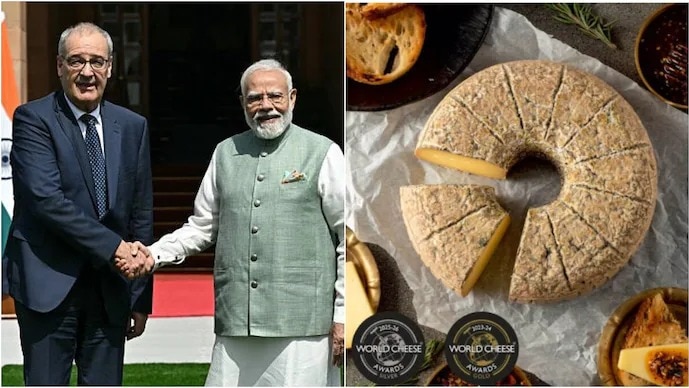
In my home in a village in Bihar, the sentence "doodh phat gaya" was a dreadful one. Bad news. The milk had split, someone had done something wrong, someone would be blamed, and the afternoon tea had gone out of the window, with the milk. Not just in Bihar, for the better part of 3,000 years, the rules of milk held: it could be boiled, churned, set, sweetened and poured over a deity, but breaking it on purpose was another matter. The word "phatna" means "to tear". The milk has not gone bad, it has been subjected to violence. Phaad diya. Torn. Assaulted. Consider that done to a liquid that enjoyed an almost divine status in the household.On October 5, Narendra Modi gave Swiss President Guy Parmelin three cheeses from a Mumbai creamery. Gulmarg is a heart-shaped Brie that won a Super Gold in Brazil this year. Konark, a rustic Tomme modelled on the Sun Temple’s chariot wheel, took gold at the World Cheese Awards in 2023. Yeoor is aged eight to nine months in the style of Gruyre, its rind dressed in rose petals and fennel. All three come from Mausam Narang's Eleftheria creamery.Switzerland has more than 450 cheeses. Its president is a farmer by trade, and his surname already sounds like something you grate over pasta. Gifting him cheese is like gifting litti to Tej Pratap Yadav. That takes nerve.In Hindi, cheez means thing. Any thing. A good pen, a bad idea, Raveena Tandon. The word came to us from Persian and was picked up by the British, who took it to England. Anglo-Indians used to say "the real cheez" when they meant the real thing. Dictionaries still argue over whether that is how English got its "big cheese", the important person in the room. If it is, India spent two centuries exporting the word to enrich Hobson-Jobson, and almost no cheese. We were not short of milk. India makes about a quarter of the world's milk, more than any other country. Cooperatives, buffaloes and Operation Flood. Our love for milk is much older. At Kotada Bhadli, a Harappan village in Gujarat, archaeologists tested broken pots and found dairy fat in them, from about 2500 BCE. People there were processing milk as sages began composing the Vedas.When the Vedic texts arrived, they were awash in milk, ghee and dahi. One line in the Rig Veda (6.48.18: "May your friendship be unbroken, like the surface of an unblemished skin containing curds") has kept scholars squabbling for a century. Some scholars thought it was "perhaps" cheese. Others said it was dahi. Historian KT Achaya read another Vedic word, dadhanvat, as cheese of two kinds, one with holes and one without. If he is right, Indians were discussing holes in cheese long before Emmental made its (w)hole fortune. Dahi is milk settling down by itself, helped by a spoon of yesterday's curd (we call it joran in eastern Bihar). Pouring acidic sour into sweet milk so that it breaks apart immediately looked, to a lot of people, like violence against a sacred thing. Dahi was okay, like milk resting. Chhena was milk molested, violated against will.But some hill people would commit that violence. Jammu's Gujjar and Bakarwal herders made kalari, a fresh cheese often called the milk chapati. Himalayan herders turned spare yak or cow milk into chhurpi. The hard kind is dried to a stone, chewed like gum and kept for years. You do not eat hard chhurpi so much as negotiate it.In the plains, a 12th-century king, Someshvara, wrote an encyclopaedia called Manasollasa that describes a sweet made from milk solids separated with buttermilk. The big public break, though, came by ship. In the 16th century, the Portuguese settled at Bandel, near Hooghly, missed their fresh cheese and did the unthinkable. They split milk with acid and taught their local cooks, many of them Mog settlers from Arakan (where today's Rohingyas come from), to do the same. Bandel cheese is the name: small, salty, smoked and still sold in Kolkata's New Market.The spare idea, chhena, fell into the hands of Bengal's sweet-makers, and changed the country's dessert landscape. Europe took broken milk and added salt, time and a cellar. Sweet-toothed Bengal added sugar and started immediately. Sandesh happened. So did the rosogolla. Bengal says Nobin Chandra Das invented it in Kolkata in 1868. Odisha says they had the chhena sweet for centuries. They fought all the way to the GI registry, both went home with a certificate each, and the dispute is not settled. Kashmir of the East! Europeans built a cheeseboard. Indians made 100 versions of the chhena. Just like tobacco. We made khaini, beedi, gul, gudakhu, chewing tobacco, and so on and on. The Portuguese are still smoking the leaf, or are they?Now to the lady whose cheese made it to the Swiss President's table. Narang did not inherit a dairy. She grew up in Mulund and worked in human resources in France and Germany for eight years. She was introduced to the cheese culture there, and when she came back to Mumbai, she started Eleftheria, Greek for freedom, in 2015 in a small rented space with one assistant. Today she has a team of 65 and sells to the Taj and the Oberoi.From the days of the old kitchen panicking when milk broke to breaking milk on purpose, and winning medals for that cheese, India's cheese story has come full circle. For a few thousand years, split milk was a bad omen. This week, it was a diplomatic gift.In my mom's kitchen, the phata doodh when fait accompli was strained, and the collection was then mixed with sugar and heated till the sugar caramelised and the milk solids were rid of the moisture. That was my homemade chhena mithai. That dreaded "doodh phat gaya" brought a wicked smile to my face. Because I didn't care for dad's afternoon tea as much as I craved the surprise sondha sweet.P.S. In the 1950s a Swiss Jesuit, Father Andr Butty, was stopped on the road to Tibet, stayed in Kalimpong, and opened the Swiss Welfare Dairy to support a mission orphanage. He made a Gouda-like cheese and, less solemnly, milk lollipops that schoolboys still remember. The dairy shut in 1990 after his visa was not renewed. He left soon after. Kalimpong cheese is what he left us. So an Indian wheel in the style of Gruyre, on a Swiss president’s table, is also a return gift.- Ends
Gifting the Swiss Desi Cheese and Chutzpah
Full Article
Original Source
Read the full article at Indiatoday →KhanList aggregates and links to publicly available news content. We do not host full articles from third-party sources. Always verify important information with original sources.