
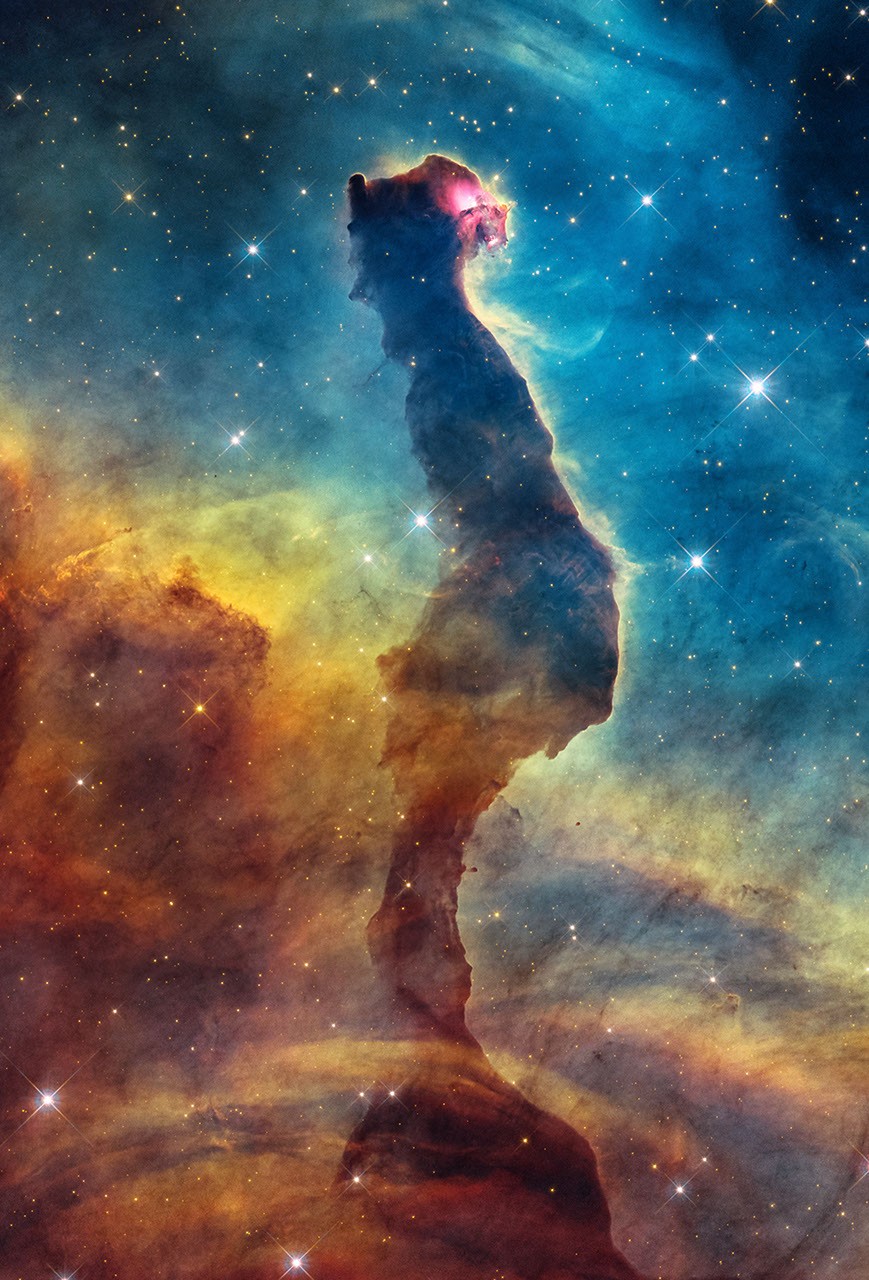
Like a spectral form rising out of a cold mist, NASA’s Hubble and James Webb Space Telescopes have captured a hauntingly dynamic star-forming scene. It lies within the vast Carina Nebula, a diffuse star-forming region located about 7,500 light-years away from Earth. The small, select area both telescopes observed is nicknamed the Cat’s Head Nebula because of its resemblance to a cat sitting with its back toward the viewer. The “head” of the cat is turned to the right, revealing a glowing eye. Though the Cat’s Head Nebula is a temporary scene that will eventually disperse as stars form and evolve over time, the region is packed with information. Hubble and Webb’s complementary views of the Cat’s Head Nebula are helping astronomers learn more about the elusive, chaotic, and complex process known as star formation. NASA’s Hubble Space Telescope shows an opaque dust pillar edged by a luminous rim of gas. Surrounding blue regions include emission from ionized gas and scattered starlight. The cat’s glowing red eye may indicate a young star embedded in the dust.Image: NASA, ESA, STScI; Image Processing: Joseph DePasquale (STScI) The distinctive “cat’s head” shape of the nebula was likely sculpted over time by the intense ultraviolet radiation and winds from massive stars in the Carina Nebula. As this stellar feedback erodes the surrounding gas and dust, denser material within the feline-shaped pillar resists erosion, at least for now. Hubble’s visible-light view reveals an opaque, dark brown pillar of dust. The cat’s glowing red eye may indicate a young star that is still partially embedded in dust. A ridge of hazy yellow seems to follow the edge of the filament’s right side. This bright rim is consistent with gas illuminated and ionized by ultraviolet radiation from nearby massive stars, potentially driving a process known as photoevaporation. The diffuse material surrounding the pillar glows blue and cyan above, shifting to yellow, orange, and red toward the bottom. Hubble’s filters capture light emitted by oxygen, hydrogen, and sulfur, along with starlight scattered by dust. These color variations reveal a complex mix of excited gas, dust, and stellar illumination. NASA’s James Webb Space Telescope’s near-infrared view reveals detailed structures in the pillar and many stars, as well as some background galaxies. The glowing yellow eye may be a young star embedded in dust.Image: NASA, ESA, CSA, STScI; Image Processing: Joseph DePasquale (STScI) Webb’s near- and mid-infrared images each offer different pieces of information to help create a more well-rounded understanding of the Cat’s Head Nebula. While the nebula’s overall structure is similar to the visible-light Hubble image, the filament becomes more transparent, and its complex surface structure becomes discernable in near-infrared light seen by Webb. On the cat’s left are ghostly wisps of dust and gas, delicate structures exposed to radiation from nearby massive stars. Webb’s near-infrared view reveals a dense scattering of stars, shown in blue and yellow. Even in infrared light, some stars are still enshrouded in dust to various degrees. The cat’s eye remains conspicuous. The telescope’s high-resolution imagery even shows faint background galaxies, offering a partial view through our Milky Way galaxy and beyond. NASA’s James Webb Space Telescope’s mid-infrared view reveals intricate structures within the nebula, traced by the emission from warm dust and carbon-based molecules excited by starlight. Changes in local conditions and compositions cause variations in color and brightness.Image: NASA, ESA, CSA, STScI; Image Processing: Joseph DePasquale (STScI) In mid-infrared light, emission from warm dust and carbon-based molecules excited by starlight outlines intricate structures within the nebula. Changes in local conditions and compositions lead to variations in color and brightness. Delicate globules and strands to the pillar’s left are particularly evident in this mid-infrared view. To the right of the pillar, a bright light source is shown as yellow in the mid-infrared image. Likely an infant star embedded in dust, it lies against reddish emission from surrounding material. A narrow filament appears to cross the source, although the image alone cannot establish whether the two are physically related. NASA’s Hubble and James Webb Space Telescopes captured an eerie, star-forming scene within the Carina Nebula just in time for Halloween.NASA's Goddard Space Flight Center; Lead Producer: Paul Morris The Hubble Space Telescope has been operating for more than three decades and continues to make ground-breaking discoveries that shape our fundamental understanding of the universe. Hubble is a project of international cooperation between NASA and ESA (European Space Agency). NASA’s Goddard Space Flight Center in Greenbelt, Maryland, manages the telescope and mission operations. Lockheed Martin Space also supports mission operations at Goddard. The Space Telescope Science Institute in Baltimore, which is operated by the Association of Universities for Research in Astronomy, conducts Hubble science operations for NASA. The James Webb Space Telescope is the world’s premier space science observatory. Webb is solving mysteries in our solar system, looking beyond to distant worlds around other stars, and probing the mysterious structures and origins of our universe and our place in it. Webb is an international program led by NASA with its partners, ESA (European Space Agency) and CSA (Canadian Space Agency).
Ghostly Cat’s Head Nebula Lurks Within Sight of NASA’s Hubble, Webb
Full Article
Original Source
Read the full article at Science →KhanList aggregates and links to publicly available news content. We do not host full articles from third-party sources. Always verify important information with original sources.