
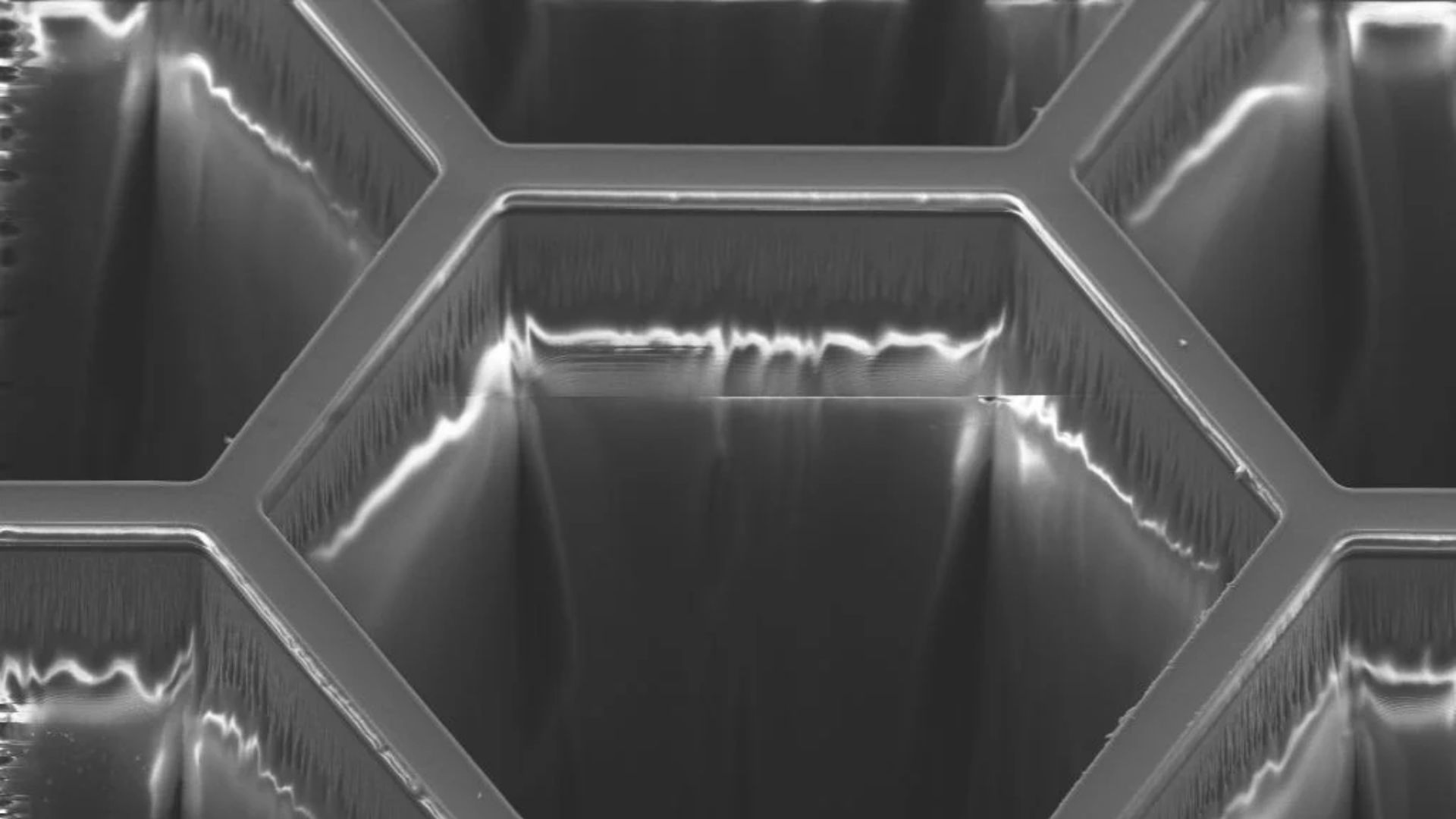
Scientists at Fraunhofer IZM have sculpted something unexpected into a slice of silicon: a 250-micrometer-deep honeycomb pattern. This microscopic structure is designed to untangle one of particle physics’ most elusive mysteries — the mass of the neutrino. The development comes from a collaboration between researchers at Fraunhofer IZM and the University of Münster. Together, they have developed a wafer-scale manufacturing process for a novel “3D energy-filter diode.” While the current 3D energy-filter diode remains a demonstrator, it establishes the technological blueprint for an entirely new generation of angle-sensitive particle detectors. The technology could improve precision experiments like the KATRIN neutrino mass experiment. Top view of the array of hexagonal cavities forming a regular honeycomb structure in the silicon. Background electron problem This device measures a particle’s energy and even the angle at which it hits the detector. That angular insight is important. In major experiments like KATRIN (the Karlsruhe Tritium Neutrino Experiment), scientists inspect the ultra-fine energy spectrum of tritium beta decay to pinpoint neutrino mass. The effort is constantly plagued by background noise. “Imposter” electrons strike the detector with nearly the exact same kinetic energy as the genuine signal electrons. However, they betray themselves through geometry. Background electrons typically arrive at shallow angles under ten degrees. Signal electrons, on the other hand, enter at steep angles up to 50 degrees. Conventional particle detectors operating inside strong magnetic fields and ultrahigh-vacuum conditions are completely blind to this angular difference. The new honeycomb design changes it. When incoming particles enter the microscopic hexagonal pits etched into the Si-PIN diode, wide-angle signal electrons hit the active sidewalls and trigger a clear signal. Shallow-angle background electrons pass straight through to the inactive floor. Computer simulations indicate this architecture could slash background interference by a factor of three to five. Not ready to use yet Building it on a full manufacturing scale was no simple task. The initial detector wafers featured an unusual 24-sided geometry incompatible with standard 200-millimeter cleanroom tools. Engineers at Fraunhofer IZM overcame the limitation by temporarily wax-bonding the custom wafers onto standard 200 mm carrier plates. Etching deep, near-vertical trenches proved equally tricky. Using Deep Reactive Ion Etching (DRIE), the engineering team systematically adjusted process pressure, plasma power, and wafer temperature to eliminate microscopic structural flaws known as “silicon grass.” Passivating the delicate 250-micrometer sidewalls presented the final hurdle. Standard thermal oxidation would have destroyed existing metal layers on the diode. The team deployed a low-temperature Plasma-Enhanced Chemical Vapor Deposition (PECVD) process at just 175 degrees Celsius, successfully coating the upper, middle, and lower sidewalls with insulating silicon dioxide to suppress unwanted dark currents. These newly minted detector wafers are currently undergoing test measurements at the University of Münster. “The 3D energy-filter diode is not yet a detector ready for use. However, the manufacturing technology developed, and the findings from the first demonstrator provide a robust foundation for systematically refining the device architecture and experimentally exploring the potential of angle-dependent particle detection,” the researchers noted. By turning simple silicon into an angle-aware shield against background noise, this micro-honeycomb diode brings us one step closer to weighing the most ghostly particle in the universe. Get the latest in engineering, tech, space & science - delivered daily to your inbox.Mrigakshi is a science journalist who enjoys writing about space exploration, biology, and technological innovations. Her work has been featured in well-known publications including Nature India, Supercluster, The Weather Channel and Astronomy magazine. If you have pitches in mind, please do not hesitate to email her.
Ghost particle mystery: Silicon honeycomb could slash noise to help weigh neutrinos
Full Article
Original Source
Read the full article at Interestingengineering →KhanList aggregates and links to publicly available news content. We do not host full articles from third-party sources. Always verify important information with original sources.