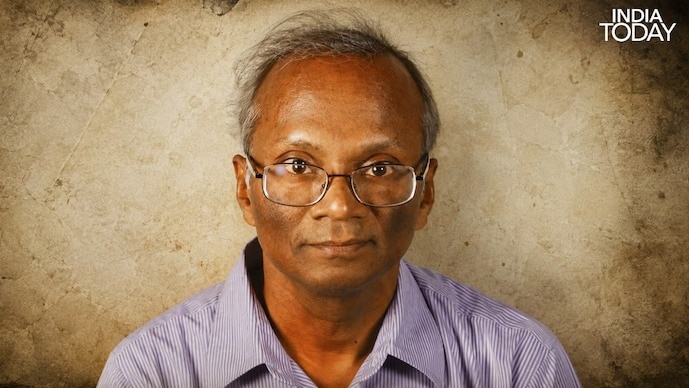
Physicist and recent Dirac medal winner professor Deepak Dhar said AI can help science but cannot replace the human search for understanding. He warned young students that dependence on instant answers could weaken curiosity, reasoning and the purpose of education.At a time when AI is writing code, solving equations, generating research summaries and even assisting with scientific papers, a question associated with research is being asked across universities and laboratories: Will AI replace physicists?Professor Deepak Dhar, one of India’s most respected theoretical physicists and the recent recipient of the Dirac Medal, believes the answer is no, at least not in the way many people imagine.In a recent podcast conversation with Rocket Media, Dhar offered a thoughtful perspective on the rapid rise of AI and what it means for the future of science.A SCIENTIST WHO HAS SEEN SCIENCE EVOLVEDhar’s own career gives weight to his views. Educated at Allahabad University and IIT Kanpur, he completed his PhD at Caltech, where he interacted with legendary physicist Richard Feynman. He later returned to India and built a distinguished career in statistical physics, and also served as a professor at IISER Pune and TIFR Bombay. He continued studying how complex patterns emerge from systems that appear random.He became the first Indian to receive the Boltzmann Medal in 2022 and was awarded the Padma Bhushan in 2023.THE AI QUESTION During the discussion, Dhar acknowledged that AI is advancing at an extraordinary speed, beating everything around fast.He noted that some people now argue that “science is dead” because machines may eventually make accurate predictions without humans needing to understand the underlying laws.But he strongly disagreed with that conclusion.According to Dhar, the original purpose of science was not merely to produce useful predictions. It was to understand the world.He explained that if a machine can predict where a ball will land, that is useful. However, the human desire to ask why it behaves that way remains important. For him, the attraction of science lies in the process of solving problems and discovering understanding, not just in obtaining the final answer.CALCULATION IS NOT THE SAME AS UNDERSTANDINGDhar drew a comparison with earlier technological changes. There was a time when people who could perform complex arithmetic mentally were highly valued. The arrival of calculators made that skill far less important.Similarly, AI may make tasks such as solving differential equations, searching literature, formatting papers or improving writing style much easier. Dhar himself said he once used AI to suggest stylistic improvements to a piece of writing and found some of the suggestions useful.However, he warned that outsourcing thinking is different from using a tool.If students simply photograph a homework problem, feed it to an AI system and submit the generated answer, the entire purpose of education is lost, he argued. The goal of solving a physics problem is not to produce the correct answer for the teacher; it is to develop the student’s ability to think.WHAT AI CANNOT EASILY REPLACEDhar did not claim that physicists possess some mystical ability beyond machines. Instead, he emphasized qualities that remain deeply human:choosing which questions are worth asking,deciding when a problem is interesting,connecting ideas across different fields,and experiencing the joy of discovery.He described science as “a fun adventure”, comparing it to writing a novel. Many people may attempt it; only some produce work that becomes memorable. Yet the creative act itself has value beyond immediate practical use.A DEBATE THAT IS NOT ENDINGThe conversation also touched on a broader issue: modern societies increasingly judge knowledge by its direct economic application.Dhar argued that fundamental science should not be funded only when it promises a quick commercial return.Just as art, literature and music enrich a civilization, basic science makes a nation intellectually richer and “worth defending,” he said, echoing a famous argument made by earlier physicists.What will matter more is the ability to ask better questions, build deeper understanding and use these tools without becoming dependent on them.For young researchers worried about the future of physics, his advice was realistic: success is never guaranteed, and the field remains competitive. But he believes that talented and committed people will continue to find opportunities, even in the AI era.The real challenge, he suggested, is not whether machines will replace physicists. It is whether humans will continue to value understanding, curiosity and intellectual growth in a world increasingly satisfied with instant answers.- EndsPublished By: Rishab ChauhanPublished On: Aug 10, 2026 18:47 IST
Getting the answer isn't the point: Deepak Dhar on physics in the AI age
Full Article
Original Source
Read the full article at Indiatoday →KhanList aggregates and links to publicly available news content. We do not host full articles from third-party sources. Always verify important information with original sources.