
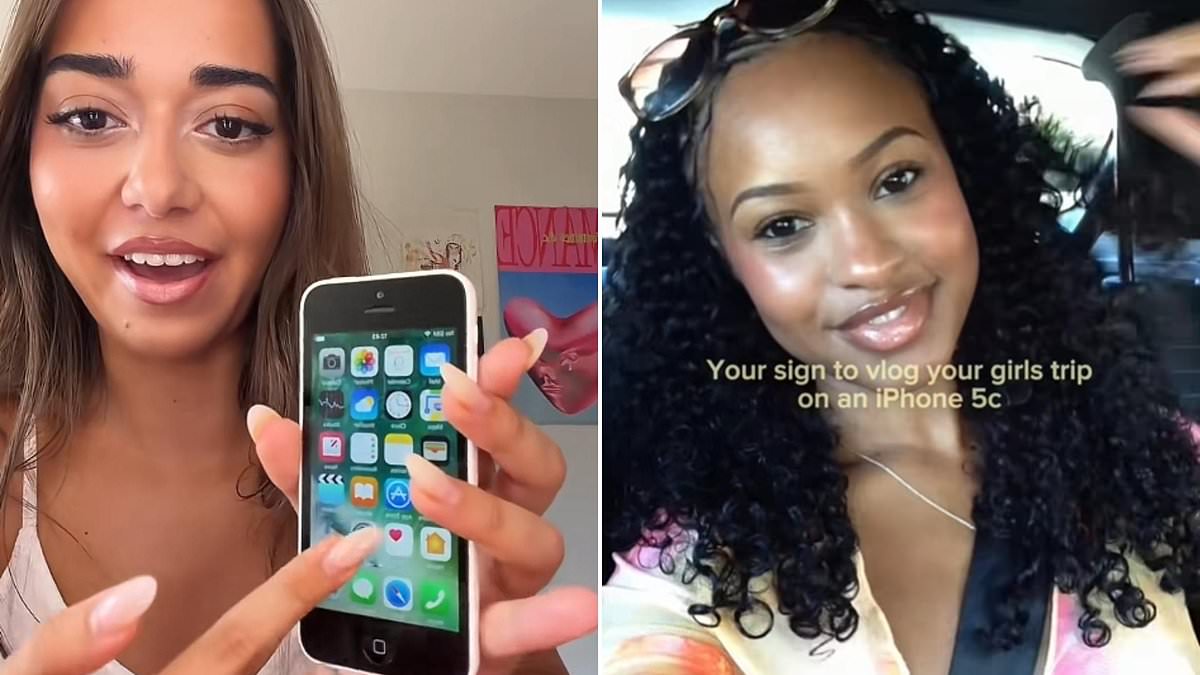
Gen Z are turning their backs on modern smartphones, in favour of an unusual alternative: the iPhone 5C. According to Compare and Recycle, searches for 'Buy iPhone 5C' have skyrocketed by 40,500 per cent in the past year – 13 years after Apple's device first went on sale. The main appeal appears to be the 'vintage' camera, which users have praised for producing 'low–fi' photos. 'Your sign to vlog your girls trip on an iPhone 5C,' one user said on TikTok, explaining that the photos made her feel 'nostalgic'. Another user shared a video of her iPhone 5C unboxing, saying: 'The main reason I got this was for the pictures.'And one simply said: 'iPhone 5C is still my all time favourite iPhone.'Gen Z are turning their backs on modern smartphones, in favour of an unusual alternative: the iPhone 5C The iPhone 5C was released on September 20, 2013, but was discontinued just two years laterThe iPhone 5C was released on September 20, 2013, but was discontinued just two years later. While it originally cost between £549 and £709 in the UK, a quick search on eBay reveals that you can now buy one for as little as £20. The device – described by Apple at launch as its 'most colourful iPhone yet' – came in five bright colours and featured an 8MP rear camera. While this is far inferior to the cameras on today's iPhones, it appears to be a key selling point for nostalgic buyers. Searches for 'buy iPhone 5C' are up 40,500 per cent, for 'iPhone 5C camera' are up 1,815 per cent and for 'iPhone 5C' are up 264 per cent in the past year.Lee Elliott, chief product officer at Compare and Recycle, explained: 'The iPhone 5C has all the hallmarks of a great vintage digital camera, offering lower–resolution, less–processed photos with a distinct and more authentic early–2010s look.'When comparing the iPhone 5C's 8MP camera to the 48MP main camera on the latest iPhone 18 Pro, it's easy to see the appeal of the iPhone 5C for creating a grainy, lo–fi aesthetic no effect can quite match.'While the 8MP camera is far inferior to the cameras on today's iPhones, it appears to be a key selling point for nostalgic buyers Searches for 'buy iPhone 5C' are up 40,500 per cent, for 'iPhone 5C camera' are up 1,815 per cent and for 'iPhone 5C' are up 264 per cent in the past yearWhile searches for the iPhone 5C have spiked, Mr Elliott warns that these older handsets don't have the same security systems as newer models. He explained: 'The last iOS version the iPhone 5C can run is iOS 10.3.3, released in 2017. 'That's almost a decade without updates or security fixes.'Because of this, the iPhone 5C can't protect personal data in the way more modern iPhones do, leaving users vulnerable to data leaks, hacking and other security breaches.'If you do want to join the retro revival, it's best to avoid logging in with your personal Apple ID, and to transfer photos manually using a cable, rather than backing them up to iCloud. 'Used with the correct precautions, older iPhones can still serve a creative purpose without exposing your personal information,' Mr Elliott added. The iPhone 5C isn't the only old Apple device that has recently surged in popularity. Data from Circana's Retail Tracking Service earlier this year revealed that in the first six weeks of 2026, revenue from wired headphones was up by 20 per cent.This follows five years of sales declines, with wireless alternatives including Apple's AirPods, Google's Pixel Buds, and Beats' Studio Pro dominating.Several celebrities are already on board with the retro revival, with Emma Watson, Harry Styles, Bella Hadid and Charli XCX all recently spotted with wired earphones glued to their ears.According to Dr Omar H Fares, a lecturer in the Ted Rogers School of Retail Management at Toronto Metropolitan University, wearers might be 'yearning for an idealized version of the past.''Y2K fashion has been steadily making a comeback over the past few years and the use of vintage technology, like disposable cameras, is on the rise,' he explained in an article for The Conversation. 'There are a few reasons why, including nostalgia and yearning for an idealized version of the past, doing a "digital detox" and increasing privacy concerns.'The trillion-dollar rise of Apple1976: Founders Steve Jobs, Steve Wozniak and Ronald Wayne created the company on April 1, 1976, as they set about selling computer kits to hobbyists, each of which was built by Wozniak.The first product was the Apple I. 1977: Apple released the Apple II in June, which was the first PC made for the mass market. Steve Jobs unveils Apple Computer Corporation's new Macintosh in California on February 6, 19841981: Jobs became chairman. 1984: The Macintosh was introduced during an ad break for the Super Bowl and later officially unveiled during a launch event. It was discontinued a year later and Jobs left the firm.1987: Apple released the Macintosh II, the first colour Mac.1997: Apple announces it will acquire NeXT software in a $400 million deal that involves Jobs returning to Apple as interim CEO. He officially took the role in 2000. Steve Jobs, then-chief executive officer of Apple, with the iPhone2001: Apple introduced iTunes, OS X and the first-generation iPod.The first iPod MP3 music player was released on October 23, 2001, at an event in Cupertino and was able to hold up to 1,000 songs.2007: Apple unveils the iPhone. 2010: The first iPad was unveiled.2011: Jobs resigned in 2011 due to illness, handing the CEO title to Tim Cook. Jobs died in October from pancreatic cancer.2014: Apple unveiled the Apple Watch. It also unveiled its first larger iPhones - the 6 and 6 Plus. 2015: After purchasing Beats from Dr Dre, Apple launched Apple Music to compete with Spotify and other music streaming services. 2016: Apple returned to its roots and announced the 4-inch iPhone SE. Meanwhile, the firm is embroiled in a legal battle with the FBI, involving the agency demanding access to the locked phone used by Syed Farook, who died in a shootout after carrying out a deadly December attack in San Bernardino, California, with his wife. The court order was dropped on March 28 after the FBI said a third party was able to unlock the device. 2017: Apple introduces the iPhone X, which removes the home button to make way for a futuristic edge-to-edge screen design and a new FaceID system that uses advanced sensors and lasers to unlock phones with just the owner's face. Jobs at an Apple event at the company's headquarters in Cupertino, California2018: In a first for the company, Apple introduces new features in its latest operating system, iOS 12, that encourage users to manage and spend less time on their devices. The move was spawned by a strongly worded letter from shareholders that urged the firm to address the growing problem of smartphone addiction among kids and teenagers. 2019: In January, Apple reports its first decline in revenues and profits in a decade. CEO Tim Cook partly blamed steep declines in revenue from China.2020: In March, Apple closes all its brick-and-mortar retail stores outside of China in response to coronavirus. 2021: In an online virtual event in April, CEO Tim Cook declares Apple's goal of becoming carbon neutral for Earth Day. Later in the year, the iPhone 13 was announced. 2022: In September, the iPhone 14 was announced. One of the new features included a new sensor to detect if a user had been in a car crash, as well as an improved camera system. 2023: Apple brings back its 'Home Pod' after the first generation was discontinued. The 'Home Pod' can be seen as an alternative to Amazon's Alexa or Google Home, as it is powered by voice commands. 2024: Apple makes its first steps into artificial intelligence with the release of Apple Intelligence. The features are not all released at once, with many delayed until the following year. 2026: Apple announces a leadership shakeup. After 15 years leading the company, Tim Cook steps aside from his position as CEO to become executive chairman. John Ternus, 51, Apple's widely respected hardware chief, takes as CEO on September 1.
Gen Z go crazy for the iPhone 5C: Interest in Apple's 2013 device skyrockets by 40,500% as youngsters gush over the 'vintage' camera
Full Article
Original Source
Read the full article at Dailymail →KhanList aggregates and links to publicly available news content. We do not host full articles from third-party sources. Always verify important information with original sources.