
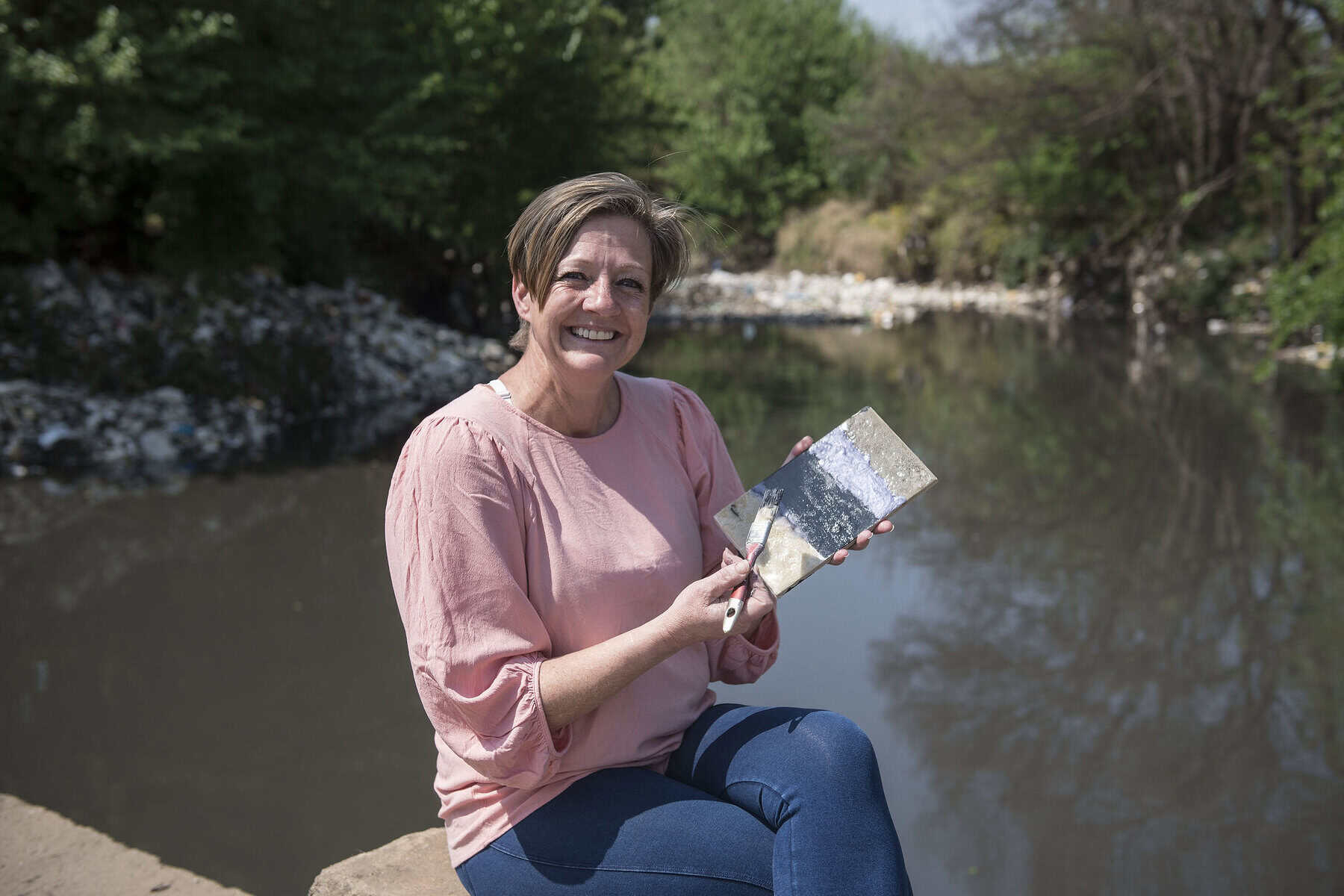
A Centurion eco-activist has developed a paint-like product using polystyrene collected from the Hennops River. Residents of Centurion woke up last week to a river of trash, with an island of polystyrene and plastic clogging the Hennops River. For eco-activist Tarryn Johnston, the sight was another reminder of a problem she has spent years trying to solve. But she believes the waste choking the river could also hold the key to a solution – a paint-like product made from polystyrene that could help fund more cleanups. Johnston, founder of the Hennops Revival non-profit organisation (NPO), has spent the past seven years working closely on the river. Seven years of cleaning the Hennops River Her NPO has removed more than five million kilograms of waste from the Hennops, a figure it stopped counting after reaching that milestone in under six years. She attributes the pollution to illegal dumping, illegal sand mining and general littering. Much of the waste comes from informal settlements and underserviced areas, where storm water channels are sometimes used as dumping sites. When it rains, the waste is carried into the river and ultimately makes its way to the ocean, if not trapped along the way. A garage experiment leads to a new idea The new product, which Johnston has developed through experiments at home, is part of a broader circular economy idea: turning waste that would otherwise end up in a landfill into something useful. The idea began after a particularly large accumulation of rubbish was found in the river in January last year. Hennops Revival removed about 3 000 bags of waste in three days. After suffering a tyre sidewall puncture while driving home from the clean-up, Johnston began wondering whether the polystyrene could be turned into something useful, rather than being sent to landfill. She initially set out to create a pothole filler. But, after bringing some of the material home and experimenting with solvents in her garage, she discovered it was better suited to use as a paint. “We just started experimenting in my garage at home and I was like, hang on, wait, this is a paint,” she said. From household paint to infrastructure potential Johnston says she has since used the product to coat and waterproof a roof, as well as on her gate and wheelbarrow. She has also experimented with making colourful earrings from the material. Johnston believes the paint could have applications beyond household projects, including pipe lining, damp-proofing, bridges and retaining walls. She says its flexibility and adhesive properties could potentially allow damaged pipes to be repaired from the inside, reducing the need to replace entire sections of infrastructure. But she acknowledges more research is required before such applications can be considered commercially, or for use in drinking water systems. A circular economy to support river restoration Tshwane municipal workers remove rubbish and litter from a low-lying bridge along the Hennops River in Centurion, 8 September 2026, following the season’s first heavy rains earlier this week. Picture: Michel Bega/The Citizen Johnston is looking for investors and scientific partners to help develop, test and scale the concept. She says the material could form part of a circular economy in which waste collected from rivers is transformed into a resource, rather than ending up in landfills. Johnston also sees a role for small, decentralised collection points upstream, close to where waste enters waterways. For her, the proposed solution is not a replacement for cleaning the Hennops, but a way of making the work more sustainable. “If we could do micronodes upstream, people can drop their polystyrene off, that would be your first prize,” she said. The river, meanwhile, continues to carry the consequences of dumping and inadequate waste management downstream. Johnston says it is a chance to change the equation: get waste out of the river, stop more from entering it, create value from the waste collected, and use that value to support the Hennops’ restoration.
From trash to treasure: Eco-activist turns Hennops River polystyrene into a paint innovation
Full Article
Original Source
Read the full article at Citizen →KhanList aggregates and links to publicly available news content. We do not host full articles from third-party sources. Always verify important information with original sources.