
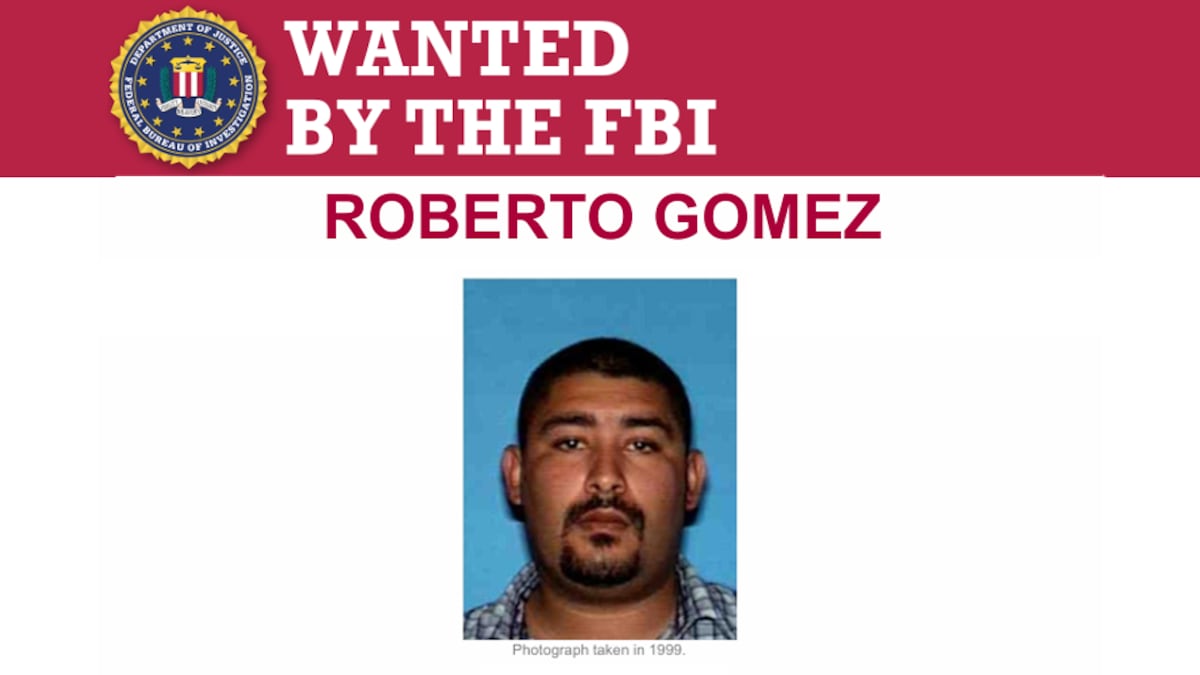
The most recent photograph of Roberto Gómez held by the Federal Bureau of Investigation (FBI) dates back to 1999. It is the image that appeared on the last driver’s license issued to him by the state of California. At the time, the gang member known as “Ruster” was around 24 years old, wore a goatee and kept his thick hair cropped short. In 2000, he left the impoverished and violence-ridden south of Los Angeles, where he had already built a reputation as a member of the 38th Street gang. Many criminals flee to Mexico after committing murders, but for Gómez, a simple robbery charge was enough to drive him into hiding south of the border. Thus began a criminal career that is only now starting to come to light.The image of Gómez in his twenties has begun circulating on the FBI’s social media accounts, as the agency appeals to the public for help in locating him in Mexico. Authorities are no longer searching for a young man accused of robbery, but for a high-profile narcotics trafficker who now rubs shoulders with leaders of the Sinaloa Cartel and the Jalisco New Generation Cartel (CJNG), and who supplied Ryan Wedding, regarded as the biggest cocaine trafficker in Canadian history, a modern-day version of Joaquín “El Chapo” Guzmán and Pablo Escobar.Alias Ruster stands accused of participating in a conspiracy to help Wedding, a former Olympic snowboarder, “run a billion-dollar drug trafficking operation.” He is also alleged to have obtained confidential information from Mexican law enforcement authorities to help the Canadian kingpin evade capture, the FBI said in a post on X.Earlier this week, the Department of Justice announced a six-count federal indictment charging a South Los Angeles gang member with helping former Olympic snowboarder, Ryan James Wedding, run a billion-dollar drug trafficking operation and obtaining law-enforcement sensitive… pic.twitter.com/BBKPDn2nZ9— FBI Los Angeles (@FBILosAngeles) November 14, 2026 This former gang member turned drug trafficker is the sole defendant in a criminal case filed last February in a federal court in the Central District of California. The case remained under seal until a few days ago. The decision to unseal it came shortly after one of his associates, Edgar Aarón Vázquez Alvarado, alias “El General” and leader of the so-called Nuevo Imperio Cartel, was killed by security forces during an operation to capture him in the State of Mexico, where he had expanded his influence.The indictment alleges that Gómez, working alongside Wedding, used boats and aircraft to transport hundreds of kilograms of cocaine from Colombia to Mexico. To smuggle the drug into the United States, they relied primarily on cargo trucks, which unloaded shipments at stash houses in Los Angeles, Riverside and San Bernardino. For years, the Sinaloa Cartel and the Jalisco New Generation Cartel have used this vast metropolitan region as a clandestine drug-storage hub. For Gómez and Wedding, however, Southern California was merely a stopover. From there, another fleet of tractor-trailers moved the shipments on to Canada, their main market.Gómez also protected his Canadian associate by sharing law-enforcement intelligence from Mexican authorities related to the manhunt for him. By late 2025, the FBI had increased the reward for information leading to Wedding’s capture from $10 million to $15 million. While the Canadian remained in hiding in Mexico, Gómez sought to broker a deal to sell him around 500 kilograms of methamphetamine, valued at approximately $550,000, according to court documents.Wedding was only one of Gómez’s associates. In Mexico, he had become a broker and supplier of cocaine, methamphetamine and fentanyl for several criminal organizations. The business entailed significant risks, but he sought to shield his profits from financial market fluctuations.According to the indictment, Gómez’s primary and preferred method for making and receiving payments was the use of stablecoins, such as USDT, or Tether, a digital currency whose value is pegged one-to-one to a real fiat currency, namely the U.S. dollar.The ‘Greenhills’ organizationAs he rose through Mexico’s criminal ranks, Gómez became the second-in-command of the criminal cell led by José Guillermo Grosso Gámez, a native of Sinaloa, according to an indictment described by the U.S. Department of Justice. Together, they trafficked thousands of kilograms of methamphetamine to destinations around the world. Their method involved concealing the drug inside consumer goods and industrial machinery.Ruster also took part in an operation to launder illicit proceeds through money transfers to the Philippines and Mexico. In that indictment, filed in a Los Angeles court in 2018, the second case against him after the 2000 charge of second-degree robbery, he was identified under several additional aliases: “Razor,” “RR,” “Rob” and “Robert.”The criminal case named a total of 17 defendants, most of whom were believed to be hiding in Mexico at the time. Grosso Gámez, known by the aliases “Memo” and “Greenhills,” was arrested in France and extradited to Los Angeles in May 2021. Upon his arrival, he was booked into a local jail under inmate number 46612-509. However, since June 2025, he has no longer appeared in the custody records of the Federal Bureau of Prisons (BOP), and his current whereabouts are unknown. His sentencing had been scheduled for November 2023, although the proceedings remain unresolved.One of their failed ventures involved shipping around 130 kilograms of methamphetamine from Mexico to Australia, concealed inside computer equipment. U.S. authorities intercepted the shipment in Memphis, Tennessee. Investigators also traced the network’s activities to Guatemala, where more than 12 tons of methamphetamine powder were seized, and to the Philippines, where a cockfighting farm was being used as a warehouse to store roughly 84 kilograms of methamphetamine.In Mexico, their main base of operations, where they allegedly enjoyed the protection of corrupt officials, authorities seized about 329 kilograms of methamphetamine in the Pacific port city of Manzanillo. The drug had been hidden inside an industrial mineral crusher and an asphalt roller before it could be shipped abroad, according to court documents.This sophisticated drug-trafficking scheme operated from a date authorities describe as “unknown” until 2018, when the criminal case landed on the desk of a federal district judge in Los Angeles.A ‘crystal meth kitchen’ in Los AngelesThe investigation by the Drug Enforcement Administration (DEA) led agents to a house in Pomona, a predominantly Hispanic city about 30 miles east of Los Angeles. The property was being used as a drug laboratory to convert methamphetamine into its crystalline form. The operation was run out of a modest single-story home, with a front yard devoid of grass and two palm trees flanking the driveway entrance. During those years, so-called “crystal meth kitchens” proliferated across the United States, before Mexican cartels took control of production south of the border, driving costs down to a minimum.From Mexico, Grosso Gámez oversaw the criminal operation in Southern California and relied on the assistance of his subordinate, Gómez, who had extensive connections in the Los Angeles gang world. His gang, also known as Barrio 38 or Tres Ocho, is one of the city’s oldest and has well-documented historical ties to the Mexican Mafia, also known as La Eme. This prison-based organization exerts influence over dozens of gangs across the region and has maintained links with Mexican cartels that have operated in California, including La Familia Michoacana, Los Zetas, the Sinaloa Cartel, and the Jalisco New Generation Cartel.When Grosso Gámez arrived handcuffed at the Los Angeles airport in May 2021, extradited from France, two other members of his drug-trafficking organization had already been taken down. One of them, who operated in the Inland Empire region of southeastern California, was arrested and died in December 2020 while in custody. Another defendant, Milton Eduardo Aquino Castañeda, a resident of Harbor City in Los Angeles, had been arrested the previous month after entering the United States from Mexico.The FBI suspects that Roberto Gómez has managed to stay a fugitive thanks to his connections within the Mexican government, whose officials he is alleged to have on his payroll. For now, authorities have not announced any reward for information leading to his capture. Ruster has spent 26 years evading justice on both sides of the border, but the FBI warns that his days of freedom are numbered.Sign up for our weekly newsletter to get more English-language news coverage from EL PAÍS USA Edition
From Los Angeles gang member to Ryan Wedding’s partner in crime: The rise of Roberto Gómez
Full Article
Original Source
Read the full article at English →KhanList aggregates and links to publicly available news content. We do not host full articles from third-party sources. Always verify important information with original sources.