
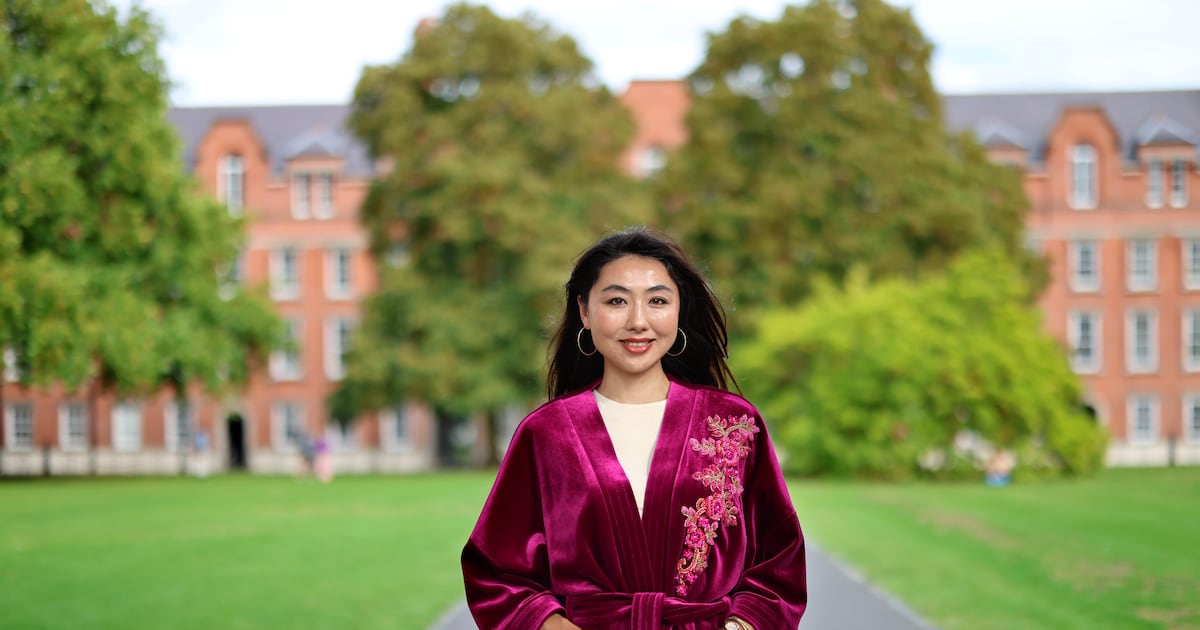
Subscriber OnlyPeopleNew to the ParishAya Omirtay was an award-winning journalist in her the one-time Soviet state before moving to Dublin in 2024Aya Omirtay, from Kazakhstan. Photograph: Dara Mac Dónaill Aya Omirtay, who is originally from Kazakhstan, had never had a female boss before she moved to Ireland. While the 34-year-old was an award-winning journalist in her native country, she has been learning English and working in hospitality since she moved to Dublin in 2024. At the restaurant where she works in Dublin city centre, her manager is a 24-year-old woman.“Kazakhstan is still quite a patriarchal society. During my journalism career, my editors and managers were always men. So having a very young woman as my manager was a new experience for me,” Omirtay says.Above all what she really appreciates about her manager is that she treats people equally regardless of their gender or position within the restaurant. “There is a sense that people are valued as human beings, not simply as employees. This was different from some of the workplaces that I had known before.”READ MOREBorn in Mongolia to a Kazakh family, Omirtay’s parents moved to Kazakhstan after the fall of the Soviet Union, when Kazakhstan gained its independence. While things in Kazakhstan are changing, Omirtay says that growing up it was a very traditional society with firm ideas about the roles of men and women. “My family was very different. My dad would always help my mum in the kitchen. He always said that girls should study and find a better job rather than staying at home.”Omirtay was inspired to become a journalist by her father, who had been a journalist when he was younger. She studied journalism at university and then spent 10 years working in the field. She was very successful and won Kazakhstan’s national journalism award in 2022 for an interview she did with religious studies expert Zamir Tuleshov, about religious unrest in the country.Why, then, did she decide to give it all up and move to Ireland?Originally, she planned to move here for six months to improve her English. However, she quickly realised that she was perhaps a bit naive to think that she could learn a new language from scratch in six months. [ ‘I’m 35 years old and I feel like my life is turning into nothing’Opens in new window ]There was also a deeper reason for why she decided to stay in Ireland, as the political environment in Kazakhstan was making her job more difficult. “Doing independent journalism in Kazakhstan has become increasingly difficult and there is limited space for journalists to work freely, particularly when it comes to investigative reporting and asking difficult questions.”As she does not want to produce work she does not believe in, she feels staying in Ireland is her only option if she wants to continue her journalistic career.Aside from work and language, she has also really enjoyed life in Dublin.“I have found such kind people. Friends from all around the world who were learning English like me.”One of the things that has made her feel so at home in Dublin is how, like Kazakh people, Irish people are so comfortable talking to strangers. “In Dublin you hear so many different ways of saying sorry and thank you. It’s very similar to Kazakh culture. Though Irish people can say ‘thank you’ more than Kazakh people. I find that very warm.”She says that more than once on a day when she has felt particularly homesick, she has had a stranger compliment her and it has really lifted her mood.“Those little moments have helped me feel like less of a stranger here.”However, occasionally she doubts her decision in moving to Dublin. “Sometimes when I am cleaning a table where 10 people have just eaten, I have this strange moment of thinking: Is this really my life now?”Aya Omirtay. Photograph: Dara Mac Dónaill While she clarifies that she does not see this job as beneath her and believes that it has helped her to assimilate better, the sharp contrast with her previous life gives her pause. She has noticed that many of the friends she has made in Dublin through her English classes were highly skilled professionals in their home countries.“One of my classmates was a university lecturer, another was an engineer. They were learning English as otherwise you cannot find a good job here. They are incredibly hard working. They study English in the morning, work one job in the afternoon and another at night as Dublin is so expensive.”Kazakhstan is not very international and Omirtay says that the only international people you will meet there are Russian tourists and Indians who have come to study. Today many of her friends are from Latin America; she had never met anyone from there before she moved here. Since moving to Ireland she has had to explain to people where Kazakhstan is in the world, and correcting the assumption that it is a Muslim country. Rather than find this tiresome she takes pride in telling people about the country’s history, which goes back to Genghis Khan and the Golden Horde. She sees her future in Ireland. She has recently done some travelling. So far she has visited Morocco, Albania, Vietnam and Thailand but has found that at the end of her trips, when she thinks about home, she thinks of Dublin.IN THIS SECTION
From Kazakhstan to Ireland: ‘In Dublin you hear so many different ways of saying sorry and thank you’
Full Article
Original Source
Read the full article at Irishtimes →KhanList aggregates and links to publicly available news content. We do not host full articles from third-party sources. Always verify important information with original sources.